The Delta State Government has reaffirmed its commitment to implementing social protection programmes devoid of political influence, insisting that interventions must directly benefit vulnerable groups across communities.
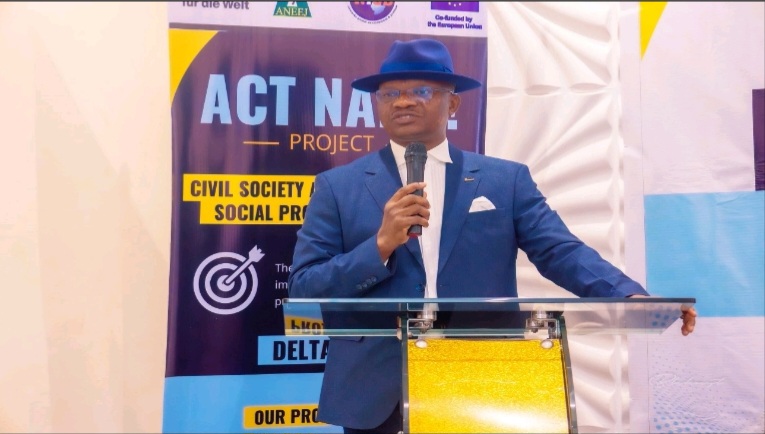
The Commissioner for Works (Rural Roads) and Public Information, Mr. Charles Aniagwu, made this known at a forum on social protection, themed “Accelerating Inclusive Social Protection in Delta State: Building Stronger Systems for Poverty Reduction and Resilience”, organized by the ActNaija Consortium in collaboration with the Ministry of Economic Planning in Asaba. He commended stakeholders, including the Commissioner for Economic Planning, Mr. Sonny Ekedayen, and social protection advocate, Rev. David Ugolo, for their consistent efforts in championing poverty reduction and inclusiveness across the country.
Aniagwu noted that while challenges such as proper targeting, coverage, and cultural barriers exist, Governor Sheriff Oborevwori has directed that social safety nets in Delta State must not be subjected to political manipulation.
“The governor has made it clear that poverty is no respecter of political affiliation. This is why we involve traditional institutions, religious leaders, town unions, youth and women’s groups in the implementation process, to ensure that these interventions reach the vulnerable without bias,” the Commissioner stated.
He explained that beyond cash transfers, the state government is investing in long-term empowerment by linking rural communities with access roads, thereby enabling farmers to move produce to markets. He added that indigenous contractors are engaged to execute these projects, ensuring resources circulate within local communities and create employment.
Aniagwu highlighted that, in addition to the MORE Business Programme and the Rural Youth Skills Acquisition (RYSA) scheme, the government has also introduced the Widows Empowerment Programme and other targeted initiatives to cushion economic pressures on disadvantaged groups. According to him, these interventions are designed to give vulnerable populations a sustainable means of livelihood, rather than one-off financial handouts.
He further cautioned against empowerment without productivity, warning that indiscriminate cash disbursements could fuel inflation. He stressed that the administration’s approach focuses on attaching value to every intervention by empowering those already engaged in business activities, while also supporting new entrants with skills development.
The Commissioner also decried the culture of political patronage where appointees receive salaries without responsibilities, noting that such practices discourage genuine enterprise. “Empowerment must be tied to productivity,” he maintained.
Aniagwu expressed optimism that the forum would not end as a talk shop but would yield practical solutions to address challenges affecting the growth and wellbeing of Deltans.