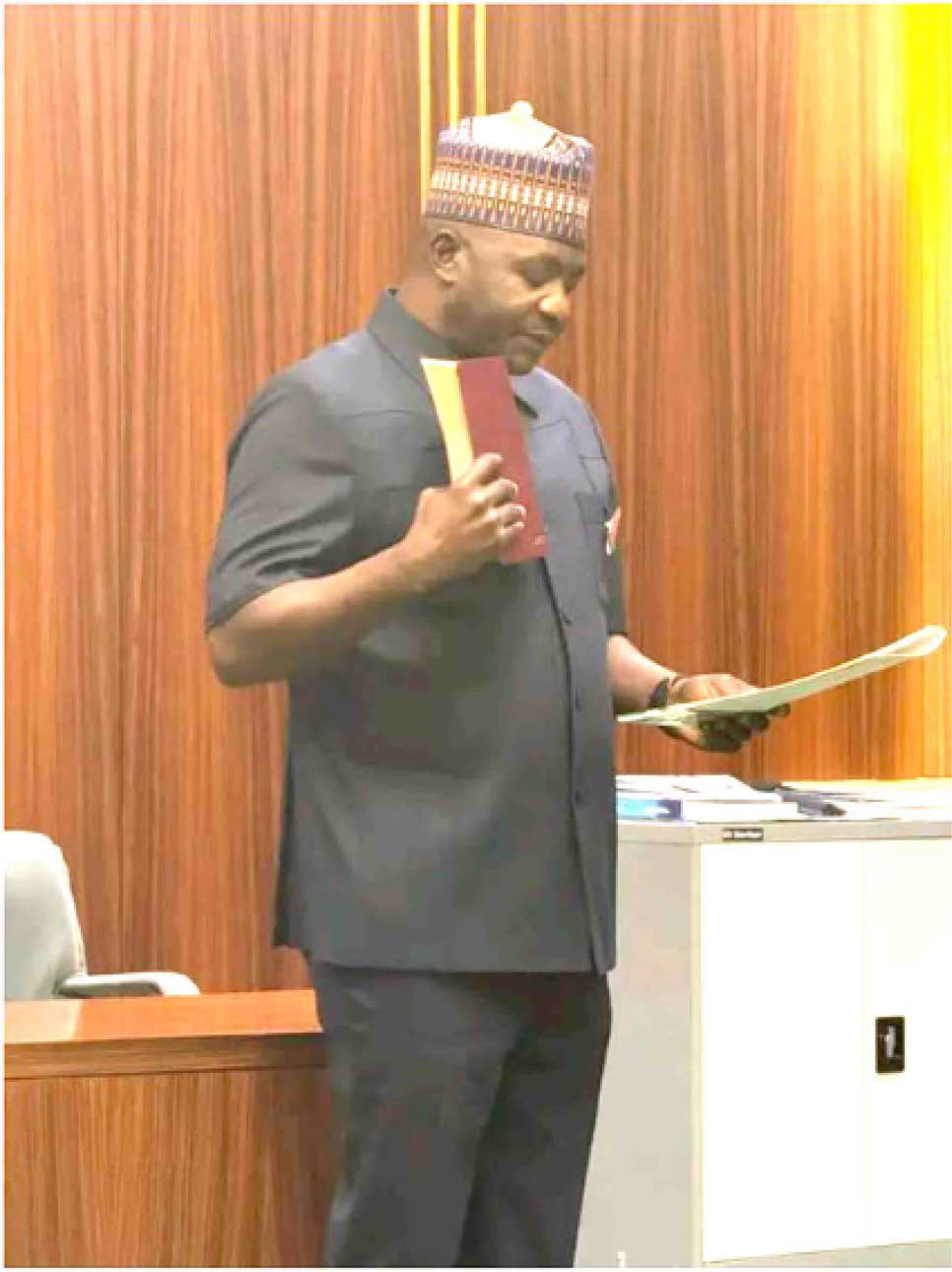
As General Christopher Gwabin Musa takes the oath of office to serve as Nigeria’s minister of defence, there has been an overwhelming show of support for the former Chief of Defence Staff from across the country.
This, according to many, is because the former CDS is believed to have given a good account of himself while he served in the military. More than that, he is coming at a time Nigerians are being gripped with apprehension owing to the activities of bandits, insurgents and terrorists, resulting in wanton attacks on communities, mass killings, large scale abductions and barefaced robbery across states and regions.
Experts have weighed in that General Musa should, however, be cautious and not be carried away by the cheers as there are quite a number of tasks before him.
Just before the immediate past minister of defence, Mohammed Badaru Abubakar left office, there were escalating cases of banditry and insurgency in no less than three geopolitical zones of the country while there are cases of abductions for ransom in all the regions.
The issues led to widespread condemnation of the approach by the current government and in response President Bola Ahmed Tinubu had to declare a statement of emergency on insecurity and directive for recruitment of more personnel into the security agencies.
Group Captain Rufa’i Garba (Rtd), a former Military Administrator of Anambra and Sokoto states, who spoke with our correspondents on the challenges, said the newly appointed minister of defence needs serious prayers for him to succeed, as there is a huge task ahead of him.
He explained that the new minister has a lot to contend with, especially the issue of saboteurs. He said the main security challenges revolves around sabotage as it is apparent that there are people within the system that are benefitting from the insecurity.
“It is unfortunate that we have had to contend with the issue of insecurity in the country for more than two decades, this is not supposed to be. Despite the fact that government has been doing a lot to address the issue, the menace continues to defy measures. It is obvious that the new minister has a huge task before him, and he needs prayers,” he said.
The former Commissioner of Internal Security and Home Affairs in Kaduna State, Mr Samuel Aruwan when contacted, said as General Musa assumes the role of minister of defence, he inherits a landscape marred by a severe epidemic of kidnappings, particularly targeting schoolchildren and must confront simultaneous and complex insurgencies.
He said these range from the persistent threats of Boko Haram and ISWAP in the North East to banditry in the North West plus the Lakurawa threat and separatist violence in the South East.
“Beyond these immediate fires, he faces profound systemic challenges: an overstretched and under-resourced military, institutional weaknesses, and critical funding that have left inadequate “boots on the ground” to meet overwhelming security demands.
“Furthermore, his tenure begins amidst significant diplomatic and external pressures, notably from strategic partners like the United States, which has raised serious concerns over Nigeria’s security management,” he said.
Former minister of sports, Solomon Dalung, who also commented on the appointment of the minister, said though Gen Musa’s grasp of Nigeria’s security challenges is clear, he may not be able to confront those that have made insecurity to thrive.
“Your intentions are noble, and you remain one of the brightest minds to emerge from the Nigerian military. But there is no guarantee you will make any meaningful impact. You will be an island surrounded by an ocean of wolves whose primary objective is to drain the nation dry,” he said.
He posed a number of questions to the minister in his verified Meta page:
“As minister, how will you withstand the entrenched cabal around President Tinubu, men who insist on having their way in every matter? As Chief of Defence Staff, you could access the president with relative ease, but that privilege diminishes once you enter the bureaucratic cage of the ministry.
“Will you sacrifice your reputation by paying “toll gate fees” in dollars just to secure audience with the president, even during national emergencies?
“Before accepting this appointment, did you extract clear commitments from the president regarding protocol and operational autonomy? If not, you may soon discover the humiliating obstacles placed between ministers and the president unless one is willing to bribe their way through,” he said.
He added that the uncomfortable truth is that the enemies of Nigeria are not in distant forests.
“They are the ones who pad security budgets, submit lists of so-called repentant terrorists for recruitment into security agencies, collect bribes before passing budgets, inflate contract figures, divert relief materials meant for their constituents, and weaponise poverty for political gain,” he said.
A rights activist, Muhammed Bello Buhari, on his part added that from a policy standpoint, the appointment of Gen Musa is baffling as one cannot understand What exactly changed between his removal as Chief of Defence Staff and his return as Minister of Defence.
He said, ‘Just weeks ago, the same president announced a full shake-up of the service chiefs, explicitly citing the need to “strengthen the national security architecture.”
“Gen Musa was removed from office alongside others because insecurity had become unbearable and public pressure had mounted. The message was clear, the system was failing and leadership had to change.
“Yet today, that same removed Chief of Defence Staff is being reintroduced into the very core of national security, this time not as a uniformed officer, but as a political appointee overseeing the same defence architecture he just exited.”
He said Musa’s removal meant he did not meet expectations, how does his appointment suddenly align with a reform agenda?
“What exactly did he fail at as CDS that he’s now expected to fix as minister? If, on the other hand, he did not fail, then what exactly was the justification for his removal in the first place?”, he queried.
A United Stated-based Professor of History, Prof Moses Ochonu, also expressed fears for the newly appointed minister.
“I don’t see how he will navigate his way through an administration whose anti-terrorism paradigm is non-kinetic peacemaking with terrorists when he is a combatant officer trained and conditioned to fight and defeat threats.
“How does he reconcile his direct military approach with the strategy of non-kinetic appeasement? For success to happen, they need to work together and align their strategies. How is that possible with these two diametrically opposed approaches? I paraphrase a Bible passage to ask: can two work together unless they’re in agreement?”
Dr Abubakar Yelwa, a security expert and a lecturer at the Department of Crime Management, Abubakr Tatari Polytechnic Bauchi, said the minister has tremendous challenges to face in his new role.
“One of the challenges that he will face is the high expectations from the Nigerians seeing him as someone that will resolve the problem of insecurity in the country.
This is a major problem because whatever achievement is likely to record, will fall short of expectations.
“Moreso, the challenges we are facing are internal security challenges which to some extent can be seen from defense perspective but largely, what we are facing is a failure of our internal security architecture, particularly the technical sabotaging and the disempowerment of the Nigeria police and Nigeria intelligent unit.
“Added to that, Christopher was just appointed as a minister who must work and receive instruction from someone that is not as experienced as he is in terms of managing insecurity issues. So, must he wait for instructions from above before acting,” he added.
‘What Gen Musa should do’
They have a few suggestions on what the new minister should do to succeed.
Dr Yelwa said for Gen Musa to meet the expectations of the president and Nigerians, he must not be restrained from taking initiatives.
He said for the minister to tackle such challenges, the government must give him a free hand to act immediately without interference, and on his part, he must work with all other security agencies to ensure that no organ of the security forces is acting in isolation, adding that all hands must be on deck to achieve the desired result.
Aruwan on his part added that to navigate this crisis, the new minister must immediately pursue a twin priority: restoring eroding public trust and fundamentally overhauling military strategy towards integrated, intelligence-led action.
“This demands the deployment of joint security task forces that embed trusted local community liaisons to improve rapid response and intelligence gathering in hotspots.
“Concurrently, accelerating the creation of a unified national database is crucial for tracking illicit finances and personnel.
“Militarily, there must be a decisive shift from a scattered, reactive posture to a proactive, targeted one. This involves strengthening and empowering aggressive, intelligence-driven joint special operations within existing structures to conduct precise, relentless raids against high-value targets.
“For lasting security, however, the minister must review the kinetics and non-kinetic approaches. He should champion a “security-development nexus” and deepen synergy and cooperation among the military, police, and all the agencies involved in the defence of the country. Crucially, he must navigate the political arena by transparently communicating security needs to secure reliable funding and by leading regional diplomatic initiatives, such as convening a Lake Chad Basin security summit, to foster coordinated cross-border strategies.
“The ultimate measure of success will be creating the conditions where the military can gradually retreat from routine domestic policing, ceding that role to a capable, trusted, and reformed police force supported by effective local governance,” he said
Group Cpt Garba (Rtd) said whatever the issues are, there will one day be over by God’s grace as there were countries that have experienced serious security challenges, but overcame them.
Since the time of General Godwin Abbey as minister of defence in 2009, every succeeding minster of defence had faced serious challenges of insurgency starting with when the group known as Boko Haram went haywire, taking up arms against the country, attacking people at will and seizing territories.
Between Abbey and the current minister are seven others who had served in that office: Adetokunbo Kayode, Haliru Mohammed Bello, Olusola Obada , Aliyu Mohammed Gusau, Mansur Muhammad Dan Ali, Bashir Salihi Magashi and Mohammed Badaru Abubakar, who exited office few days ago.
They faced other common problems like lack of adequate personnel, insufficient weapons and pressure from external forces.
The issue of lack of sufficient weapons was so pronounced during the Jonathan era that the then governor of Borno State, Kashim Shettima, stated, “Boko Haram are better armed and are better motivated than our own troops.”
DAILY TRUST.