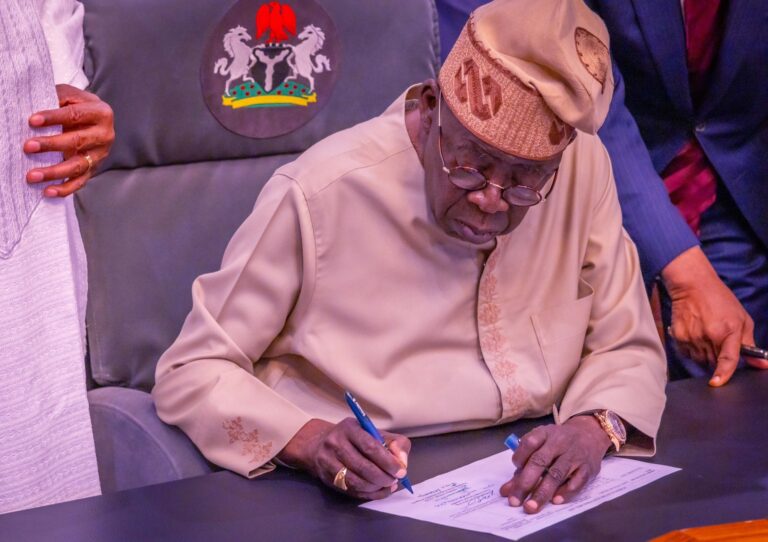
The Senate Tuesday approved President Bola Ahmed Tinubu’s request for the deployment of Nigerian troops to the Republic of Benin, endorsing an action the president had taken days earlier to avert an attempted disruption of democratic governance in the neighbouring country.
However, diplomats, political analysts and experts have expressed mixed feelings, calling on the Nigerian government to be strategic in its dealings with neighbours.
The president’s request, contained in a letter, was read on the Senate floor by Senate President Godswill Akpabio, during plenary.
Tinubu had ordered the deployment last week to forestall an unconstitutional takeover of Benin Republic and instability in the West African subregion, but didn’t seek legislative approval in line with constitutional requirements.
Following the reading of the letter, the Senate dissolved into the Committee of the Whole to scrutinise the request.
During the session, lawmakers examined the security, humanitarian, and diplomatic implications of the deployment.
Key concerns included the potential influx of refugees into Nigeria, the safety of border communities, and the broader consequences for regional peace and security.
Benin: Praises, flak over troops deployment
After an extensive debate, the lawmakers overwhelmingly voted to ratify the president’s action.
Senate President Akpabio then presented the committee’s report for confirmation, which senators affirmed before approving the deployment through a second voice vote
In his remarks, Akpabio praised Tinubu for taking steps to stabilise the region and upholding constitutional norms by seeking Senate consent, even after an “urgent deployment”.
“This is a necessary intervention. The president has acted in the interest of Nigeria’s national security and the protection of democracy in West Africa. A threat to one is a threat to all,” he said.
‘Tinubu committed a constitutional transgression’
However, Bello Abdullahi, the founder of GaskiyaAlliance, said the president’s deployment of Nigerian troops to the Republic of Benin before approaching the Senate for approval is not just a procedural misstep, but also a constitutional transgression with profound implications for democracy.
The public affairs commentator said, “It confirms a worrying pattern: the executive acts first, and only when public scrutiny intensifies does it remember the existence of the law.
“For clarity, the Constitution is not vague. Section 5(4) of the 1999 Constitution stipulates that the president shall not deploy the Armed Forces on combat missions without the prior approval of the National Assembly.
“This provision was not inserted to decorate the text. It is the firewall separating democracy from militarised executive impunity. It is the guardrail preventing one man from dragging a nation of over 200 million into costly foreign entanglements based on personal judgment alone.
“Yet, here we are again, a president making consequential military decisions first, and only afterwards sending a polite letter to the Senate to ‘seek approval’. This is not democratic governance. It is a constitutional afterthought masquerading as consultation.”
He recalled that Nigeria had a painful history of soldiers returning in sealed coffins from wars they never understood, fighting in terrain that offered neither strategic benefit nor moral justification.
“This is why troop deployment is one of the most jealously guarded legislative powers in every functioning democracy. It is not an administrative formality. It is a matter of life, death, sovereignty, and national interest.
“The president’s letter to the Senate is, therefore, not evidence of respect for the law; it is evidence of having breached it,” the analyst said.
He queried the assumption that the National Assembly’s role is merely to stamp decisions already made, adding that, “This is how democratic institutions decay: not by dramatic collapse, but by slow, stealthy erosion disguised as ‘executive necessity.”
Tinubu averted major security threat to Nigeria – Governors
Governors under the aegis of the Nigeria Governors’ Forum (NGF) said President Tinubu’s “prompt intervention” in the attempted coup in the Benin Republic prevented a major security threat to Nigeria.
NGF Chairman and Kwara State Governor, AbdulRahman AbdulRazaq, disclosed this while reacting to the development on behalf of the Forum.
According to him, a successful takeover in Benin would have created opportunities for militants and other non-state actors operating across the Sahel to further destabilise the country.
He said large portions of Benin, including the forests, are already infiltrated by armed groups.
The governor said in a statement that any collapse of constitutional order in the neighbouring country would have had direct security implications for Nigerian border communities.
“Apart from supporting democratic order in the subregion, the president acted in the best interest of Nigeria and West Africa.
“With the Sahel already in severe security distress, a successful coup in Benin would have had devastating effects on our own country due to the long and porous borders we share,” the statement added.
The Forum praised the Nigerian Armed Forces for the rapid response, which helped restore stability in Benin, noting that threats to cities such as Porto Novo, Cotonou or Parakou pose serious risks to Nigeria.
“It is our position that democracy, despite its challenges, remains the most reliable framework for regional peace, stability and development,” it added.
The NGF said the intervention, carried out at the request of the Republic of Benin, strengthens ongoing ECOWAS security efforts aimed at preventing further spread of militancy in the region.
Nigeria’s intervention justifiable’
Ambassador Suleiman Dahiru, a former envoy to Sudan and the Ivory Coast, told Daily Trust that Nigeria’s intervention in Benin was justified given the urgency of the situation.
“Ideally, there should be Senate approval, but it has happened. And you find all over the world, governments taking such decisions without Senate approval,” he said.
According to him, the timing of the attempted coup made parliamentary approval impractical. “They may say that it is an emergency. Like the case of Benin, the attempted coup was on Sunday morning. And we all know that Saturday and Sunday are not working days in Nigeria.
“So, if Saturday and Sunday are not working days, it follows that the president cannot ask the Senate for approval. He had to make the emergency decision that he took. Personally, I don’t see anything wrong with it.”
Amb. Dahiru stressed that Nigeria’s internal security challenges should not prevent it from assisting Benin, saying, “The challenges Nigeria has been facing have been there for many years.”
“In spite of the challenges, Nigeria should come to the assistance of the Benin Republic. They have been a dependable ally of Nigeria. We should see ourselves as big brothers. Whatever happens to Benin Republic, Nigeria should show interest in it. We cannot say that because we have our own security challenges, we abandon our neighbour,” he said.
He added that the deployment was temporary and aimed at stabilising the situation. “Already, from the information one gets, the situation has stabilised. People are coming out to conduct their legitimate business. Nigerian troops will be in Benin Republic, in my opinion, for a short period of time. Because I don’t think any right‑thinking soldier in Benin Republic will think of toppling the government,” Amb. Dahiru noted.
The ambassador emphasised that Nigeria acted on request. “This thing that Nigeria has done, both the deployment of the Air Force and now the deployment of the troops, has shown that Nigeria can be relied upon by our neighbours when they request. Because you have to understand that the request was made. It was not Nigeria just deciding to send its Air Force or troops. The president considered that the request deserved consideration. That is why the decision was taken,” he said.
On criticism that Nigeria supported Benin but not Niger, Mali or Burkina Faso, Dahiru argued that each case must be judged on its merits. “Considering the situation in the Benin Republic, there is merit in the request made and merit in the consideration given,” he said.
He dismissed fears that Nigeria’s action could further damage ties with the AES alliance of Niger, Mali and Burkina Faso. “The three Sahel countries are acting on their own. They are not saying the Benin Republic is going to be part of them. It may be wishful thinking that if the coup had succeeded, Benin might have joined those countries. But unfortunately for them, the coup did not succeed.
“The president of Benin Republic was smart and clever enough to request Nigeria’s assistance. That has completely settled whatever mischief the coup plotters were thinking,” Amb. Dahiru said.
He described the Sahel states as “political children” who should not be treated as enemies. “We belong to the ECOWAS sub‑region. As long as they stay outside ECOWAS, the time will come when they will see the futility of being outside. ECOWAS will be too glad to welcome them back. We should not treat them as enemies. If anything, we just look at them as wayward children,” he said.
Idris Mohammed, a communications specialist and Sahel analyst with the University of Alabama, also justified Nigeria’s intervention but warned of diplomatic risks.
“Nigeria’s intervention in Benin makes sense from a security standpoint. The borders in that region are porous, and any political instability in Benin could quickly become a safe haven for extremist groups or criminal networks operating across West Africa.
“By acting quickly to stop the coup, Nigeria essentially prevented a potential security vacuum that militants could exploit,” he said.
Mohammed stressed that the move was necessary to prevent instability from spilling across the region.
“The attempted coup risked creating a vacuum that extremist groups or criminal networks could exploit. By acting quickly, Nigeria helped stabilise the situation and prevent immediate threats,” he explained.
However, he cautioned that the intervention could complicate relations with Sahel states.
“Sahel states like Burkina Faso, Mali, and Niger may see Nigeria’s actions as overreach, especially since they have stepped away from ECOWAS. That suspicion could make future counterterrorism collaboration more complicated,” Mohammed said.
He added that the intervention sends a strong message in Francophone West Africa.
“It shows Nigeria is willing to project power to defend democratic governments. But it could also create tension, particularly with countries wary of external involvement.
“If the diplomatic fallout grows, it could weaken regional intelligence sharing and coordination, exactly the kind of gaps extremists look to exploit.
“Nigeria prevented a crisis, but now the challenge is making sure the security gains don’t come at the cost of long‑term regional trust and cooperation,” he said.
‘Deployment, a contradiction’
Malik Ado-Ibrahim, the 2023 Young Progressive Party (YPP) presidential candidate, speaking during an interview on Channels Television yesterday, said deployment of the troops by Nigeria was a contradiction.
“You went to Benin Republic, you didn’t pay attention at home here. That’s the contradiction that we’ve seen in the last 48 or so hours,” he said. He added that while Nigeria can project force externally, communities at home continue to face kidnappings and terrorist attacks.
Malik said the president’s visit to Benin Republic was a “very wise and very clever, well-thought-out political statement,” adding that it was intended not just for external audiences but also to reinforce Nigeria’s democracy and national interests.
He noted that while the country managed to deliver “exceptional results” abroad, it still lacks the capacity to hold its own territory. “There are those who would say Nigeria has swiftly moved with military intervention to Benin Republic to douse the tension. But has it got the stamina to secure the West African nation?”
He added that kidnappers exploit Nigeria as a “soft target,” noting that $1.4 billion was spent on ransom payments between 2024 and 2025. These are people who have realised that we’re an easy target to get money from. Somebody kidnaps, another person camps, another person asks for the ransom, and then we know where they are and we cannot do anything about it.”
Nigerians speak on social media
Meanwhile, Nigerians have taken to social media to express their feelings about the country’s intervention in Benin.
On Facebook, Abubakar Lale Nguroje said: “So now, what if American Senate approves Trump request to deploy troops to Nigeria..”
Common Citizens wrote: “Why not in Sambisa forest, Sokoto East, Kaduna, Katsina and Zamfara?
Sani Sabo: “Is democracy in Benin more important than Nigerian lives, why can’t u take sudden response in the area, where there is insecurity, as u did in Benin Republic?
Abubarkar Na’amare Jega said: “Why is Nigeria rushing to deploy troops abroad while insecurity, banditry, and kidnappings are still terrorising our own people at home? May Allah protect our nation, grant our leaders wisdom, and bring peace and security to every corner of Nigeria.
@miky_young said: “Nigeria should focus on fighting its bandits and leave Benin to liberate itself from French Imperialist!! Benin and Togo are the least developed. But big global businesses come through their ports. Who is benefiting?
@chinedum218 said: “Nigeria is being overrun by TERRORISTS, but you’re sending fighter jets & troops to go and stop a REVOLUTION in Benin?”
@CadinalRodgers added: “If Nigeria can go and bomb Benin, what is stopping Trump and America from coming to bomb those terrorists in Nigeria.”
AES accuses Nigerian Air Force of violating airspace
Meanwhile, 11 Nigerian military officers were briefly detained in Burkina Faso after their aircraft made an emergency landing in the country, Burkinabè security sources told the BBC.
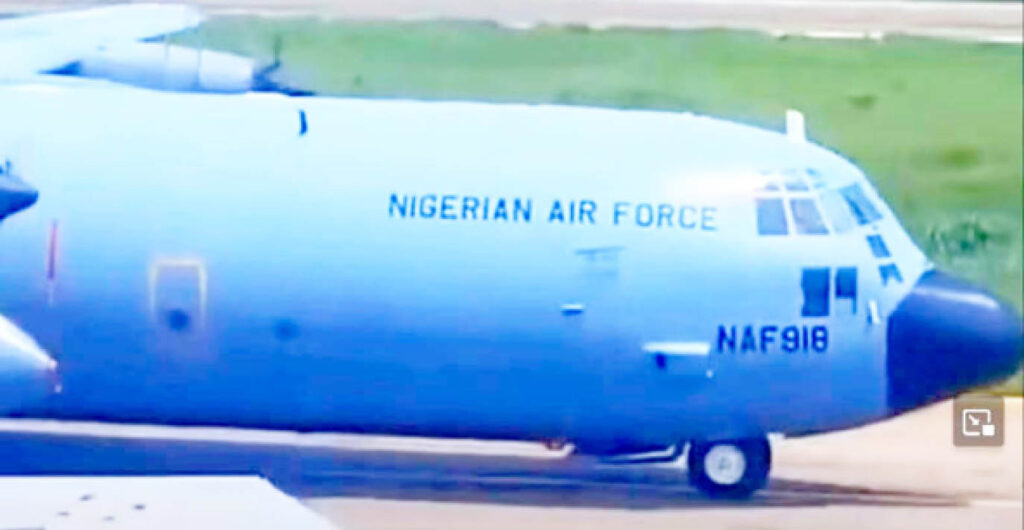
The Air Force C-130 aircraft entered Burkina Faso’s airspace on Monday without authorisation, according to the country’s Territorial Administration Minister Emile Zerbo.
In a joint statement, the military governments of Burkina Faso, Mali and Niger said their prompt investigation confirmed the “violation of its airspace and the sovereignty of its member states.”
But the Nigerian Air Force (NAF) said a technical problem meant the plane, which was en route to Portugal, had to land in accordance with safety procedures.
The aircraft landed in Bobo-Dioulasso, in the west of Burkina Faso and its second-largest city. The NAF said it was the site of the nearest airfield when the plane had to make an emergency stop.
But the Nigerian account of the incident contradicts the position of the trio of Sahel countries, formally known as the Alliance of Sahel States (AES), which said that the aircraft entered Burkinabè airspace without prior authorisation and was forced to land.
“An investigation was immediately opened by the competent Burkinabè services and highlighted the lack of authorisation to fly over Burkinabè territory for this military apparatus,” the AES said in a joint statement.
It called the landing an “unfriendly act” and said the countries’ respective air forces had been put on maximum alert and authorised to “neutralise any aircraft” found to violate the confederation’s airspace.
On board were two crew members and nine passengers, all military officers, according to the AES.
The Burkinabè authorities told the BBC that the soldiers were released and given permission to fly back to Nigeria.
In its statement, the NAF said that plans were underway to resume the mission to Portugal as scheduled, assuring the public that the Air Force remained committed to operational aviation procedures and safety standards.
Nigeria’s Ministry of Foreign Affairs said it was monitoring the situation in Burkina Faso and will issue a statement “when we receive adequate information.”
However, political analysts have linked the incident to the deployment of troops from ECOWAS to Benin following an attempted coup on Sunday.
Nigeria led the regional mission with the deployment of jets and troops to suppress the mutiny in Benin.
Earlier this year, all three military-led countries – Burkina Faso, Mali and Niger – withdrew from ECOWAS, citing a mix of political and security grievances.
They had rejected ECOWAS’ demands for them to restore democratic rule.
The three Sahel countries have also distanced themselves from Western countries, notably from former colonial ruler France, while drawing closer to Russia.
Growing tension in Sahel worrisome – Dr Dukawa
A political analyst, Dr Sa’idu Ahmad Dukawa, has raised concerns over the growing tension in the Sahel, following the incident in Burkina Faso. Speaking in an interview, Dr Dukawa said the situation has raised critical questions about adherence to international airspace protocols and the increasingly fragile diplomatic relations between Nigeria and the Sahelian states.
He questioned the circumstances surrounding the NAF aircraft’s presence in the region and whether due process was followed before entering foreign airspace.
“The situation begets a number of questions that need answers,” he said.
“What do the Nigerian Air Force flights have to do with the region or the countries? What did they go to do? What protocols are in place if the Air Force of any country needs to pass through the airspace of another country? Did our soldiers or the Air Force abide by the protocol? If they did, why the interception?”
Dr Dukawa said the incident was “an unhealthy development,” warning that the region’s growing ideological and military divide—between governments supportive of military intervention and those opposed to it—could fuel further mistrust.
He said despite disagreements over the attempted coup in Benin Republic and the subsequent response by ECOWAS member states, no justification exists for intercepting a sovereign nation’s military aircraft.
“Of course, they will not be happy with Nigeria’s involvement in the Benin Republic attempted coup,” he noted.
He warned that external interests were influencing the political and military realignments in the region, adding that this could further inflame tensions.
“We are well aware that there are foreign interests in this divide, so no country will take it lightly,” he said.
Dr Dukawa urged Nigeria and all affected countries to strictly follow established diplomatic and aviation protocols, saying any country that feels offended should pursue redress through diplomatic channels rather than retaliation or escalation.
He said the African Union (AU) must now step in to prevent further deterioration of relations.
“I think the AU needs to come in here,” he said. “Either one of the warring parties should seek the intervention of the African Union, or the AU headquarters should initiate a meeting, invite the parties, listen to them and mediate the conflict before it escalates.”
DAILY TRUST.