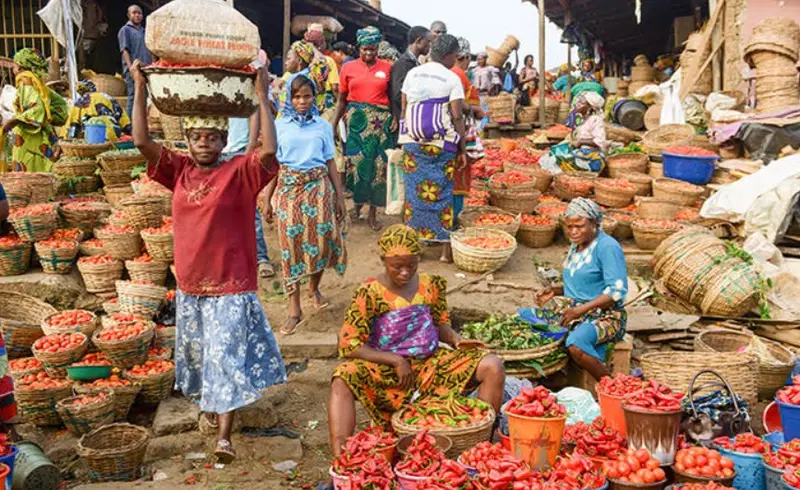
Food price increases, driven by year-end festivities demand and insecurity challenges, emerged as the major driver of inflationary pressure in November 2025, pushing the month-on-month (MoM) headline inflation rate to 1.22 per cent, its highest level in four months, with analysts projecting a similar trend in December.
Similarly, the month-on-month (MoM) food inflation rate rose to 1.13 per cent, the highest in three months since, driven by increase in the average prices of some food items.
However, the Headline inflation rate declined for the eight consecutive months, to 14.45 per cent from 16.05 per cent in October.
The National Bureau of Statistics (NBS), disclosed this in its latest Consumer Price Index (CPI) report.
CPI rises, MoM inflation accelerates
The NBS said: “The Consumer Price Index (CPI) rose to 130.5 in November 2025, reflecting a 1.6-point increase from the preceding month (128.9). In November 2025, the Headline inflation rate eased to 14.45% relative to the October 2025 headline inflation rate of 16.05%. Looking at the movement, the November 2025 Headline inflation rate showed a decrease of 1.6% compared to the October 2025 Headline inflation rate.
“On a year-on-year basis, the Headline inflation rate was 20.15% lower than the rate recorded in November 2024 (34.60%). This shows that the Headline inflation rate (year-on-year basis) decreased in November 2025 compared to the same month in the preceding year (i.e., November 2024), though with a different base year, November 2009 = 100.
“On a month-on-month basis, the Headline inflation rate in November 2025 was 1.22%, which was 0.29% higher than the rate recorded in October 2025 (0.93%). This means that in November 2025, the rate of increase in the average price level was higher than the rate of increase in the average price level in October 2025.
“he percentage change in the average CPI for the twelve months ending November 2025 over the average for the previous twelve-month period was 20.41%, showing a 12.36% decrease compared to 32.77% recorded in November 2024.
Food inflation surges month-on-month
“The Food inflation rate in November 2025 was 11.08% on a year-on-year basis. This was 28.85% points lower compared to the rate recorded in November 2024 (39.93%). The significant decline in the annual food inflation figure is technically due to the change in the base year.
“On a month-on-month basis, the Food inflation rate in November 2025 was 1.13%, up by 1.5% compared to October 2025 (-0.37%). The increase can be attributed to the rate of increase in the average prices of Tomatoes (Dried), Cassava Tu ber, Periwinkle (Shelled), Grounded Pepper, Eggs, Crayfish, Melon (Egusi) Unshelled, Oxtail, Onions (Fresh), etc.”
Core inflation eases
Meanwhile, core inflation, which excludes the prices of volatile agricultural produce and energy, stood at 18.04 per cent on a YoY basis in November 2025, representing a decline of 10.71 percentage points from the 28.75 per cent recorded in November 2024. On a MoM basis, core inflation eased to 1.28 per cent in November, down by 0.14 percentage points from the 1.42 per cent recorded in October.
Wide state-level inflation disparities
The report also highlighted significant variations in inflation across states. On a YoY basis, all-items inflation was highest in Rivers State at 17.78 per cent, followed by Ogun at 17.65 per cent and Ekiti at 16.77 per cent. In contrast, Plateau recorded the lowest rise at 9.13 per cent, while Kebbi and Katsina recorded 10.32 per cent and 10.60 per cent, respectively.
On a MoM basis, Bayelsa recorded the highest increase in all-items inflation at 6.58 per cent, followed by Gombe at 5.11 per cent and Edo at 4.45 per cent. However, Plateau (-2.54%), Delta (-2.38%) and Kaduna (-2.24%) recorded declines in MoM inflation during the period.
A similar pattern was observed in food inflation across states. On a YoY basis, food inflation was highest in Kogi at 17.83 per cent, followed by Ogun at 16.52 per cent and Rivers at 16.11 per cent. Imo (3.52%), Katsina (3.65%) and Akwa Ibom (4.52%) recorded the slowest rise in food inflation on a YoY basis.
On a MoM basis, food inflation was highest in Yobe at 9.52 per cent, followed by Katsina at 6.61 per cent and Ondo at 6.04 per cent. In contrast, Imo (-6.49%), Nasarawa (-5.48%) and Enugu (-2.54%) recorded declines in MoM food inflation in November.”
Analysts warn of festive pressure
Commenting, Ayo Akinwunmi, Chief Economist, United Capital Plc, said: “The increase in the MoM inflation rate might have been linked to the insecurity challenges in the month of November which affected food supply and increased transport costs across the country.
“Prices of food items are expected to increase in December due to the festive season. But with improvement in the security architecture in the country, food prices are expected to drop or moderate in January 2026.
“Although the month-on-month Consumer Price Index (CPI) increased by 1.22%, it is a good development that the headline inflation rate decelerated to 14.45% lower than the forecast of 15%.45 released by United Capital Research.
“The drop in the headline inflation rate supports our view that Nigeria is going into an era of low interest rate and yields should support inclusive economic growth. This should be positive to the equity market. The federal Government should continue to guarantee security in the food-producing region in the country to ensure uninterrupted food production and supply across the country in order to drive down inflation rate sustainably.
Also commenting, Tunde Abioye, Head, Equity Research, FBNQuest Merchant Bank, said: “I think the MoM rise in food inflation aligns with seasonal patterns – notably a surge in food prices as consumers make purchases ahead of the year end festive season. I believe the MoM inflation rate is likely to remain elevated given the year end and new year holidays
In the same vein, Clifford Egbomeade, public analyst and communications expert, said : “Nigeria’s latest inflation figures show a delicate midpoint in the country’s stabilisation journey. Annual inflation continues to ease, reflecting tighter monetary conditions, a more predictable FX market and gradually improving supply chains.
“The downward trend signals that the broad macro stance is working, with headline inflation falling to levels last seen in 2020 and core inflation cooling for a fifth straight month.
“Month-on-month headline inflation, however, tells a more cautionary story. The rise from 0.93 percent to 1.22 percent, driven mainly by food prices, shows that underlying pressures have not fully subsided. Markets remain vulnerable to seasonal swings, transport disruptions and storage gaps, especially for perishables and protein-rich items that respond sharply to supply tightness. This dimension matters for public welfare because food remains the single largest component of household spending.
“December’s seasonal patterns point toward a likely continuation of this monthly pressure. Festive demand, higher logistics costs and end-year adjustments among traders usually nudge prices upward, so another mild MoM increase appears more plausible than a decline.
“Annual inflation should still trend downward due to base effects and currency stability, yet the monthly picture will stay sensitive until supply-side reforms strengthen resilience across food and transport systems”.
Tinubu’s reforms helped Nigeria beat 2025 inflation target – Presidency
Meanwhile, the Presidency, commenting on the continued decline in YoY headline inflation rate to 14.45 per cent in November, said President Bola Tinubu’s economic reforms have helped Nigeria beat its inflation target for 2025.
In a statement posted on X, the Special Adviser to the President on Policy Communication, Daniel Bwala, said Tinubu had set a 15 per cent inflation target in January, a goal he said many critics doubted at the time.
According to Bwala, the latest figure represents a decline from 16.05 per cent recorded in October, describing the development as evidence of the impact of what he called “tough, radical reforms and disciplined economic management.”
“In January, President Bola Ahmed Tinubu set a 15% inflation target. Many doubted it.
“Today, the facts have answered them. Headline inflation eased to 14.45% in November 2025, beating the target and dropping from 16.05% in October.
“This is not luck. It is the outcome of tough, radical reforms and disciplined economic management,” the presidential aide wrote.
Bwala maintained that the improvement showed the country was “steadily turning the corner,” insisting that the President’s economic promises were being fulfilled. Promise made, promise being fulfilled every step of the way,” he added.
VANGUARD.