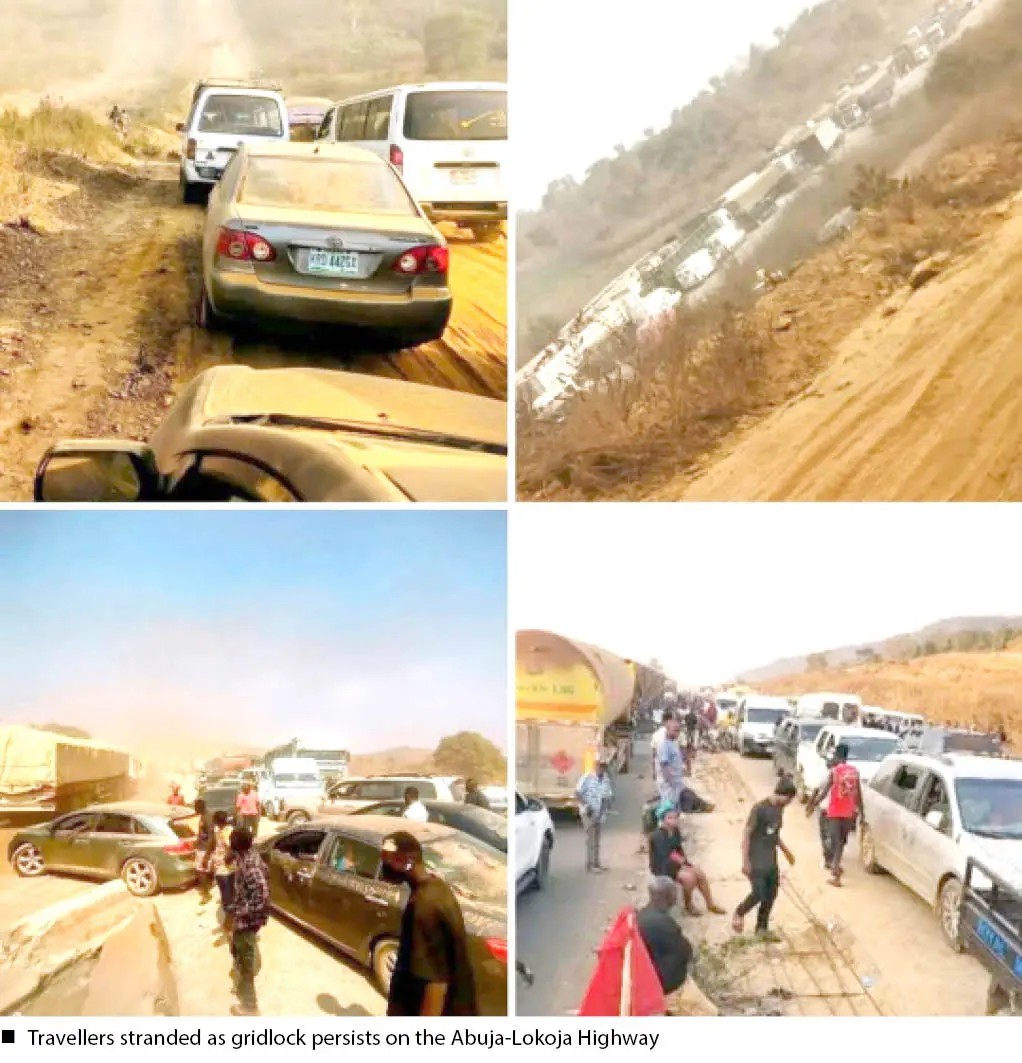
Travellers on the Abuja–Lokoja highway are still grappling with severe traffic lockdowns that have been spreading toward Lokoja, the Kogi State capital, despite efforts by authorities to ease the congestion over the past three days.
Findings on Monday revealed that passengers remain stranded at the same spots for hours due to gridlock that has affected the busy road since Friday.
Broken-down trucks, bad roads, and the influx of motorists during the festive season are said to have triggered the congestion.
The traffic, which has immobilised thousands of vehicles since Friday evening, reportedly started from an accident involving trucks at Koton-Karfe’s collapsed second bridge and deteriorated highway sections between Gegu and Koton-Karfe.
Despite the federal government’s claims that the gridlock has been cleared, the situation on the ground tells a different story.
Our correspondent observed that while traffic on the Abuja–Kogi axis initially appeared free-flowing, movement slowed drastically about 30 kilometres from Lokoja, particularly near Ozi village and Opka, where vehicles were completely immobilised in both lanes.
Smaller vehicles and passengers attempted to navigate bush paths and dusty shoulders. Roadside traders took advantage of the standstill to sell food and water.
Travellers recount harrowing experience
As of Monday evening, the lockdown had extended from Gegu to Jamata-Lokoja. Travellers described the ordeal as a “survival of the fittest,” with costs far exceeding planned budgets.
Abubakar Abdullai, a resident of Magajia, recounted his ordeal: “We boarded a car from Zuba on Monday around 8 a.m. to Lokoja at an agreed fare of N9,000 instead of the usual N6,000. Unfortunately, we got caught in the lockdown upon reaching the Gegu axis of Kogi State.
“The driver diverted onto a footpath linking Gegu to Koton-Karfe, which local drivers had opened earlier in the day. We disembarked at Ishuegbe, a few kilometres from Koton-Karfe, when it became clear we had reached a dead end. I then paid N7,000 to a commercial motorcyclist to reach Magajia village—a barely 15-minute journey—around 5 p.m., after leaving Abuja at 8 a.m.”
Another motorist revealed that some who attempted to navigate the gas pipeline route from Jamata to Koton-Karfe were stranded in the bush after their vehicles broke down due to the rough terrain.
“I left Abuja on Sunday afternoon for Okene and only reached Koton-Karfe at night, where I had to sleep before continuing. Learning that others were using the gas pipeline, I joined them from Koton-Karfe’s Murtala Mohammed Bridge to Jamata and then took the risky route toward Lokoja. Along this path, I observed that the lockdown stretches through Jamata, Ohohon, Okpaka, Magajia, Akpanya, almost reaching Banda-Lokoja,” said James Adeyemi.
A motorist who managed to navigate the traffic by a stroke of luck said a bypass at the collapsed portion of the second bridge was blocked by a truck after the first one had been cleared overnight.
“It takes hours for one or two vehicles to slip through that section of the collapsed bridge. The unethical behaviour of many motorists worsened the situation, slowing recovery at that spot,” said Adah Omeji, who spent the night in Koton-Karfe during his journey from Abuja to Okpo in Olamaboro Local Government. “Some of my passengers who could afford it hired commercial motorcyclists and left. One passenger reportedly paid N15,000 to reach Lokoja, hoping to join another car to Enugu.”
Passengers also reported that some residents along the highway exploited stranded travellers.
Joy, a mother of three travelling to Edo State, said Omeji kindly helped her and her children from Koton-Karfe to Lokoja, where she planned to continue to Auchi. She arrived at Koton-Karfe late Sunday but could not continue because her vehicle broke down on the bush route from Gegu.
“A bottle of Coke or other drinks costs N1,000, and a sachet of water sells for N200–300. Okada riders were even worse. I paid N10,000 to travel from Gegu to Koton-Karfe after much pleading. I slept in front of a shop with my children, with the owner’s permission. It’s a nightmare I won’t forget soon,” she said.
Vincent A. Yusuf, a journalist with Daily Trust, described the “worst traffic experience” of his life on the Lokoja-Abuja highway last Saturday.
He encountered the jam around 4 pm at Koton Karfe, expecting a brief delay, only to find a gridlock stretching tens of kilometres. By the time vehicles started moving, it was already 2 am Sunday.
He said, “Thousands of travellers, including families heading south for Christmas, were stranded with no access to food or clear exit routes. Attempts to divert through villages proved futile, as countless vehicles clogged every available path, raising dust and confusion. Network signals were poor, making communication impossible.
“Security personnel, including the military, police, and road safety officials, were present but unable to restore order. Vehicles broke down in the chaos, compounding the problem.”
Yusuf attributed part of the crisis to reckless driving and poor coordination. He explained that a head-on collision between two trailers at a construction diversion triggered the jam.
“Drivers trying to navigate around the accident blocked both lanes, creating a total standstill,” he added.
“It was so chaotic; I’ve never witnessed anything like it,” Yusuf said, describing the confusion, dust, and sheer scale of the traffic nightmare.
Gov Ododo caught up in gridlock
Kogi State Governor Usman Ahmed Ododo was reportedly trapped in the massive traffic jam on the Lokoja-Abuja highway on Sunday, nearly getting stuck at Gegu settlement.
An eyewitness said the governor had to use a bypass commonly navigated by local drivers, linking Gegu town to Koton-Karfe, to reach Lokoja.
His security details and other operatives faced a challenging task clearing the convoy through the standstill, which lasted several hours.
Governor Ododo reportedly expressed frustration over the situation and contacted relevant authorities to intervene promptly.
FRSC, police intensify efforts to gridlock
The Kogi State Sector Commandant of the Federal Road Safety Corps (FRSC), Tenimu Etuku, said traffic officials are working to ease the prolonged traffic lockdown on the Lokoja–Abuja highway.
He said four trucks responsible for the congestion have been cleared, while the truck causing the blockage at the second bridge in Koton-Karfe was nearly removed by yesterday afternoon.
The commandant attributed the severe gridlock partly to motorists ignoring traffic rules. He added that reinforcements from the FRSC headquarters in Abuja are expected to join the operatives for faster restoration of traffic flow.
Also, Kogi State Commissioner of Police, Naziru Bello Kankarofi, said the command has deployed adequate and reinforced personnel along the Lokoja–Abuja Highway to ensure public safety, manage traffic effectively, and prevent congestion and potential accidents.
“This proactive measure ensures smooth traffic flow while safeguarding motorists and commuters. Personnel deployed include the Police Mobile Force (PMF), Motor Traffic Section, Safer Highway Patrol Teams, Rapid Response Squad, and other conventional police units.
“These officers have been strategically positioned at critical points, diversion routes, and designated checkpoints to regulate vehicular movement, prevent gridlocks, and ensure a prompt response to any traffic or security-related issues,” William Aya, the command’s spokesperson, said in a statement.
DAILY TRUST.