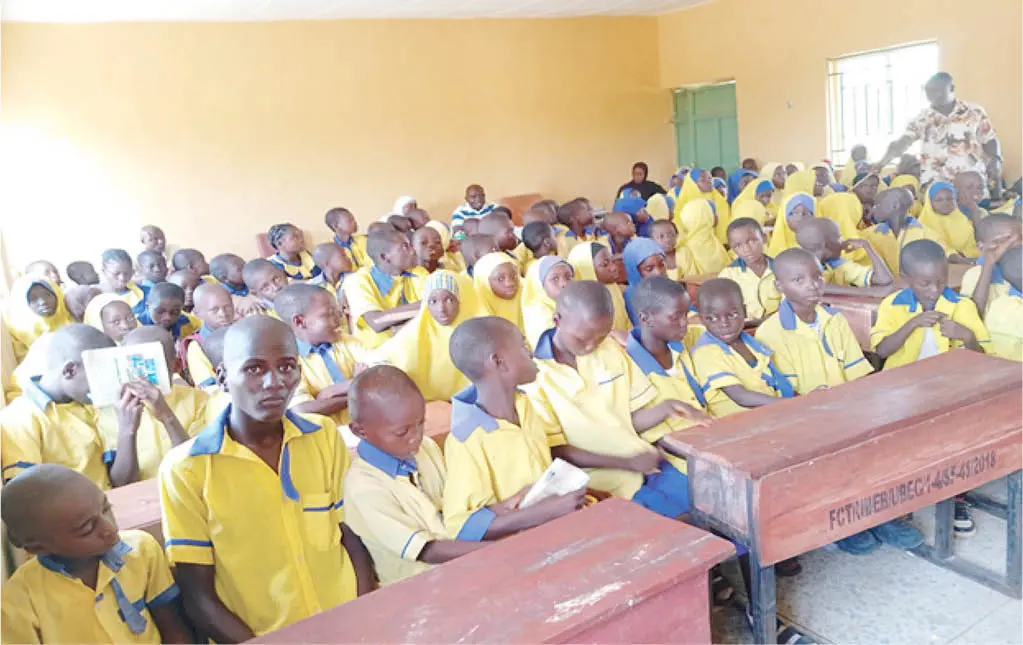
The village head of the Dogon-Ruwa community in the Gawu ward of Abaji Area Council, HRH Alhaji Sani Adamu, has said that primary school children in the area no longer attend classes due to the total absence of teachers.
Alhaji Adamu, who spoke to Abuja Metro at his palace on Thursday, said teachers posted to the Local Education Authority (LEA) primary school in the community have stopped showing up, leaving the children with no choice but to stay at home.
He noted that the situation worsened following reports of bandit attacks in neighboring communities a year ago, which initially prompted teachers to stop commuting to the area.
Despite several efforts by the palace, community elders, and the Chairman of the Parents-Teachers Association (PTA) to resolve the issue, the chief said there has been no positive response from the authorities or the teachers
“When the issue of insecurity, especially bandit attacks, worsened two years ago—because we share a border with Niger State—teachers posted to the school suddenly stopped coming,” he said, adding that “Even though the security situation improved over a year ago, the teachers still don’t bother coming to the school. Consequently, parents now engage their children in farming.”
The chief lamented that it was unfortunate for children to remain out of school for over a year.
He added that the palace had on several occasions set up a committee to reach out to the LEA authorities in Abaji, but these efforts have proved abortive.
“The only excuses we hear from the teachers is that Dogon-Ruwa is too far from Abaji town and that the security situation is not encouraging,” he said.
The PTA Chairman, Shedrack Gambo, corroborated the chief’s concerns, stating that the year-long absence of teachers is a major challenge.
He emphasized that while parents are eager for their children to access education, the lack of staff has brought learning to a standstill.
Dilapidated infrastructure
The community chief also lamented the deteriorating state of the LEA primary school buildings.
“If you go round the school, you will discover that some roofs have blown off while ceilings have caved in. The structures are falling apart because they are no longer in use,” he said.
To solve the crisis, Alhaji Adamu suggested that the FCT Universal Basic Education Board (UBEB) should consider recruiting local indigenes who hold a National Certificate in Education (NCE).
“Even here in Dogon-Ruwa, as well as in neighboring Gawu and Mawogi villages, we have indigenes who are NCE holders. I advise the FCT UBEB to recruit them so they can teach our children, since teachers posted from Abaji are unwilling to stay here,” he suggested.
Water scarcity, population pressure
Beyond education, the chief highlighted a severe lack of potable water, noting that residents mostly depend on pond water.
He explained that the community’s single hand-pump borehole is insufficient for the growing population.
“We have many Tiv and Hausa dry-season farmers who have been here for years, solely focused on yam farming. Considering their population, one hand-pump cannot serve everyone,” he said. He appealed to the council authorities to provide motorized boreholes to alleviate the water crisis.
An official of the area council, who preferred to remain anonymous, told our reporter that the council chairman recently promised to address these challenges during a visit to the community.
“About two weeks ago, the chairman was in that village and assured the people that additional boreholes would be provided to address the water shortage,” the official said.
DAILY TRUST.