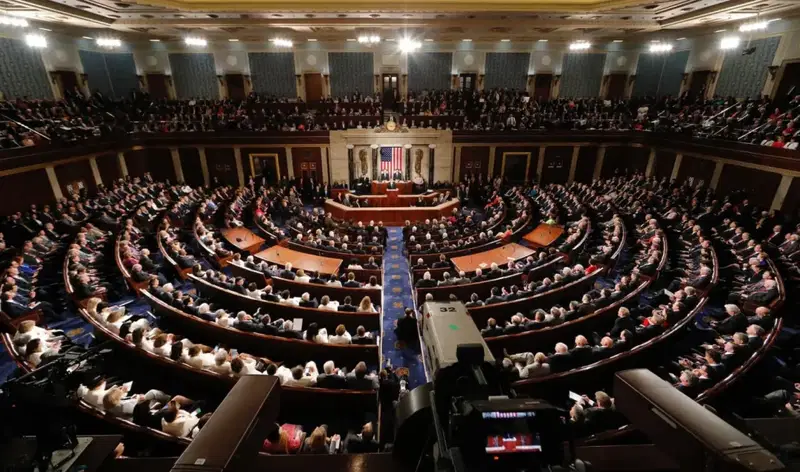
The United States Congress is set to hold another session on allegations of Christian genocide in Nigeria on Wednesday, with witnesses scheduled to testify before the House Foreign Affairs Committee.
The hearing, titled “Defending Religious Freedom Around the World,” will be jointly convened by the House Foreign Affairs Committee Subcommittee on Africa and the Subcommittee on the Western Hemisphere.
Ahead of the session, the witnesses — whose testimonies were released on the committees website ahead of the hearing — warned that Nigeria is sliding towards widespread Christian–Muslim violence.
The witnesses expected at the hearing are former US Ambassador-at-Large for International Religious Freedom, Sam Brownback; Grace Drexel, daughter of Pastor Ezra Jin; and Dr Stephen F. Schneck, former chair of the United States Commission on International Religious Freedom.
In his prepared testimony released ahead of the hearing, Brownback alleged that extremist groups are targeting Nigeria as part of a wider religious campaign.
“Radical, militant Islam continues its purification efforts throughout the MENA region and beyond. Syria and Nigeria are key focus areas of opportunity for them in their quest for dominance — excluding all other faiths, even others within Islam,” he said.
Brownback further warned that religious violence is escalating across the Africa continent.
“Early warning signs of a Muslim-on-Christian war are brewing across Africa,” he said, adding that “Nigeria is the deadliest place on the planet to be a Christian.”
He also claimed that, “at the same time, the Nigerian government is seeking and receiving support from China, Russia, Turkey and Saudi Arabia.”
In his own submission, Schneck argued that insecurity and weak governance create conditions for religious persecution.
“Failing or failed states are locations for the emergence or fostering of militarized groups — insurgent, ethnic, or religious — that can pose a threat to freedom of religion,” he said.
He added that, “banditry and organized crime also target religious communities in such circumstances.”
According to Schneck, Nigeria is among countries where such conditions are already present.
“Nigeria, Syria, and Sudan are current examples of such conditions threatening freedom of religion or belief. Both Nigeria and Syria are experiencing high levels of societal insecurity and their respective governments have been unable to halt widespread violence against communities of faith,” he said.
Schneck also raised concerns over delays in the release of the United States Department of State’s International Religious Freedom reports and the absence of updated designations of countries of concern.
“The State Department has still not made its designations of Countries of Particular Concern, Special Watch List, or Entities of Particular Concern. President Biden’s 2023 designations were to have lapsed at the end of 2025,” he said.
He added that Nigeria currently stands alone on the designation list.
“Apparently, Nigeria, thanks to its unique designation by President Trump, is the only country in the world currently designated as a Country of Particular Concern and there are no designated Special Watch List countries or Entities of Particular Concern.
“This is very concerning at a time when countries like China and Iran are engaged in ever more repressive actions against people of faith,” Schneck stated.
It would be recalled that in 2025, the United States redesignated Nigeria as a Country of Particular Concern over alleged violations of religious freedom, a move that was accompanied by threats of possible US military intervention.
The US government later carried out air strikes on terrorist hideouts in Sokoto on Christmas Day.
However, the Federal Government has repeatedly rejected claims of systemic persecution of Christians, insisting that insecurity affects Nigerians of all faiths.
On November 20, 2025, the US Secretary of War, Pete Hegseth, hosted Nigeria’s National Security Adviser, Nuhu Ribadu, at the Pentagon for talks on coordinated strategies to address the security crisis.
In December, Ribadu also disclosed that a US congressional delegation visited Abuja as part of ongoing security consultations between both countries.
According to the Office of the National Security Adviser, discussions during the engagement focused on “counter-terrorism cooperation, regional stability,” and ways to “strengthen the strategic security partnership between Nigeria and the United States.”