Screenshot
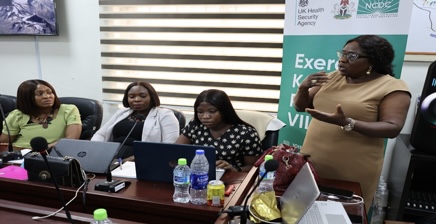
As part of concerted efforts to establish a functional emergency management system that will withstand medical and other natural disaster response, the Nigerian Centre for Disease Control, NCDC, has begun the 7th in the series of Emergency Response Simulation Exercise tagged: “Exercise Keep Pushing VII.”
The Simulation Training Exercise which kicked off in Asaba on Tuesday involves ten participating states’ Public Health Emergency Operations Centres, PHEOCs. The simulation exercise was coordinated by the NCDC by virtual operation. The participating states include Delta, Benue, Imo, Jigawa, Katsina and Nasarawa. Other states participating in the virtually coordinated simulation exercise include Ogun, Sokoto, Yobe and Zamfara states.
In her overview of the exercise, the Response Division Lead of the Nigerian Centre for Disease Control, Dr. Rejoice Luka-Lawal explained that the aim of the exercise is to evaluate the Emergency Preparedness Response status of National and Subnational partners for a more coordinated response to any possible emergency.
“It is one thing to have structures in place, but another to ensure that they are functional structures that can deliver on their objectives.”
According to Dr. Luka-Lawal, the Emergency Response Simulation helps to evaluate the capabilities of an Emergency Response System, test plans, policies, and procedures, reveal gaps/challenges as well as help provide solutions that can help modify the plans and procedures to withstand actual emergencies.
She advised that every Public Health Emergency Operations Centre should have regular simulation exercises as part of strengthening the emergency response systems.
While describing simulation exercises as part of a comprehensive Public Health Preparedness strategy, Dr. Luka-Lawal noted that the exercises are cost-effective management tools for preparedness response and planning for emergencies.
Also speaking, Delta State Epidemiologist, Dr. Mildred Okowa described the exercise as part of strategic preparedness response designed to test coordination, incident management, and decision-making process across the National Public Health Emergency Operations Centre and selected state PHEOCs.
Dr. Okowa emphasised that Delta State will continue to work closely with its partners at the national and international levels to ensure that public health emergencies are managed in a timely and professional manner, according to best practices.
The Simulation exercise will be rounded off tomorrow.