Approximately, only 20 per cent of the current projected 220 million Nigerian population is under the age of 50.
Of the 20 per cent, less than half are above 60 implying that those who were more than 10 years and old enough to decipher what happened in Nigeria on February 13, 1976 are very few.
Those in their 50s recall only faintly what happened as they were too young to understand, while those who could recall vividly what happened, are either too old to remember or do not bother anymore.
The youth population, which usually marks such watersheds in history with verve and vigour, can only relate with this particular one that put Nigeria on the edge only from third party narratives.
Former minister of information and communication, Alhaji Dasuki Nakande, who was old enough to understand what was happening then, said he was a student at the Kaduna Polytechnic, when the Bukar Suka Dimka led abortive coup occurred.
He recalled that he, along other students were shocked to hear that another coup had been attempted not long after Yakubu Gowon was overthrown.
“We listened to the Col Dimka broadcast on Radio Nigeria and people were shocked. All sorts of conspiracy theories were woven around the coup with some saying that it was instigated by the CIA,” he stated.
Nakande also remembered that the students in Kaduna wanted to troop to the streets in protest but were dissuaded from doing so due to the high military presence around Kaduna town.
He added: “The protest could not hold but classes were suspended on campus on that day and other activities halted as people were listening to their radio to know what next.”
Veteran broadcaster, John Aduku, recalls that he had just started work at the Broadcasting Corporation of North Nigeria (BCNN) which later became the Federal Radio Corporation of Nigeria (FRCN) when the news came that the Head of State had been killed.
“We heard it from the Radio Nigeria, Kaduna, news and you know how powerful the station was at that time so the story was all over the place.”
Aduku recounts how people panicked and were running helter skelter as they did not know what would happen next.
We had not witnessed anything like that before. Just like that, a head of state was killed. We were surprised because the coup that overthrew Gowon was not like that.”
Former commissioner for information in Plateau State, Yakubu Dati recalled that he was in primary school in Jos when he, along other pupils, started hearing martial music being played on the radio.
He said even as children, they knew that something had gone amiss for the radio station to be playing martial music repeatedly.
“It was later that some people who had radio with them explained to us that the Head of State has been killed and we could sense the anxiety in the air. But as children we did not know the implication of what happened,” he stated.
The younger ones who are currently below 50, said they only got to hear about what happened from either books or from discussions with older persons.
Why the coup shook the nation
Analysts point to the fact that of the five heads of Nigerian governments that died in office, three; Abubakar Tafawa Balewa, Johnson Aguiyi-Ironsi and Murtala Mohammed were brutally murdered in the bid to overthrow their governments while Umaru Yar’adua and General Sani Abacha died under less violent circumstances.
In the cases of Tafawa Balewa and Aguiyi-Ironsi, people had foreboding that something ominous was going to happen as their deaths were precipitated by crises and rumours of putsches.
Why that of Murtala shook the nation was because of the suddenness and gruesomeness of the act.
Again, Murtala was ruling in a manner Nigerians appreciated, bringing in the full effect of military discipline so much so that it was said that the irritating traffic gridlock in Lagos, known as ‘go slow’ quickly disappeared.
New policies and transformational changes were being reeled out with breathtaking speed, churning out measures that were redefining Nigeria.
Within the six months Murtala was in office, he created seven states; served notice for the relocation of the Federal Capital from Lagos to Abuja; sacked allegedly corrupt civil servants; lent the support of Nigeria to anti-imperialist struggles and made Africa the centerpiece of his foreign policy.
Everyone knew there was a government at the center such that people did not envisage that its reign would be cut short abruptly.
He even announced a definite date for the military to disengage from governance.
This made it easy for his chief of staff, supreme headquarters, General Olusegun Obasanjo, who stepped in as head of state after him, to hand over to a civilian administration on October 1, 1979.
It would mark the first time in Nigeria that a military regime would willingly hand over the reins of government to a democratically elected government.
Why this year’s anniversary is different
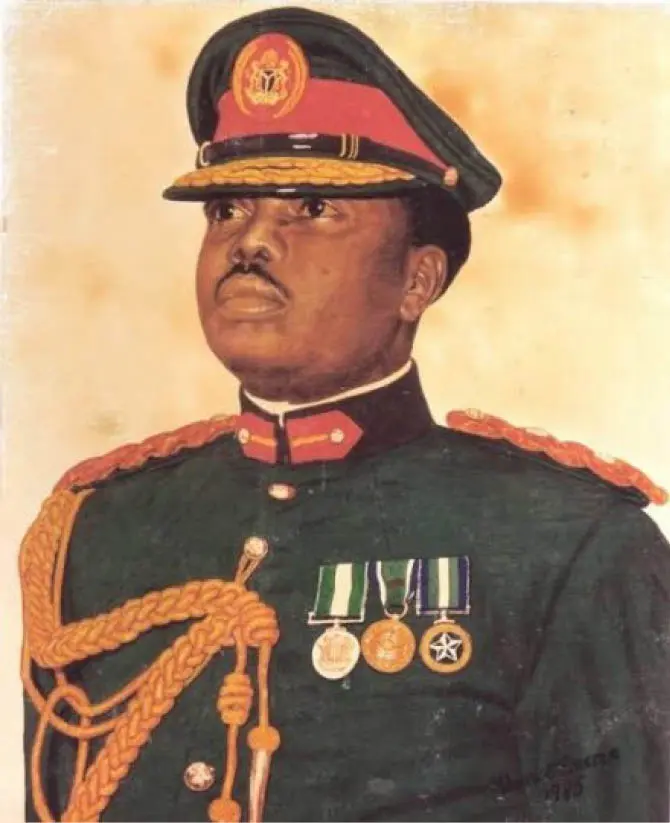
Apart from the significance of 50 years, what makes the 50th anniversary of General Murtala Mohammed’s death remarkable is that it is coming on a Friday, the particular day of the week, when the then head of state was mauled by his assailants at an intersection in Lagos.
For family and friends, 50 years may seem like yesterday, but for others who were around the then Head of State, it is becoming a fading memory.
Most of those indicted for plotting the coup were executed publicly while those who served in the Murtala government have gradually exited the stage with only a few still around.
Those that served under Murtala then include Olusegun Obasanjo;Theophilus Yakubu Danjuma; John Yisa Doko; Michael Adelanwa; Maigari Yusufu; Iliya Bisalla; Joseph Garba; Dr. M. T. O. Akobo; Dan Suleiman; Umoru Muttalab; Justice Dan Ibekwe; Effiom Otu Ekong; Brigadier M. Shuwa; Shehu Musa Yar’adua; O. Olumide; M. Ajose-Adeogun; Dr. R. A. Adeleye; Dr. I. U. William-Osisiogu and Shuaibu Kalaure.
Second youngest to rule Nigeria
Murtala died at 37, the second youngest person to rule Nigeria, after Yakubu Gowon, who assumed office at the age of 31.