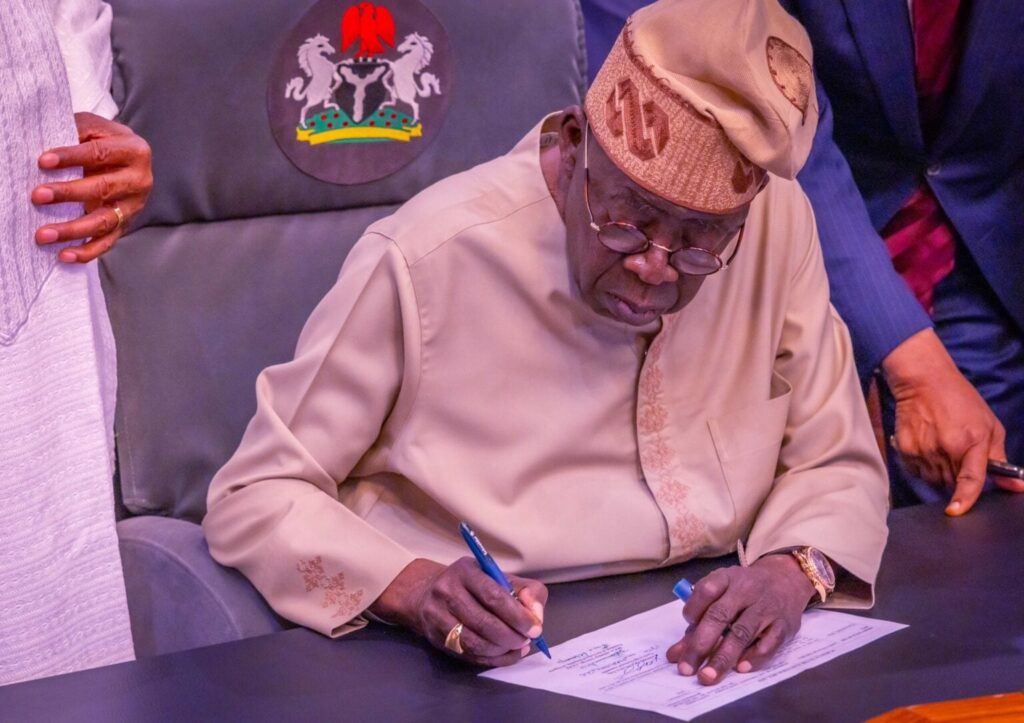
WITH speed, President Bola Tinubu signed the Electoral Act Amendment Bill into law on Wednesday. As passed by the National Assembly on Tuesday, the contentious Section 60 of the Act empowers the Independent Electoral Commission to use a dual system of electronic and manual transmission of results.
The dual transmission system is confusing, contentious and dangerously prone to fraud, manipulation and endless litigation. It is retrogressive.
Before Tinubu’s assent, the Senate ignited public outrage with its retention of Section 60 of the 2022 Electoral Act. The provision empowered INEC to transmit election results “in a manner prescribed by the Commission.”
After ostensibly reinstating e-transmission of results, the Senate promptly undermined it with a dangerous caveat: where electronic transmission fails due to “communication failure,” the signed and stamped Form EC8A becomes the primary source for collation and declaration of results.
In December, the House of Representatives adopted a far clearer and more credible provision: mandatory real-time electronic transmission of results from polling units to the iREV portal, simultaneous with physical collation.
Despite the public outcry and protests at the National Assembly, the two chambers passed the watered-down dual transmission version on Tuesday. The law will be used for the 2027 polls. It is a setback for better, credible and transparent elections in Nigeria.
The judiciary relied on Section 60 to approve the 2023 presidential polls after INEC failed to transmit the results to the iREV as promised during the electioneering period.
The new Act has complicated what should have been a straightforward amendment.
Over time, rigging, manipulation, violence and questionable litigation outcomes have damaged the credibility of Nigerian elections.
The “communication failure” excuse the Senate advanced is a facade. Network challenges exist, but they are neither novel nor insurmountable.
To calm public anger, both chambers initially constituted a 24-member committee to harmonise their positions. The committee did not achieve anything.
Most Nigerians — except those who benefit from electoral corruption — want a law that makes electronic transmission compulsory. Its inclusion in the 2025 Electoral Amendment Bill offered a clear path away from the uncertainties and disputes of the past.
Nigeria is not breaking new ground. Kenya, Brazil and India already transmit election results electronically. So, Nigerian legislators have no excuse for resisting this progressive standard.
For efficiency, INEC must strengthen its infrastructure by partnering with ICT service providers and Mobile Network Operators. The MNOs should dedicate data resources for elections as part of corporate social responsibility.
India’s experience shows that only political will stands in the way of real-time transmission. Prime Minister Narendra Modi illustrated this vividly during the country’s 2024 election, noting that out of 980 million registered voters, 646 million cast their ballots across more than one million polling booths, with results announced within a day — despite the scale, complexity and heat.
India’s success demolishes the excuses advanced by the Senate and its allies. Real-time transmission is not a fantasy; it is achievable. Nigeria must settle for nothing less.
In Nigeria, real-time transmission, while fundamental, is not a silver bullet for election credibility. Pre-election manipulations continue to plague the system.
Vote buying remains most insidious, brazenly executed under the noses of security agents. All major political parties participate, with victory often going to the highest bidder. Only intelligence-led policing, robust security, and the prosecution of both buyers and sellers can curb this menace.
In this regard, the Senate’s proposal to raise penalties for vote buying from a N500,000 fine to fines of up to N5 million, prison terms of two years and a 10-year ban from contesting elections is in order.
Voter suppression also persists through violence, intimidation and the hoarding of Permanent Voter Cards. During the by-elections in 2025, at least 288 armed thugs were arrested across four local governments in Kano State. In 2024, gunfire by hired thugs forced INEC to suspend inspection of election materials during an off-season election in Edo State.
Manipulation between the polling units and the collation centres before transmission is another recurring abuse. A High Court in Ikot Ekpene jailed a returning officer, Peter Ogban, for falsifying results during a 2019 National Assembly election.
Reforms must go further. Mail-in voting should be introduced to protect ballot secrecy and reduce manipulation. PVC registration and collection must also be simplified. Downloadable PVCs with QR codes would ease access, boost registration and increase participation.
As the debate rages on, vigilance is essential. The media, civil society and the public all have roles to play.
Election manipulation thrives on voter apathy. Declining voter turnout — from 57.54 per cent in 2007 to a historic low of 26.72 per cent in 2023 — has made rigging easier and less risky.
Despite the amended law, mass participation in elections is the ultimate antidote. Nigerians must turn out in large numbers and actively defend their votes.
PUNCH.