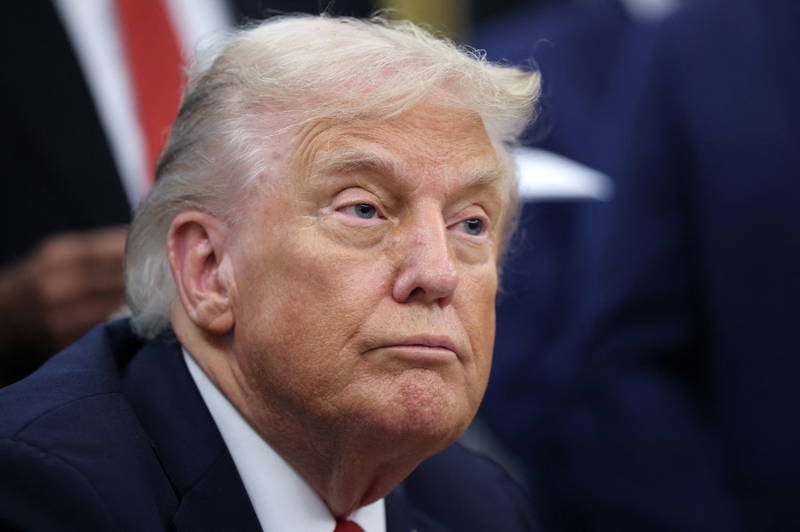
WASHINGTON, DC - SEPTEMBER 30: U.S. President Donald Trump (L) answers questions while childhood cancer survivors and their families gather in the Oval Office at the White House on September 30, 2025 in Washington, DC. According to Trump, the executive order he was signing will accelerate pediatric cancer research, including by harnessing the power of artificial intelligence. Win McNamee/Getty Images/AFP (Photo by WIN MCNAMEE / GETTY IMAGES NORTH AMERICA / Getty Images via AFP)
Democrats on Wednesday accused US President Donald Trump’s administration of the “largest government cover-up in modern history” over reports that it withheld documents relating to allegations that the Republican leader sexually abused a minor.
The Justice Department said it is reviewing its Epstein files to see if any were handled “improperly” but denied any wrongdoing.
The department has released millions of pages from files connected to notorious sex trafficker Jeffrey Epstein under a transparency law enacted last year. But public broadcaster NPR found gaps in the files tied to one woman’s 2019 assault complaint against Trump.
Indexes and serial numbers attached to the investigative materials into Epstein’s trafficking ring indicate that FBI agents conducted four interviews with the accuser and generated summaries and accompanying notes, NPR reported.
Only one summary — focused largely on her allegations against Epstein — appears in the public database.
The remaining three summaries and related notes, totaling more than 50 pages, are not available on the Justice Department’s website, according to NPR’s review of the document numbering. The New York Times and cable network MS NOW reported similar findings.
“This is largest government cover-up in modern history. We are demanding answers,” the Democrats on the House Oversight Committee said in statement posted to social media.
– ‘Improperly tagged’ –
In a statement Wednesday evening, the Justice Department said some media outlets have alleged that files related to Epstein accomplice Ghislaine Maxwell are also missing from records released to the public.
“As with all documents that have been flagged by the public, the Department is currently reviewing files within that category of the production,” it said on X.
“Should any document be found to have been improperly tagged in the review process and is responsive to the Act, the Department will of course publish it, consistent with the law,” it said, alluding to the bipartisan bill passed last year that ordered the Trump adminstration to release all its Epstein files.
The woman at the heart of this episode of the Epstein drama first contacted authorities in July 2019, shortly after Epstein’s arrest on federal sex trafficking charges.
Later internal references in the released files describe her as alleging that the disgraced financier introduced her to Trump and that Trump assaulted her in the mid-1980s, when she was 13 to 15 years old.
A 2025 FBI document in the public database recounts that claim but does not include an assessment of its credibility. The detailed memos from the follow-up interviews — conducted in August and October 2019, according to the indexes — are not included.
Robert Garcia, the top Democrat on the Oversight Committee, said he reviewed unredacted evidence logs at the Justice Department and reached the same conclusion.
“Oversight Democrats can confirm that the DOJ appears to have illegally withheld FBI interviews with this survivor,” Garcia said, adding that Democrats would open a parallel investigation and demand the missing records be provided to Congress.
The Justice Department argues that any material not posted falls within categories allowed under the law, including duplicates, privileged records or documents tied to an ongoing federal investigation.
Asked for comment, the Justice Department earlier Wednesday referred AFP to a social media response in which it denied deleting files and said documents temporarily removed for victim-related redactions or to remove personally identifiable information will be restored.
Democrats argue that the missing interview records do not fit the categories cited by the department.
AFP