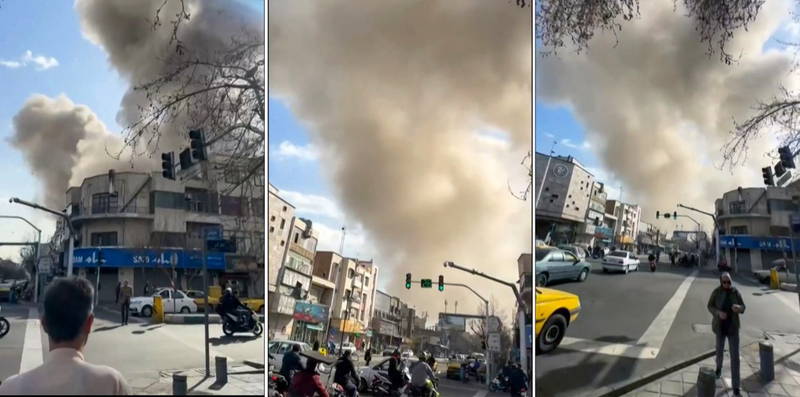
UNITED States and Isra-el have completely wiped out Iran’s top military brass in a war that entered its third day today, as the Iranians took their pound of flesh killing at least 9 Israelis and three American military officers and seriously wounding 11 others.
Among the top Iranian military commanders killed include Ali Shamkhani, Senior Advisor to the Supreme Leader, Ayatollah Ali Khamenei, who was also killed; Mohammed Pakpour, Commander of the IRGC; Amir Nasirzadeh, Minister of Defence; and Saleh Asadi, Senior Intelligence Official/Head of Emergency Command Intelligence.
Others are Hossein Jabal Amelian, Head of Organisation of Defensive Innovation and Research (SPND) (Nuclear Research); and Reza Mozaffari-Nia, former Head of SPND (Nuclear Programme).
This is exclusive of the killing of former President, Mahmoud Ahmedinejad, who was killed under house arrest.
Iran’s ex-President Ahmadinejad killed in US-Israel strikes
Ahmadinejad, a hardline figure known for his confrontational rhetoric and role in Tehran’s nuclear defiance, was reportedly killed during Israeli airstrikes inside Iran on Saturday.
According to media reports like Israeli outlet, Ma’ariv, quoted by NY Post, Ahmadinejad was under house arrest at the time and was killed in a targeted strike on his residence.
Israeli War room also quoted Iranian media to have reported the death.
“Former president of Iran’s Islamist Terror Regime, Mahmoud Ahmadinejad, was eliminated, per Iranian media. Ahmadinejad was sanctioned by the US in 2023 for his involvement in the wrongful detention of Americans,” it said.
However, in a fight back, Iran killed at least nine people and 27 injured others in a missile strike on the Israeli city of Beit Shemesh, emergency services say, with Qatar and United Arab Emirates completely shut down.
One person was killed in Abu Dhabi, capital of the United Arab Emirates, UAE, and and a death has also been reported in Kuwait. Dozens more people have been injured in strikes across the region.
Across the Gulf, Iran has used ballistic missiles and drones to launch large-scale attacks on US allies and assets, after Iran’s supreme leader was killed in the ongoing US-Israel air offensive launched on Saturday morning.
In a post on X, the Israel Defense Forces accused Iran of directly firing missiles toward Beit Shemesh, west of Jerusalem, “killing innocent civilians”.
Officials say a synagogue where people were sheltering from the air raids was hit.
The building was completely destroyed – dozens of rescuers were at the scene of the attack searching for people feared to be under the rubble.
There are piles of broken concrete and twisted metal, and a huge crater which indicates the point of impact. Cars that were parked nearby were completely destroyed.
Police say 11 people are still missing, while search is ongoing.
Magen David Adom paramedic, Dror Eini, said: “We saw destroyed homes, flames and smoke rising from residential buildings, wrecked cars, and significant chaos at the scene.’’
3 US military officers killed in Iran operation — Pentagon
Also yesterday, the US Central Command, CENTCOM, announced the killing of three American military officers, adding that 11 others were seriously wounded.
The command said in a statement: “Three U.S. service members have been killed in action and five are seriously wounded as part of Operation Epic Fury. Several others sustained minor shrapnel injuries and concussions, and are in the process of being returned to duty.
Earlier yesterday, Iran’s Revolutionary Guards also said they had successfully hit the aircraft carrier, USS Abraham Lincoln, in the Gulf with four ballistic missiles but CENTCOM said the aircraft carrier “was not hit.”
“The missiles launched didn’t even come close. The Lincoln continues to launch aircraft in support of CENTCOM’s relentless campaign to defend the American people by eliminating threats from the Iranian regime,” the statement added.
These developments came as more flights bound for the Middle East remained either delayed or cancelled yesterday as a result of the war.
On the last count, no fewer than 19,000 flights had been delayed or suspended since the war started.
This comes as Ayatollah Alireza Arafi has been appointed to Iran’s three-member temporary Leadership Council after the death of Ali Khamenei in the US-Israel Saturday airstrikes that targeted Iran’s military and nuclear installations.
Iran has also declared 40 days mourning and seven holidays, following Khamenei’s murder, as no fewer than 19,000 flights to the Middle East had either been delayed or cancelled, leaving hundreds of thousands of passengers stranded.
Senior cleric, Ayatollah Arafi, named interim leader after Khamenei’s assassination
Meanwhile, senior cleric, Ayatollah Alireza Arafi, has been appointed to Iran’s three-member temporary Leadership Council after the death of Ali Khamene
Arafi’s appointment comes as Iran’s key allies, including China, Russia and North Korea, condemned the killing of the supreme leader, describing it as violation of law and morality.
Arafi joins judiciary chief, Gholam-Hossein, Mohseni-Ejei and President Masoud Pezeshkian on the panel.
The three-member Leadership Council would govern Tehran until a new supreme leader is selected.
Ahmad Vahidi has also been named Iran’s Revolutionary Guards Commander-in-Chief, Iranian media reported yesterday, hours after the Revolutionary Guards commander was killed alongside the supreme leader.
The killing of the leaders of Iran Revolutionary Guards Command, IRGC, is the second time in less than a year that IRGC’s Commander-in-Chief would be assassinated.
Meanwhile, the attacks have triggered fresh uncertainty in global energy markets as Iran’s Revolutionary Guards has blocked the Strait of Hormuz, a chokepoint through which nearly a fifth of the world’s oil supply passes, and warned that no vessel would be allowed to pass as Iran retaliates the murder of its supreme leader.
This is even as US President, Donald Trump, warned Iran of unprecedented force if it retaliated as fresh blasts continued to rock the Gulf cities of Dubai, Doha, and Manama yesterday, with Iran’s attacks targeting US bases in the Gulf states entering its second day.
The United States will hit Iran “with a force that ` has never been seen before,” Trump warned after several explosions were heard in the Iranian capital yesterday.
Trump says he’s open to talks with Iran’s new leadership
Meanwhile, President Trump said yesterday that he was open to speaking to Iran’s new leadership and that they want to do so on the second day of U.S. and Israeli attacks on the country.
“They want to talk, and I have agreed to talk, so I will be talking to them,” Mr. Trump said in an interview with The Atlantic from his Mar-a-Lago estate in Florida. “They should have done it sooner. They should have given what was very practical and easy to do sooner. They waited too long,” he said.
Mr. Trump did not specify whom those talks would be with. Iran’s supreme leader. A senior White House official, speaking on the condition of anonymity to discuss the administration’s next steps in the military conflict, confirmed Mr. Trump’s willingness to talk to the Iranians.
The official said Iran had indicated that it was willing to talk with Mr. Trump but declined to provide details about the outreach and added that the military assault against Iran would continue unabated.
In the absence of clear leadership, Iran’s top national security official, Ali Larijani, announced that an interim committee would run the country. He committed to hitting back against Israel and American targets “with a force they have never experienced before.”
Khamenei killing, a ‘war against Muslims – Iran’s president
President Masoud Pezeshkian of Iran said yesterday that the interim leadership council had begun its work to avenge the death of the Ayatollah.
“The United States and Israel should know that nothing will come of this except their own downfall,” Mr. Pezeshkian said in a recorded video statement broadcast on state television.
Mr. Trump was noncommittal to The Atlantic on whether he would prolong the bombing campaign against Iran if it was necessary to support the Iranian people overthrowing their government. “I have to look at the situation at the time it happens,” Mr. Trump said.
A new leader might be chosen within days – Iran’s foreign minister
Iranian Foreign Minister, Abbas Araghchi, said it was a violation of international law for foreign forces to kill the leader of another nation.
“It is absolutely unprecedented and a major violation of international law for a leader of another country to be assassinated by foreign forces,” he said.
He said a new supreme leader could be chosen within days, noting that state institutions in Iran were functioning and the country “has constitutional procedures in place.”
“You may see the selection of a supreme leader in a day or two,” he said.
It’s cynical violation of law and morality
— Putin
Russian President, Vladimir Putin, condemned the killing, calling it a “cynical violation of all norms of human morality and international law.”
In a letter to Iranian President, Masoud Pezeshkian, published by the Kremlin, Putin expressed his “deepest condolences” over the assassination of the Iranian leader.
Moscow and Tehran have been allies for a long time, and have elevated their relations to a comprehensive, strategic partnership in 2025.
On Saturday, the Russian foreign ministry condemned the strikes, calling it “a preplanned and unprovoked act of armed aggression against a sovereign and independent U.N. member state.”
North Korea calls strikes on Iran illegal act of aggression’
Condemning the strikes, North Korea yesterday said the ongoing US/Israeli attacks on Iran was an “illegal act of aggression” and accused Washington of showing a “gangster-like nature.”
Spokesperson for the North Korean Foreign Ministry said the strikes represented a serious violation of Iran’s sovereignty and described them as “the most vile form” of aggression, according to the state-run Korean Central News Agency.
China’s Wang Yi says attacks on Iran unacceptable
China’s Foreign Minister, Wang Yi, told Russia’s Foreign Minister, Sergei Lavrov, yesterday that attacks by the United States and Israel on Iran during US-Iran negotiations were “unacceptable”, according to state news agency, Xinhua.
Wang said the “blatant killing of a sovereign leader” and the incitement of regime change were unacceptable.
Khamenei’s killing, defining moment in Iran’s history, says EU foreign policy chief
EU’s Foreign Policy Chief, Kaja Kallas, described the death of Ali Khamenei as a defining moment in Iran’s history, saying that what comes next is uncertain.
“What comes next is uncertain. But there is now an open path to a different Iran, one that its people may have greater freedom to shape.
“I’m in contact with partners, including those in the region that bear the brunt of Iran’s military actions, to find practical steps to de-escalation,” she said in a post on X.
Pope appeals for end to spiral of violence
In his reaction, Pope Leo has said that he is following events after US-Israeli strikes against Iran with “deep concern” and made an appeal to stop what he called a “spiral of violence”.
“I address a heartfelt appeal to the parties involved to assume the moral responsibility to stop the spiral of violence before it becomes ` an irreparable abyss,” the pope said.
“Stability and peace are not built through mutual ` threats or through weapons … but ` only through reasonable, genuine, and responsible dialogue,” the pope said during his weekly address to pilgrims in St Peter’s Square after a Sunday prayer.
Iran blocks Strait of Hormuz, warns no vessel should cross
Meanwhile, the IRGC has blocked the Strait of Hormuz as Iran retaliates to avenge the US and Israel’s assassination of Supreme Leader Ayatollah Ali Khamenei and other top officials.
An official from the European Union’s naval mission, Aspides, said vessels in the region had received VHF transmissions from Iran’s Revolutionary Guards stating that “no ship is allowed to pass the Strait of Hormuz”, Reuters reported on Sunday.
Reuters reported that at least 100 further tankers were stationed near the Coasts of the UAE and Oman outside the Strait of Hormuz after the closure, while Iran is reported you have attacked an oil tanker passing through the Strait of Hormuz near the coast of Oman.
The Strait of Hormuz connects the Gulf’s largest oil producers, including Saudi Arabia, Iran, Iraq and the United Arab Emirates, to the Gulf of Oman and the Arabian Sea.
Around 20 million barrels per day of crude and refined products move through the narrow shipping lane between Iran and Oman, accounting for almost one-fifth of global oil consumption
A disruption there would ripple across Asia’s largest economies. It would also halt Iran’s own exports, depriving Tehran of critical revenues, one reason the waterway has never been fully blocked despite repeated threats.
However, many countries, particularly those heavily dependent on oil imports, could tap strategic reserves in the event of a supply shock.
The International Energy Agency, IEA, requires its members to hold at least 90 days of net imports of crude oil and refined products in strategic reserves.
Over 19,000 flights delayed, cancelled
In the last few hours, the United Arab Emirates airports and national carriers have handled approximately 20,200 passengers affected by the rescheduling of certain flights.
24 out of 56 flights scheduled to depart from Heathrow to destinations in the Middle East were cancelled on Sunday. Of around 4,218 flights scheduled to land in Middle Eastern countries on Saturday, 966 (22.9 per cent) were cancelled. For Sunday, 716 flights out of 4,329 scheduled to the Middle East have been cancelled.
Flight tracking website FlightAware said more than 19,000 flights had been delayed globally. While Flightradar24 said more than 3,400 flights have been cancelled on Sunday across seven airports in the Middle East: Dubai International, Hamad International Airport in Doha, Zayed International Airport in Abu Dhabi, Sharjah International Airport, Kuwait International Airport, Bahrain International Airport and Dubai World Central – Al Maktoum International.
Oil price hits
$73 per barrel
Global oil prices climbed to $73 per barrel from about $70 per barrel, following fresh strikes by the United States on Iran, which has escalated tensions in the Middle East and raised concerns over potential disruption to crude oil flows.
The surge reflects heightened geopolitical risks in a region that accounts for a significant share of global oil supply.
Specifically, the price of Nigeria’s Bonny Light crude rose to $72.90 per barrel from $70.80 per barrel. Similarly, Brent crude increased to $72.87 per barrel from $71.10 per barrel, while Murban crude gained to $74.24 per barrel from $71.50 per barrel.
Market analysts said the spike was driven largely by fears that the conflict could impact shipping routes and production facilities in the Gulf region, thereby tightening global supply.
Meanwhile, members of OPEC+ have reaffirmed their commitment to maintaining market stability, even as they agreed to gradually return 1.65 million barrels per day (bpd) of voluntary production cuts to the market.
In a statement issued after a virtual meeting held on March 1, 2026, eight member countries, including Saudi Arabia, Russia, Iraq, United Arab Emirates, Kuwait, Kazakhstan, Algeria, and Oman, reviewed global market conditions and outlook.
The eight countries, which previously announced additional voluntary production adjustments in April and November 2023, said that in view of a steady global economic outlook and healthy market fundamentals, reflected in relatively low oil inventories, they would resume the unwinding of the 1.65 million bpd cuts announced in April 2023.
They agreed on a production increase of 206,000 bpd to be implemented in April 2026. The group noted that the full 1.65 million bpd could be returned either in part or in full, depending on evolving market conditions and in a gradual manner.
“The countries will continue to closely monitor and assess market conditions and, in their continuous efforts to support market stability, they reaffirmed the importance of adopting a cautious approach and retaining full flexibility to increase, pause or reverse the phase-out of the voluntary production adjustments,” the statement said.
VANGUARD.