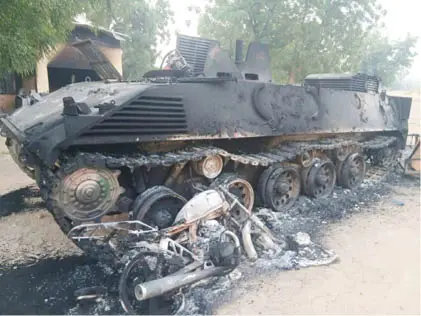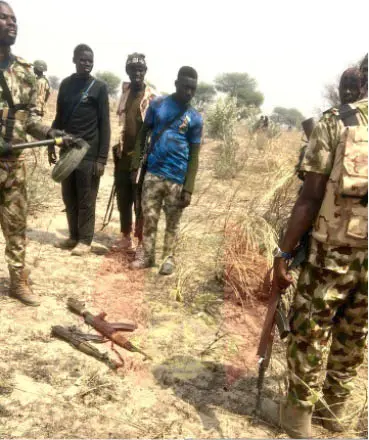
The Wednesday killing of some people and military operatives in Gwoza Local Government Area of Borno State by Boko Haram terrorists has sent shock waves across Nigeria and beyond.
This is in addition to the abduction of over 100 people, including men, women and children.
Reports have it that the abductees were shepherded to the nearby Sambisa Forest and the Mandara Mountains along the Nigeria–Cameroon borders.
Sambisa and Mandara are ‘a necessary evil’ to hundreds of thousands of people in Borno and its environs. Countless towns and villages surround the two natural endowments that various governments left at the mercy of criminals, who in turn converted them for different atrocities.
Sambisa and Mandara are also a nightmare to our security operatives. The people recently abducted from Ngoshe will most likely join the league of hundreds of people who have been abducted by Boko Haram.
Sadly, unless a certain miracle happens and they are rescued, most of the women and girls would be turned into sex slaves.
Over the years, terrorists have also used Sambisa and the Mandara Mountains as fertile grounds for converting and training young men as fighters and some of the women as suicide bombers.
Why attack people in the holy month of Ramadan? This is the question on the lips of many Nigerians.
Since yesterday, when the news of the killings and abductions came to the fore, debates have also intensified on social media as to why Boko Haram or ISIS fighters, who claim to be Muslims, would have the courage to attack hapless and vulnerable people in the month of Ramadan.
But this is not new, just as it is not the first time since the Boko Haram crisis began in 2009.
I recall my days in Maiduguri as a reporter when a similar attack on the civilian population happened in the month of Ramadan in 2011.
This was almost two years after a hiatus following the killing of Mohammed Yusuf, the leader of the group.
It was a tough period to report from Maiduguri and its environs. During the time under review, the Boko Haram fighters had a way of reaching out to the press.
Soon after the Ramadan attack, most of us reporting from Maiduguri were confused, arguing among ourselves as to whether the attack was carried out by Boko Haram, who claimed to be Muslims, or by some sundry criminals.
It was amid the confusion that one of their vocal spokesmen, who went by the pseudonym, Abu Qaqa, called.
He was fairly educated, especially in Western education, and mostly spoke after bomb and gun attacks to claim them for the group and justify the choice of targets for their nefarious acts.
He was the closest person the sect had to a public face before Abubakar Shekau began to post videos of himself as their leader.
Qaqa, during the call, confirmed that indeed they were behind the heinous act.
I then posed the question to him as to why they chose to attack during the month of Ramadan.
There was a silence of the grave for some seconds from the other end, meaning he never expected such a question from me.
He responded in a subdued tone, saying, “Give me some time; I will call you back and tell you why we struck.” I assumed that he did not have the answer at the time I asked the question.
Indeed, the call came about 30 minutes later, meaning he must have consulted some of their members.
Qaqa said, “Look, in Islam there are four sacred months during which warfare is traditionally prohibited. They are Dhu al-Qa’dah (11th month), Dhu al-Hijjah (12th month), Muharram (1st month) and Rajab (7th month).”
Confident of what he was told, Abu Qaqa was unapologetic in claiming responsibility for the heinous act.
I reminded him that Ramadan is the ninth month of the Islamic calendar, a period of fasting, intensive prayer, reflection and community, marking when the Quran was first revealed to Prophet Muhammad.
I said it is considered a deeply sacred time, often referred to as “Allah’s month,” which serves to purify the soul, increase devotion and foster empathy for the less fortunate.
From the response I got, my admonition made no sense to him, as he remained adamant, insisting that what they were doing was ordained by God.
Since then, I noticed that rather than reduce the frequency of their attacks, Boko Haram terrorists have taken relish in launching attacks during the Ramadan period.
For instance, there was the Maiduguri Market bombing in July 2014, which was equivalent to Ramadan 1435 AH.
The attack, which was launched about 48 hours after the start of Ramadan, caused numerous casualties as traders and buyers gathered during the fasting period.
Pundits at the time said Boko Haram often targets crowded markets, mosques and public spaces during Ramadan because large gatherings make attacks deadlier and attract attention.
In June 2016, there was an attempted mosque attack during Ramadan prayers at the Sulemanti area in Maiduguri.
Two suicide bombers attempted to enter a mosque during late-night Ramadan prayers but detonated explosives outside after being confronted by local vigilantes.
In May 2019, Boko Haram fighters attacked the Madu Musaha IDP camp in Dikwa, Borno State. The period coincided with Ramadan 1440 AH.
Obviously, mosques and prayer gatherings are often targeted either to punish communities seen as opposing Boko Haram or to create maximum casualties among congregations.
From statements attributed to the group and analyses by Nigerian security officials and experts, several recurring motives explain why the insurgents strike during Ramadan.
Ramadan involves large crowds at mosques, markets and food distribution centres, making attacks easier and deadlier.
Communities suspected of cooperating with the Nigerian military, vigilantes or intelligence networks are also frequently attacked.
Boko Haram also portrays the Nigerian state and local Muslim authorities as “apostates” or enemies of their interpretation of Islam, which they claim legitimizes attacks even during Ramadan.
While Ramadan is traditionally a time of restraint and worship in Islam, Boko Haram has repeatedly carried out attacks during the period, prompting many Muslim leaders and organisations in Nigeria to condemn the group as acting contrary to Islamic teachings.
Every activity of Boko Haram or any criminal group is reprehensible, but recently the Ngoshe incident drew greater attention considering the timing of the attacks.
The victims had reportedly just broken their fast after toiling in the scorching sun for hours. Some barely took dates and water, went to the mosque and observed the Maghrib prayers.
Among those killed was the Chief Imam of Ngoshe and others. They were slaughtered by a large number of armed terrorists.
Before descending on Ngoshe, they had reportedly invaded a military base of the 82 Division Task Force Battalion.
Boko Haram fighters have no convention; they know no Ramadan. The only way to bring peace is to take the war to them.
DAILY TRUST.