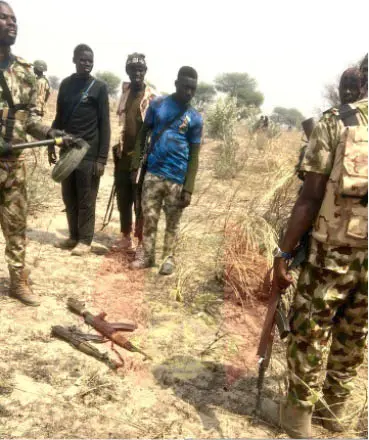
Suspected Boko Haram/ISWAP terrorists abducted more than 100 women and children in an attack on Ngoshe community in Gwoza Local Government Area of Borno State, Daily Trust gathered.
They also killed some soldiers, the chief imam of the town and some community elders during the assault which occurred shortly after Muslims broke their fast on Wednesday.
Local and security sources said the terrorists first attacked a military base belonging to the 82 Division Task Force Battalion before storming the community and an Internally Displaced Persons (IDPs) camp.
“The militants invaded a military base of 82 Division of TF Battalion. They also launched an assault on the internally displaced persons (IDPs) camp in the community,” said one of the sources.
He said the terrorists overpowered the troops due to their large numbers and went after the fleeing troops, ransacking the community and surrounding bushes.
“We cannot ascertain the actual number of soldiers and civilians killed but nine bodies of soldiers have been recovered so far,” he said.
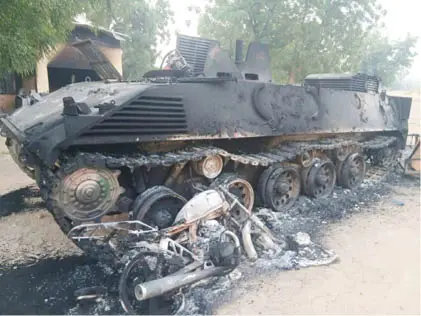
He said the assailants also burnt armoured tanks and military vehicles and made away with unquantifiable ammunition.
“Residents have fled Ngoshe town to the adjoining town, Pulka. The attack is very devastating considering that refugees have started returning from Cameroon,’ one other source said.
He alleged that informants might have played a role in the coordinated attack, “It’s not possible to carry out such an attack without information from within us.
“The chief imam and some elders were slaughtered by the terrorists, and over 100 women and children were abducted or missing”, he said.
Army intercepts, kills several terrorists
However, the Nigerian military killed over 50 of the Boko Haram terrorists that had carried out attack on a military base in Borno State.
An online platform, Zagazola Makama, reported that the strikes were carried out by the Nigerian Air Force.
The platform quoted military sources as saying the terrorists had attacked troops’ positions at about 7:30pm on March 3 before fleeing.
Following the attack, surveillance aircraft tracked the terrorists along their known escape routes and carried out precision strikes on their positions, killing more than 50, it was gathered.
Security analysts attributed the resurgence of Boko Haram attacks on military locations to the military operations in Sambisa, Mandara mountain and Lake Chad general area.
Residents of Ngoshe told our reporter that many of their loved ones fled to Pulka.
One of them, Malam Umar, said: “You will see a mother crying, searching for her children and husband or children looking for their parents.
“The trauma of losing their homes and loved ones during this difficult time is quite devastating.” he said.
Ndume seeks operations in Sambisa, Mandara
Senator Ali Ndume (APC, Borno South) called for improved military operations in Sambisa Forest and the Mandara Mountains.
“I strongly condemn the attack. Let me commiserate with families of those killed and wish the injured quick recovery.
“Unfortunately, soldiers, the chief imam of Ngoshe and some elders of the community were among those slaughtered or killed during the attack.
“The military base was dislodged with some major equipment destroyed, including residential houses and property worth millions of naira set ablaze. I was informed that the General Officer Commanding 7Div, Brigadier-General Ugochukwu Unachukwu and the Brigade Commander of Gwoza are right now in Ngoshe to ensure civil authority is restored.
“We are liaising with Borno State Emergency Management Agency (SEMA) and the Chairman of Gwoza LGA to immediately provide relief items to the displaced persons in Pulka community,” he said.
He reiterated that the inability of the military to have a stationed attack helicopter(s) or fighter jets in the Northeast was a setback to their effective operation in the region.
Timeline of terrorist attacks on military
On March 1, 2026, Boko Haram terrorists attacked Forward Operations military Base (FOB) and killed its commander, Major UI Mairiga, three soldiers and a hunter in Mayanti, Bama Local Government Area of Borno State.
On February 6, four soldiers were killed in a Boko Haram ambush at Auno, near Jakana along the Maiduguri-Damaturu road in Borno State.
The troops came under attack at about 10:50 pm. on their way to reinforce colleagues who were under attack.
On January 5, at least nine soldiers were killed and several others injured when their convoy struck a landmine and came under Boko Haram terrorists fire.
The attack took place near Bindundul village, about 20 kilometres from Kareto, Damasak. Mobbar LGA of Borno State.
On January 28, Boko Haram attacked military formation in Damasak and killed seven soldiers, including the commanding officer, who is also a major.
On January 30, the terrorists attacked Wajirko community along the Biu-Damboa Road in Borno State, killing 5 soldiers and 15 civilians.
On April 18, 2025, Boko Haram insurgents attacked resettled Yamtake community in the Gwoza LGA of Borno State, killing two soldiers and an unspecified number of civilians.
On August 11, 2025, the insurgents attacked Kirawa town in Gwoza LGA of Borno State, killing three soldiers and abducting a female schoolgirl, Aishatu Aja, according to local and security sources.
On October 20, 2025, the army confirmed the death of Lt. -Col Aliyu Saidu Paiko, the commanding officer of 202 battalion and other soldiers during encounters with Boko Haram terrorists in Borno State.
Army spokeswoman, Lt.-Col Appolonia Anele, also said the operatives attached to 21 Special Armoured Brigade, Operation HADIN KAI, resisted the terrorists on October 17, at Kashimri general area of Bama local government council of Borno State.
On May 12, 2025, Boko Haram terrorists attacked a Nigerian Army base in Marte LGA of Borno State, killing an unspecified number of soldiers.
On January 25, 2025, 20 soldiers were reportedly killed in a suspected Boko Haram attack on army base in Malam-Fatori town, Abadam LGA of Borno State.
Gwoza youths appeal for victims’ support
Meanwhile, in a social media post, the Gwoza Youth Forum yesterday appealed for assistance for the victims of Ngoshe attack.
Its chairman, Malam Idrissa Hamman, said: “We humbly write to seek your urgent support for our brothers and sisters who have been displaced from Ngoshe and are currently taking refuge in Pulka.
“Many of them are living under extremely difficult conditions and lack basic necessities for daily survival.
“In view of this humanitarian situation, we are earnestly appealing for your kind support, either in cash or in kind to assist these vulnerable families.
“As a matter of urgency, we are particularly soliciting the following items: clothes, shoes, blankets, buckets, food items and other essential household items.
“This humanitarian initiative is being coordinated under the platform of the Gwoza Youths Forum.
“The chairman of the committee for this initiative is Mal. Idirisa Hamman, while the secretary is Engr. Aliyu Shehu & BK Glavda as Member,” he said.
Deadly attacks since Ramadan began
Terrorist and bandit groups have launched a series of attacks on communities since the commencement of Ramadan, killing and abducting scores of rural dwellers.
This development contrasts with previous years when insurgents often scaled down attacks during the holy month.
States such as Adamawa, Kebbi, Zamfara, Bauchi, Borno and Yobe have witnessed repeated bandit and terrorist assaults in recent weeks.
At least 34 persons were reportedly killed on February 18, the first day of Ramadan, in a series of coordinated attacks by suspected Lakurawa militants across communities in Arewa Local Government Area of Kebbi State.
The hardest-hit community was Mamunu, where 16 people lost their lives. Five youths were killed in Awashaka, while three residents were killed in Masama. Two persons each were also killed in Gorin Dena, Kamzo, Dan Mai Rago, Tungar Bature and Tungar Tsoho communities.
A week later, five worshippers were killed and three others injured when terrorists attacked a mosque in Dadin Kowa community in Maiyama Local Government Area of Kebbi State.
Police said the attack occurred around 8:30 p.m. during a nighttime Qur’anic Tafsir session that coincided with Taraweeh prayers.
On February 20, bandits killed about 50 people in an attack on Dutsin Dan Ajiya village in Anka Local Government Area of Zamfara State.
The assault began Thursday night and continued into Friday morning, with attackers riding motorcycles, setting buildings on fire and shooting at residents of Tungan Dutse village who attempted to flee. Many residents were also abducted during the raid.
Hamisu Faru, a state lawmaker, said the victims were given a mass burial on Saturday.
In Niger State, at least 15 people were killed on February 28, after gunmen attacked Tashan Maje, Saduro and Runtuwa villages in the Borgu area of the state.
Similarly, at least 25 people were killed and many others injured in two separate raids by suspected terrorists in Adamawa State on February 24.
The night raids targeted the neighbouring villages of Kirchinga and Garaha in Madagali and Hong local government areas respectively.
The attackers, who arrived on motorcycles, reportedly opened fire indiscriminately on residents and were believed to be members of the Boko Haram terrorist group.
The Adamawa police spokesman, Suleiman Yahaya-Nguroje, confirmed the attack. The state governor, Ahmadu Umaru Fintiri, condemned the assaults, describing them as “cowardly acts of terrorism,” and said the government was working with security agencies to pursue the perpetrators and ensure justice is served.
On February 26, bandits also abducted six Muslims while they were observing Taraweeh prayers inside a mosque in the Azara community of Kachia Local Government Area of Kaduna State.
A resident of Azara, Tanimu Ibrahim, said the incident occurred on Thursday night when armed men invaded the community and fired sporadically into the air before whisking away six adults—four men and two women.
Killing, one of the gravest sins in Islam – Cleric
A Kano-based Islamic cleric, Dr Ibrahim Siraj, said Islam strongly condemns the act of killing as it is one of the gravest sins.
Quoting from the Qur’an, he said: “Whoever kills a believer intentionally, his recompense is Hell, to abide therein forever; and the wrath and curse of Allah are upon him, and a dreadful punishment is prepared for him.”
He noted that no other sin in Islam has been described with such a series of retributions.
Siraj, who also lectures at Bayero University Kano (BUK), added that the gravity of the offence becomes even worse when it occurs during the sacred month of Ramadan.
“In addition to violating the sanctity of life, it also violates the sanctity of the month itself. Ramadan is a time when Muslims are encouraged to do good, refrain from bad behaviour, and draw closer to Allah. To take a life in this holy month is to show contempt and disrespect for its sacredness,” he said.
On the punishment for such acts, the cleric explained that Islamic law prescribes capital punishment for murder if enforced by those in authority.
“Whoever kills must be killed. That is the worldly punishment. But beyond that, the Qur’an makes it clear that the killer will face the wrath of Allah, His curse, and eternal damnation in the hereafter,” he said.
He urged Muslims to uphold the sanctity of life and the holiness of Ramadan, warning that careless disregard for these values is unbecoming of any true believer.
A Kaduna-based Islamic cleric, Sheikh Halliru Maraya, on his part, said the rising wave of attacks by gunmen during the holy month of Ramadan has no basis in Islamic teachings.
He said many of the perpetrators do not respect the sanctity of Ramadan, therefore, feel no obligation to restrain themselves during the fasting period.
“One of the reasons these criminal gunmen step up their atrocities against Nigerians during the holy month of Ramadan is that they are not acting in the name of Islam or based on its teachings. They are simply acting on their own whims and caprices.
“These atrocities clearly contradict the faith. Islam does not condone violence, let alone the taking of human life without a just cause. According to the Qur’an, taking a human life unjustly is like killing all of mankind. Whoever kills a soul unless for a soul or for corruption in the land – it is as if he had slain all mankind,” he said.
He added; “There are many motivations behind their actions. As I said earlier, they are not guided by the faith, so they do not attach any sanctity to the month. Because of that, they believe they can continue their activities without restraint”.
He also noted that some groups wrongly interpret Islamic history to justify their actions.
“In Islam, there are four sacred months during which warfare is prohibited — Dhul Qida, Dhul Hijja, Muharram and Rajab. Ramadan is not among these four months. So some of those who claim they are waging jihad believe they can continue their fight even during Ramadan,” he said.
“They also point to historical events such as the Battle of Badr, which was fought during the time of the Prophet in Ramadan in the year 624 of the Gregorian calendar, to justify their actions,” he added.
The cleric further noted that many of those involved in kidnapping and banditry are not even practicing Muslims.
“Some of these criminals who abduct people for ransom are simply drunkards who do not even observe fasting. They carry out their attacks while intoxicated, so you cannot expect them to respect the sanctity of Ramadan or abandon their bad habits during the period,” he said.
He urged Nigerians not to associate the actions of such criminals with Islam, stressing that the religion places a high value on the sanctity of human life.
DAILY TRUST.