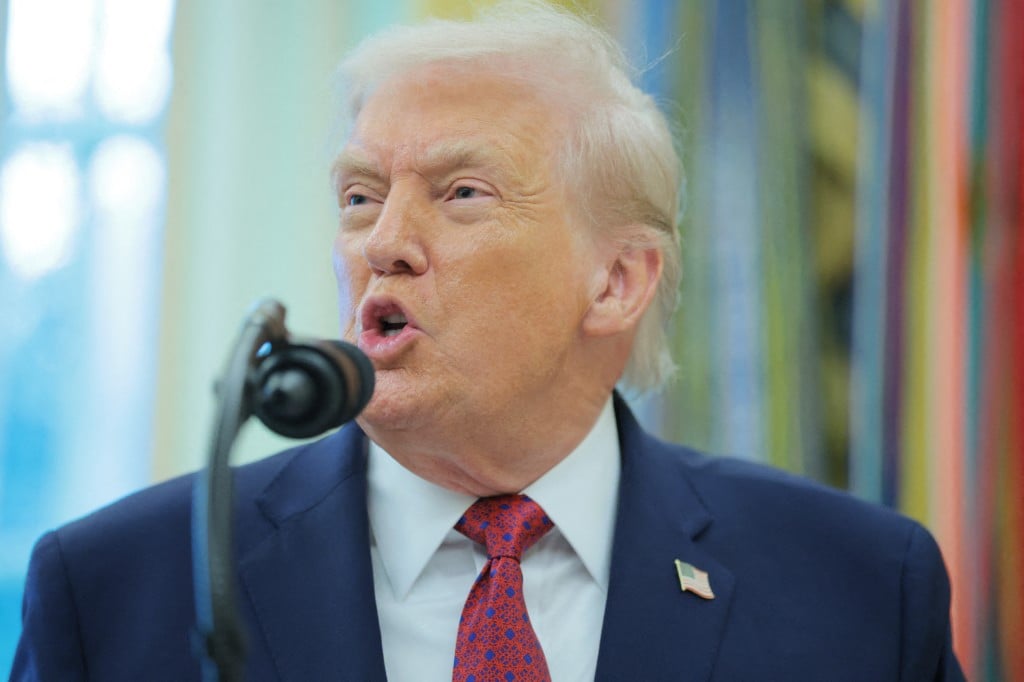
European leaders have rejected demands by the US President, Donald Trump, for help to clear the strait of Hormuz, as foreign ministers from the European Union gathered in Brussels yesterday to discuss skyrocketing oil prices from the US-Israeli war on Iran.
The push back came after Trump called on the UK, China, France, Japan, South Korea and other NATO countries to send ships to secure the Strait of Hormuz, saying it would be very bad for the future of NATO if allies don’t help secure the strait.
US officials had also spent much of the weekend working to rally support behind Trump’s demand and said they hoped to announce a new coalition in the coming days, according to people familiar with the matter.
Who that coalition consists of, and when it might be announced, remain open questions.
Even staunch US allies sound cautious about sending their militaries into the contested waterway while an active war is underway.
Still, US officials said they hoped to, at least, receive preliminary commitments of support for securing the strait, even if countries left the specifics, such as what ships were deployed and when, to a later date.
But the EU foreign ministers at the meeting demanded to know more about Trump’s plans for the war on Iran and when the conflict might end, even as they weighed his request for help.
Speaking at the meeting, German Foreign Minister, Johann Wadephul, said Berlin had no intention of joining military operations during the conflict, adding that NATO needed clarity on when US and Israel considered the military aims of their deployment to have been reached.
“We expect from the US and Israel to inform us, to include us into what they’re doing there and to tell us if these goals are achieved.
“Once we have a clear picture of that, we believe we need to move into the next phase, namely, defining a security architecture for this entire region, together with the neighbouring states,” he told reporters before the meeting in Brussels.
Wadephul added that NATO had not made any decision on assuming responsibilities in the Strait of Hormuz.
German Chancellor, Friedrich Merz’s spokesperson, Stefan Kornelius, underlined that “it is not NATO’s war. NATOis an alliance to defend the alliance area.”
Kornelius said Berlin “took note” of Trump’s comments, but added that “the United States did not consult us before this war, and so we believe this is not a matter for NATO or the German government.
“What does … Trump expect a handful or two handfuls of European frigates to do in the Strait of Hormuz that the powerful US Navy cannot do?” German Defence Minister, Boris Pistorius, said in Berlin.
“This is not our war. We have not started it,’’ he said.
Greek government spokesman, Pavlos Marinakis, said that Greece would not engage in any military operations in the Strait of Hormuz, while Italian Foreign Minister, Antonio Tajani, said Italy was not involved in any naval missions that could be extended to the area.
Meanwhile, Estonian Foreign Minister, Margus Tsahkna, also said US allies in Europe wanted to understand Trump’s “strategic goals. What will be the plan?”, while Polish Foreign Minister, Radek Sikorski, invited the Trump administration to go through the proper channels.
“If there is a request via NATO, we will, of course, out of respect and sympathy for our American allies consider it very carefully,” he said.
However, the Danish Foreign Minister, Lars Lokke Rasmussen, said Europe should keep an open mind on helping to ensure freedom of navigation in the strait, even if the continent did not support the US-Israeli decision to go to war with Iran.
“We must face the world as it is, not as we want it to be,” Rasmussen said, adding that the EU must decide on a plan “with a view towards de-escalation.”
Meanwhile, the United Kingdom said it was working on a collective plan to reopen the Strait of Hormuz and restore freedom of navigation in the Middle East but noted that doing so would not be easy.
‘’UK won’t be drawn into ‘wider war’ and will work with allies on Strait of Hormuz plan,’’ Prime Minister Keir Starmer, said
EU foreign policy chief, Kaja Kallas, told reporters before the meeting in Brussels that the bloc’s leaders would focus on how the EU could contribute to reopening the waterway.
“We first need to discuss what the member states are willing to do in the Strait of Hormuz. Of course, the needs to open the Strait of Hormuz are there right now,’’ she said.
Kallas said the strait’s closure, which had sent oil prices to more than $100 a barrel, was benefitting Russia’s war on Ukraine, which is largely funded by Moscow’s energy revenues.
IEA prepared to release more oil reserves
Meanwhile, the International Energy Agency, IEA, said it was prepared to release more oil reserves, if needed, amid what it said was the “largest supply disruption in the history of the global oil market”.
IEA had last week released a record 400 million barrels of oil to cushion the effect of the strait’s bloackade.
IEA’s Executive Director, Fatih Birol, said the volume of oil supply offline was already higher than during any previous disruption, including the oil crisis of 1973.
“Oil prices today are significantly lower than they were one week ago,” he said, but added that the reserves were not a lasting solution while passage through the strait remains uncertain.
The IEA still has more than 1.4 billion barrels of oil remaining, “which means we can do more later as, and if needed,” Birol said.
VANGUARD.