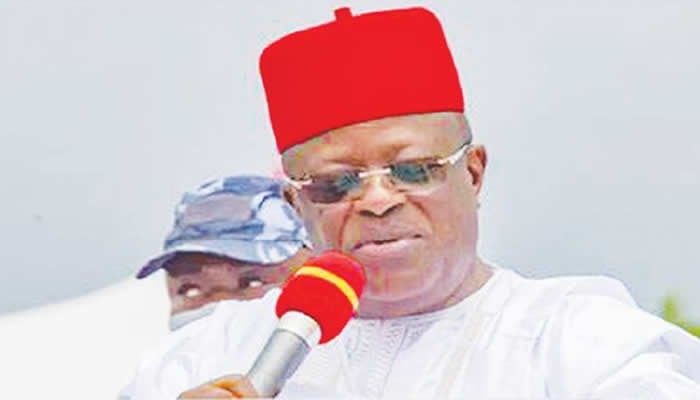
In a bid to counter mounting allegations of corruption and mismanagement, the Minister of Works, David Umahi, has invited Nigeria’s anti-corruption agencies to conduct a full-scale probe of road projects under his ministry, declaring that “nothing is hidden” in the execution of federal infrastructure contracts.
Umahi revealed that both the Independent Corrupt Practices and Other Related Offences Commission and the Economic and Financial Crimes Commission had been formally invited to independently scrutinise not just documentation, but the physical execution of projects across the country.
The minister disclosed this on Wednesday in Abuja after receiving a “Personality of the Year” award from Al-Jazeera Newspaper Nigeria. He said the move was a deliberate step to demonstrate transparency and rebuild public trust amid growing public criticisms.
Umahi said, “There have been several allegations and accusations against us, but to show our transparency, we decided to open up the entire Ministry of Works for probe.
“We wrote to ICPC to go round and investigate all our projects, not on paper, but physically. We also wrote to EFCC. We are not hiding anything. Any file they want, any information, is available.”
The minister revealed that the ICPC had already concluded part of its assignment and is currently reviewing procurement processes, while the EFCC is expected to commence its own investigation after the Sallah break.
“Let me tell you something. We wrote to ICPC to go around and investigate all our projects, not on paper, but to go around and investigate the physical accomplishment of what the president is doing. We also wrote to EFCC. Now, ICPC has concluded its own, and we are giving them a space here to check our procurement process.
“They have started their work. Nobody is interfering. Any information—and that’s how it should be—is available. I’m told that EFCC will start their own after the Sallah break. We are not hiding anything because we feel for the people,” he said.
Umahi maintained that every contract awarded by the ministry can be fully accounted for, stressing that the costing structure of projects is transparent and subject to scrutiny.
“If you wake me up and ask about any project, say the cost of concrete per cubic metre, we can disaggregate everything: the cost of cement, sand, chippings, equipment, and labour. There is nothing we do in this ministry that we cannot defend,” he stated.
He attributed some of the criticisms to the ministry’s controversial decision to transition from asphalt to concrete road construction, a policy he said was resisted by vested interests but ultimately designed to serve the long-term interest of Nigerians.
“We fought a big battle to move from asphalt to concrete. But we believe that what we are doing is right. Concrete roads will last up to 100 years with minimal maintenance. So, there is no battle we are afraid of, provided we are working in the interest of the people,” Umahi said.
Highlighting the broader economic implications of road infrastructure, the minister likened poor road networks to a form of confinement for citizens. “When a road is cut into two, it is like putting people in prison because they cannot move from one point to another. That is what this administration is trying to change,” he added.
Umahi also used the opportunity to caution the media against amplifying unverified allegations, urging journalists to prioritise accuracy and due diligence.
“In journalism, do not escalate what you are not sure of. Whatever you sow, you will reap. If you attack people who have done nothing wrong, go and check whether you will succeed. We support freedom of information, but we must all be accountable.
“We are with the people, we are with God, and we are with the President. We will continue to do everything possible to fix our roads. And I assure you that we are not discouraged or disturbed. It is those who are making efforts to destroy us that we pity, because they have a lot of work to do. But for us, we are with God, we are with the people, we are with the President, and we will do everything to benefit people at the grassroots.”
The transparency push comes against the backdrop of increased public scrutiny of government spending on infrastructure, especially under the Renewed Hope Agenda of President Bola Tinubu.
Nigeria’s road sector has historically been plagued by allegations of inflated contracts, abandoned projects, and weak oversight, prompting repeated calls for stronger accountability mechanisms.
For the 2025 fiscal cycle, the ministry proposed a capital expenditure of about N3.24 trillion, largely targeted at completing ongoing “legacy” road projects across the country. The allocation forms part of a broader infrastructure push under the Renewed Hope Agenda, which prioritises transport networks as a driver of economic growth and national integration.
By inviting anti-graft agencies to independently audit projects, the Works Ministry appears to be adopting a proactive approach to accountability, a move analysts say could set a new precedent if sustained.
Earlier, the Chief Executive Officer of Al-Jazeera Newspaper Nigeria, Williams Bassey, said Umahi’s recognition followed an extensive evaluation process, including independent investigations into allegations surrounding the ministry.
“After rigorous evaluation and peer consultation, we unanimously selected the minister for this award,” Bassey said. “In 2024, we deployed investigative resources within and outside Nigeria, and no evidence of corruption was established. This honour reflects his role in transforming infrastructure delivery,” he added.
PUNCH.