Screenshot
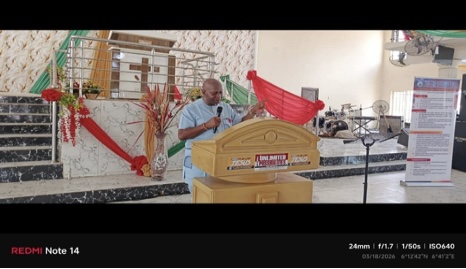
The Executive Director of Projects on the Board of Delta State Oil Producing Areas Development Commission DESOPADEC, Olorogun Dr. Ebenezer Okorodudu has called on Christians across Nigeria to actively engage in governance and national development, stressing that the Church must reclaim its position as the moral conscience of society.
He made this known while delivering a special address at a prayer rally organised by Alpha Ministers Prayer Forum International on March 18, 2026, at Life & Power Christian Assembly, Asaba, Delta State.
Speaking to a congregation of church leaders, pastors, and faithful, Dr. Okorodudu clarified that the conversation on governance is not merely political but deeply rooted in purpose and responsibility.
According to him, governance reflects how society is organised and should be anchored on truth, accountability, fairness, and service to the people.
He lamented the current realities of corruption, insecurity, and the widening gap between leaders and citizens, posing a critical question about the role of the Church in addressing these challenges.
Drawing from biblical teachings, he said that God has always been concerned about the wellbeing of nations, noting that the responsibility for national transformation begins with believers.
He rejected the notion that the Church should remain detached from governance, citing scriptural and historical examples where faith-based values shaped societies and institutions.
He pointed out that the true gospel, when genuinely practiced, has the power to reform nations by instilling integrity, diligence, and accountability.
Dr. Okorodudu, however, acknowledged that the Church has fallen short in influencing governance effectively.
He identified key challenges including political apathy among Christians, distortion of prosperity teachings, politicisation of religion, weak institutional engagement, and loss of moral credibility.
He further warned that excessive partisanship and endorsement of questionable leaders from the pulpit have undermined the Church’s prophetic role in society.
Highlighting the dangers of an apolitical Church, he stated that disengagement from governance leads to marginalisation, loss of influence, and increased vulnerability of Christian institutions.
He stressed that the Church must not remain passive while critical decisions that shape society are made, warning that continued inaction could have long-term consequences for both faith and national stability.
He urged Christians to obtain their Permanent Voters Cards, participate in elections responsibly, and support credible leaders who demonstrate integrity and accountability.
He further called on the Church to speak truth to power without fear, maintain high moral standards in both public and private life, and invest in social interventions that uplift the poor and vulnerable.
According to him, governance is not limited to political offices but also includes everyday acts of service and community impact.
The prayer rally ended with a strong call to action for believers to carry the message beyond the church walls and into every sphere of influence, reaffirming that national transformation is possible when the Church fully embraces its responsibility in governance.