Screenshot
In the political conversation across Delta Central, and indeed Delta State at large, the name Ede Dafinone continues to surface not in loud, dramatic headlines, but in steady, deliberate interventions that are gradually defining his style of leadership.
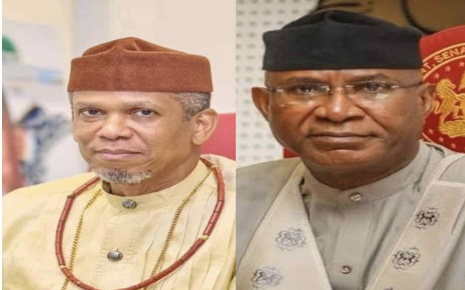
While comparisons with Ovie Omo Agege remain inevitable, what is becoming clearer is that Dafinone is carving a different path, one that leans more toward cultural revival, economic thinking, and grassroots empowerment, even if critics argue that his approach appears less “visible” than that of his predecessor.
One of the most widely acknowledged achievements of Dafinone so far is his sponsorship and revival of the Urhobo Language Competition. This initiative, originally started by the late Senator Pius Ewherido, had faded over time before Dafinone stepped in to revive and expand it. The competition is not just symbolic, it is strategic. It brings together students from primary school to university level and rewards excellence with significant cash prizes. More importantly, it reconnects a generation with its cultural identity at a time when local languages are gradually fading.
Beyond culture, there is growing evidence that Dafinone is also investing deeply in social welfare and empowerment programmes that directly touch lives across the eight local government areas of Delta Central. One of his most impactful interventions has been his large-scale medical outreach programme, which has reached over 2,000 residents with free healthcare services, including diabetes screening, blood pressure checks, medications, and eye care support.
This outreach is not a one off event, it has been conducted in phases across multiple communities, showing a structured and sustained approach to healthcare delivery. The programme also involved partnerships with reputable organizations, further strengthening its credibility and reach.
In addition to medical outreach, Dafinone has demonstrated a clear commitment to economic empowerment. Reports show that over 2,500 constituents have benefited from empowerment programmes, where items such as sewing machines, grinding machines, generators, and food supplies were distributed to support livelihoods and reduce economic hardship.
His agricultural empowerment initiatives have also stood out. Through targeted training programmes, farmers across Delta Central have been equipped with modern techniques aimed at improving productivity and food security. This reflects a long term strategy, moving beyond short term assistance to building sustainable economic capacity among constituents.
Youths and women have also been major beneficiaries of his empowerment philosophy. Through structured programmes, many have received training, starter packs, and access to micro credit schemes to support small businesses.
These efforts align with his extensive belief in self-reliance rather than dependency.
Furthermore, Dafinone has extended his interventions into the healthcare system itself. His donation of modern medical equipment to facilities such as Sapele Central Hospital, including oxygen systems, monitors, and other essential tools, demonstrates a practical approach to strengthening public health infrastructure.
There are also consistent reports of job facilitation and support for constituents in securing opportunities within government agencies, alongside constituency level projects like transformers and local infrastructure support, which, though less publicized, remain crucial to everyday living.
If taken together, these efforts paint a picture of a leader focused on gradual but meaningful impact, one who prioritizes human capital development, healthcare access, and economic empowerment.
However, it is important to examine the contributions of Ovie Omo Agege, not only within Delta Central, but across Delta State as a whole. His political footprint extends beyond a single senatorial district, and many of his achievements reflect a wider, more expansive reach.
One of the most defining and widely recognized achievements associated with Omo Agege is the establishment of the Federal Polytechnic, Orogun. This institution stands as a major achievement in the educational and economic development of Delta Central, particularly within Urhoboland. Beyond providing access to higher education, the polytechnic has created employment opportunities, stimulated local economic activities, and positioned Orogun as an emerging academic hub within the region. For many, this single project alone represents a lasting legacy that will continue to impact generations.
Closely tied to this is his influence in facilitating other educational and institutional developments within Delta Central, including contributions toward the establishment of a Nigerian Law School campus and other federal interventions aimed at strengthening human capital development.
When attention shifts beyond Delta Central to other parts in Delta State, Omo-Agege’s reach becomes even more evident. A notable example is the Federal University of Medical and Health Sciences in Kwale. This project is widely seen as a landmark intervention for Delta North, particularly the Ndokwa region, which had long yearned for a significant federal presence. The institution is expected to boost healthcare education, create jobs, and stimulate economic growth across the state.
In addition to these landmark institutions, Omo Agege’s tenure was marked by widespread infrastructure and empowerment programmes across Delta Central. Numerous communities benefited from electrification projects, solar powered street lighting, classroom construction and renovation, ICT centres, and water supply schemes. These projects were spread across the senatorial district, reinforcing his reputation for inclusive representation.
His empowerment initiatives were equally extensive, with the distribution of motorcycles, tricycles, sewing machines, and financial grants to support small businesses. These interventions directly impacted livelihoods and contributed to reducing unemployment at the grassroots level.
Beyond physical projects, his legislative influence was equally significant. As Deputy Senate President, he played a key role in national legislative processes, including constitutional review efforts. His leadership position allowed him to shape policies and decisions at the highest level of government, giving Delta Central and, by extension, Delta State a stronger voice in national affairs.
When placed side by side, the contrast between both men becomes even clearer.
Dafinone represents a model of leadership that is quieter, but deeply rooted in sustainability, focusing on health, economic empowerment, and policy driven representation. His interventions are often structured, long term, and targeted at improving quality of life.
Omo Agege, on the other hand, represents a more assertive and influence driven model, one that prioritizes visibility, large scale projects, and leveraging political power to attract development.
Neither approach is inherently superior; they simply reflect different philosophies of governance.
For Delta State APC leaders, this creates a delicate balancing act. Dafinone offers continuity, stability, and a less confrontational political atmosphere. His growing record of empowerment and healthcare interventions makes him appealing in a time when economic hardship is a major concern.
Omo-Agege, however, brings unmatched political weight. His ability to attract major institutions like the Federal Polytechnic in Orogun, and extend influence to projects such as the medical university in Kwale, positions him as a formidable force whose reach goes beyond Delta Central.
This is where the question of influence becomes critical. Omo-Agege’s political strength can be seen both as an advantage and a potential challenge within the party. His established structure and loyal following make him a dominant figure, capable of shaping political outcomes significantly.
Yet, that same influence is also one of the APC’s greatest assets in Delta State. Many believe that, without his earlier efforts, the party would not have reached its current level of relevance in the state.
Among the people, opinions remain divided, but thoughtful. Some prefer Omo-Agege’s bold and visible approach, which delivers large projects and a strong federal presence. Others are beginning to appreciate Dafinone’s calm, methodical style, especially in a period where economic expertise and social interventions are increasingly important.
In truth, what Delta Central and Delta State are witnessing is not just a contest between two individuals, but a comparison of two leadership directions. One is built on political dominance and expansive influence; the other is grounded in policy, empowerment, and gradual transformation.
Dafinone’s growing list of empowerment programmes, from healthcare outreach reaching thousands, to agricultural training, to the distribution of tools and financial support, shows a leader investing in people.
Omo-Agege’s legacy of institutional development, particularly the landmark Federal Polytechnic in Orogun and the medical university in Kwale, reflects a leader focused on structural transformation.
As the political future unfolds, the choice between these two men will ultimately depend on what the people and party leaders value most at this time of immediate, visible influence or steady, long term impact.
What is undeniable, however, is that both Ede Dafinone and Ovie Omo-Agege have left and are still leaving significant footprints on the political and developmental landscape of Delta State.