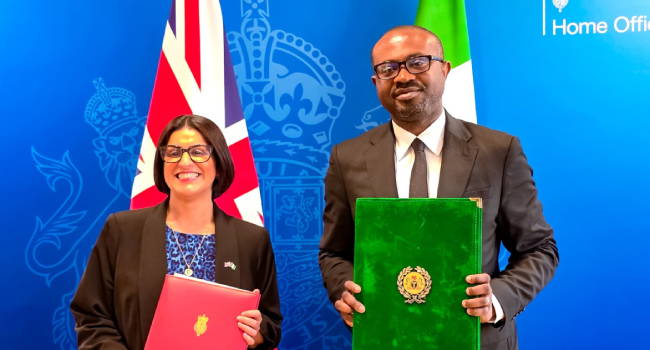
The Minister of Interior, Olubunmi Tunji-Ojo, has rejected claims that Nigeria’s recent migration agreement with the United Kingdom includes provisions for relocating foreign criminals to the country.
The agreement, signed during President Bola Ahmed Tinubu’s state visit to the UK, is part of broader efforts to strengthen cooperation on migration control, border security, and economic ties.
However, it has generated public concern following reports that it could allow the UK to transfer offenders to Nigeria.
Speaking on Channels Television’s Politics Today, Tunji-Ojo said such interpretations are incorrect, explaining that the arrangement only covers Nigerian citizens residing illegally in the UK.
“Article 7 of the agreement says the parties will work together to secure the dignified return of their nationals who do not or who no longer have the right to enter or remain in that country,” he said.
He dismissed suggestions that Nigeria would accept criminals from other countries, insisting the government would not enter into such an arrangement.
“There is no way this government under this president will sign that sort of agreement; it’s never going to be done,” he said, adding that the deal strictly concerns “Nigerians who are overstayers or who are out of status in the United Kingdom.”
The minister assured Nigerians that the agreement poses no danger, noting that it is built on mutual obligations between both countries.
“These agreements have opened a vista of opportunities for collaboration,” he said, stressing that the government remains focused on resolving domestic challenges rather than shifting them elsewhere.
He also described irregular migration as a shared global concern that requires coordinated solutions.
“We believe that irregular migration today is not just a UK problem, it’s not just an American problem — it’s a problem all over the world, including in our own country. Partnership is needed to bring all hands together to solve this problem,” Tunji-Ojo stated.
Addressing concerns about transparency, the minister said the government had not concealed any aspect of the agreement, noting that key provisions had already been made public through official communication by presidential spokesperson Bayo Onanuga.
He further explained that the deal includes safeguards for those affected, particularly with regard to their treatment upon return.
According to the minister Article 8 addresses the rights of returnees, adding that individuals would be treated with dignity and in accordance with their fundamental rights.
Tunji-Ojo described the agreement as balanced and reciprocal, while also clarifying that it is separate from controversial third-country asylum arrangements, with each case to be handled based on specific legal provisions.
VANGUARD.