The Independent National Electoral Commission (INEC) has come under scrutiny, following Wednesday’s decision by the commission not to recognise the David Mark-led National Working Committee (NWC) of the African Democratic Congress (ADC).
INEC had on Wednesday, said it will cease further communication with all the leadership of the ADC and will not monitor the national convention of the party slated for April 14.
Opposition political parties, Civil Society Organisations (CSOs) various groups and individuals have descended heavily on the electoral umpire accusing it of acting as an agent of the ruling party in the bid to frustrate the chances of other parties to participate in the 2027 elections.
They also called for the sack of the INEC chairman, Professor Joash Amupitan.
Shortly after he was appointed INEC chairman, the Muslim Rights Concern (MURIC) and others called for the removal of Professor Joash Amupitan (SAN), with many groups filing petitions to the National Assembly in early 2026. They alleged that Prof. Amupitan is biased against Muslims due to his authorship of a 2020 legal brief commissioned by Christian groups, which described violence in Nigeria as a “coordinated anti-Christian campaign”.
ADC said the call yesterday became imperative as the commission’s chairman and commissioners “have taken side with the ruling All Progressives Congress (APC) and cannot be trusted to conduct the 2027 general elections”.
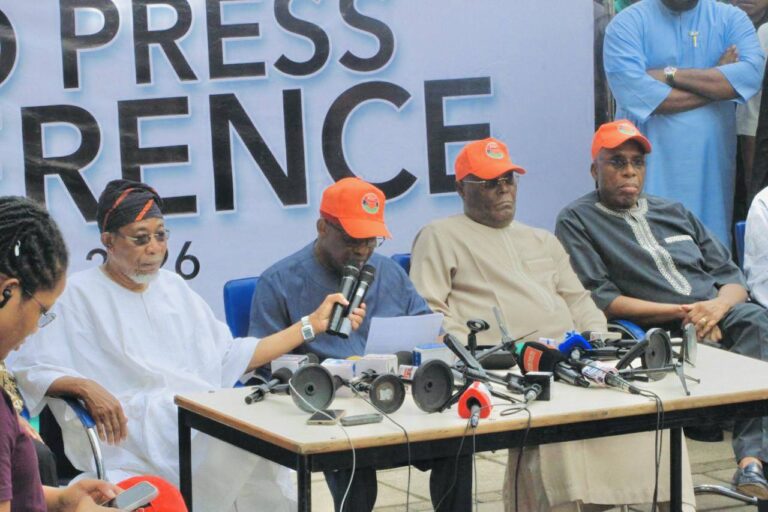
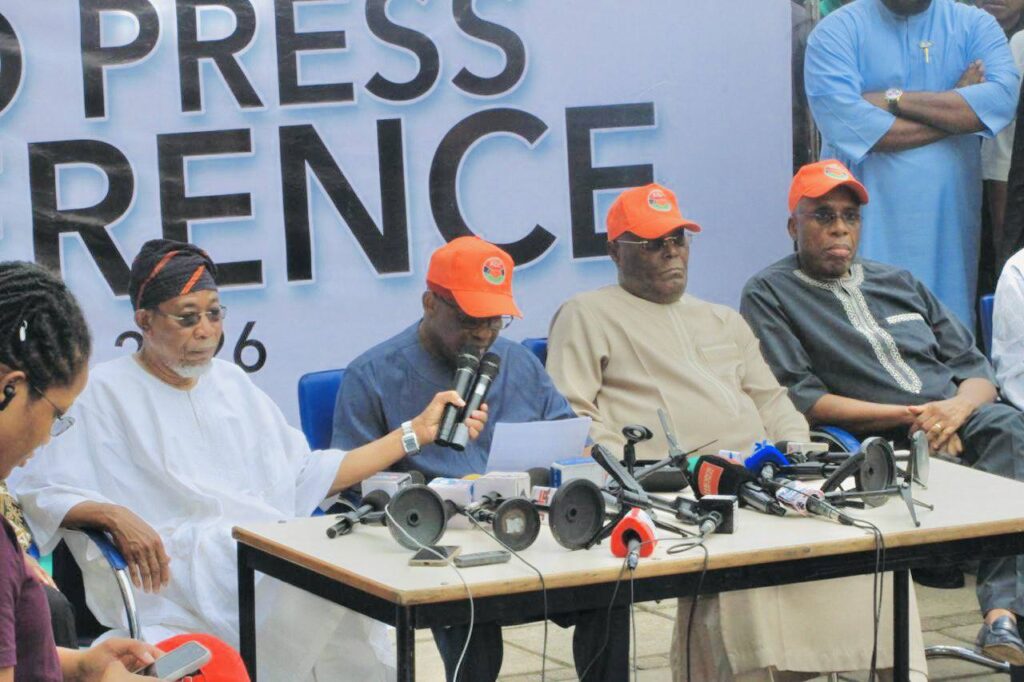
Addressing journalists in Abuja on Thursday, the ADC national chairman, Senator David Mark, said they no longer have confidence in INEC.
Flanked by other leaders of the party, Mark said, “We demand the immediate resignation or sack of the INEC Chairman, Professor Amupitan, and all the national commissioners. We no longer have confidence in them. We are convinced that they are incapable of conducting any credible election.
“Let us also make it clear: we are proceeding with our party programmes, because there is nothing under the law that makes INEC’s attendance, a mandatory requirement. We have duly served INEC notice, and we will proceed accordingly”.
They called on the international community to take note of INEC’s actions of April 1, urging them to recognise “the clear threat to Nigeria’s democracy and stability, and to hold accountable those who are undermining the integrity of the electoral process”.
Mark said since President Tinubu came to power, the opposition has witnessed what he described as a relentless assault on the freedom of the people.
“The agenda is very clear, to create a situation where, in 2027, President Bola Ahmed Tinubu emerges as the only option left for the people, despite the widespread suffering and wanton killings going on across the country.
“The twin challenge of deepening poverty, and worsening security situation in the country did not just happen. They are direct consequences of the failure of this government. They know that Nigerians will not want this to continue. They know Nigerians will vote them out. This is why they would do anything to hang on to power,” he said.
INEC rejects calls for chairman’s removal
The Independent National Electoral Commission (INEC) has dismissed calls for the removal of its Chairman, describing such demands as unconstitutional and a threat to the independence of the electoral body. INEC, in a press release issued Thursday in Abuja and signed by its Chief Press Secretary, Adedayo Oketola, said calls by some political actors for the chairman’s removal over the commission’s decision to comply with a Court of Appeal judgment were “a distraction” and “a direct assault on the independence of the nation’s electoral umpire.”
“The Chairman does not hold office at the pleasure of any political party or interest group. Any call for removal outside the established constitutional process is not only a distraction but a direct assault on the independence of the nation’s electoral umpire,” the commission said.
The commission stressed that its actions were guided by the Constitution, noting that “the appointment, tenure, and removal of the Chairman and National Commissioners are strictly governed by Section 157 of the 1999 Constitution (as amended).”
INEC explained that its decision to comply with the Court of Appeal judgment in the ongoing African Democratic Congress (ADC) leadership dispute was to avoid a repeat of past situations where elected officials were removed due to disobedience of court orders.
“The Commission decided to comply with the Judgment of the Court of Appeal to avert a situation that occurred in Zamfara State and Plateau State where elected officials were removed by the Election Tribunal on account of the disobedience of Court Judgment,” it stated.
It added that it also acted to obey a preservative court order restraining it from taking steps that could render ongoing court processes nugatory, including monitoring meetings of a faction of the party.
“It is either that INEC obeys the order of the Court of Appeal fully or refuses to obey it. Section 287(2) of the Constitution… mandates every person and authority in Nigeria not only to obey the Judgment of the Court of Appeal but also to enforce such Judgment,” the commission said.
On allegations of bias, INEC said it remained neutral and committed to expanding the democratic space, citing the recent registration of new political parties.
INEC’s legal position
Senator Mark explained that what INEC tried to do was the interpretation of what constitutes status quo ante bellum, which the Court of Appeal directed should be maintained, adding that from all authoritative counsel at their disposal, there is no legal interpretation or precedent that could possibly lead to the outcome that INEC seeks to foist on the party.
The ADC chairman accused INEC of pretending to be confused as to what constitutes the status quo ante bellum, saying “If this was so, under the circumstances, what one would have expected was for INEC to approach the Court of Appeal to request a judicial interpretation of what truly represents the status quo under the circumstances. But it did not do this.”
“With its press release yesterday, INEC has invented a status quo that never existed, because there was no time that the African Democratic Congress did not have a duly constituted leadership. What INEC has done is to create a situation that, by its own curious logic, leaves the ADC without leadership.”
The national chairman further stated that INEC should have waited for the Court of Appeal to decide this matter but instead, went ahead “to do the bidding of the ruling party”.
“For the avoidance of doubt, the leadership of ADC inaugurated at the 29th July 2025 NEC meeting remains the lawful leaders of the party. Party members and all Nigerians should therefore remain calm as there is no cause for alarm whatsoever.”
ADC said it has given due notice to INEC about its congresses and national convention and they have acknowledged receipt of that notice.
“Let us sound a note of warning. This INEC under Professor Joash Amupitan will be held directly responsible for whatever actions or reactions that follow this criminal path that it has chosen to take.”
Over 20 patrol vehicles deployed as ADC protests
Security agencies maintained a heavy presence before, during and after a protest by supporters of a faction of the African Democratic Congress (ADC) at the headquarters of the Independent National Electoral Commission (INEC) in Abuja.
Our correspondent observed that more than 20 patrol Hilux vehicles belonging to the police, Nigeria Security and Civil Defence Corps (NSCDC), Nigeria Army, immigration and the Department of State Services (DSS) were stationed along access roads leading to the commission’s headquarters.
The security operatives were positioned at strategic points, blocking major access routes and, effectively restricting movement around the area.
The deployment on Thursday early morning, it was gathered, was linked to intelligence reports of a planned protest amid ongoing political tensions surrounding the ADC leadership crisis.
Later, supporters of a faction of the party, led by Nafiu Bala, staged a protest at the INEC headquarters, demanding his recognition as the party’s National Chairman.
The protesters, who marched to the commission chanting solidarity songs, carried placards with inscriptions such as “Obey the Court,” “INEC must recognise Nafiu Bala as Chairman,” and “No to impunity.”
They hinged their demand on the March 12, 2026 judgment of the Court of Appeal, Abuja Division, which they said must be obeyed in line with the rule of law.
Security operatives, however, denied the protesters access into the commission’s premises.
Addressing journalists, the Special Adviser on Strategy to the ADC chairman, Abimiku Monday, accused INEC of failing to comply with a valid court order.
“The persistent refusal of INEC to comply with a valid court order is a matter of grave concern. This disregard for judicial authority undermines the rule of law and threatens the foundation of our democracy,” he said.
INEC needs to reverse itself – Nwankwo
The Executive Director of Legal and Policy Advocay Centre, Clement Nwankwo, in his reaction, said INEC’s de-recognition of ADC leadership under the guise of obeying a court order of “status quo ante bellum” raises serious red flags.
“At a time when trust in the electoral process is critical, actions that suggest interference in party affairs only deepen fears of bias and democratic backsliding. INEC must remain neutral— or risk undermining itself and the credibility of the 2027 elections.
“INEC needs to reverse itself on this ill-advised decision,” he added.
Speaking on the issue, Abeni Mohammed (SAN) said INEC needed to explain to Nigerians the reason for its action.
According to him, “We must be aware that INEC initially registered the ADC as a political party. Then some people later split from the party to form a faction. However, most of the original members who were registered are still with the party.
“So it is INEC that will tell the world why they are trying to de-register people like David Mark, former Vice President Atiku Abubakar, Aregbesola and others. These were people that were originally recognised”, he noted.
He argued that public perception suggests possible external influence on the electoral body.
“The perception from Nigerians now, not just some of us lawyers, is that INEC is being teleguided to ensure there is no viable, strong opposition party to challenge the APC in next year’s election,” he said.
He added that he finds INEC’s position difficult to justify.
“I don’t see anywhere I can place the action of INEC. So the ADC is challenging INEC’s position on this matter. Well, they know what to do,” he said.
Electoral law bars courts from entertaining internal party affairs – Constitutional lawyer
A Kano-based constitutional lawyer, Barrister Umar Usman Danbaito, said by law, it is illegal for anyone to take internal party disputes to court, stressing that both litigants and their lawyers risk heavy penalties under the Electoral Act.
Danbaito said on the INEC decision to de-recognise the ADC’s leadership, the Section 83(5) of the Electoral Act expressly bars courts from entertaining matters relating to the internal affairs of political parties.
He explained that it is unlawful for any lawyer to institute such an action, and equally unlawful for the court to grant restraining orders against party leaders.
“Section 83(6) provides that if a lawyer contravenes this provision, he shall pay N1 million, while the party that instituted the action shall pay N10 million in damages,” he said.
According to him, the implication is that no individual or group has the legal right to render a political party leaderless through court action.
The lawyer maintained that ADC had a recognised leadership before the matter was taken to court, and the principle of status quo ante requires that such leadership remains intact until the case is resolved.
Danbaito faulted INEC’s decision to de-recognise ADC’s leadership, describing it as “wrongful and not according to law.”
He stressed that INEC, by its very nature, is meant to be an independent umpire and should not be seen as acting under the influence of the ruling party or the executive.
No individual should stretch Nigerians – PDP
The Peoples Democratic Party (PDP) also berated INEC for the decision, warning that no individual or institution should stretch the patience of Nigerians beyond its present bounds.
Comrade Ini Ememobong, National Publicity Secretary of the PDP under the leadership of Kabiru Tanimu Turaki, in a statement accused the electoral umpire of partisanship, adding that democracy is at risk in Nigeria and that INEC and other national institutions must be careful.
PDP said with recent political events “which are clear orchestrations and manipulation against opposition political parties, the political temperature of the country has been unnecessarily raised to near-fever levels”, adding, “society, like the human body, either breaks down or adjusts when subjected to fever.”
The PDP faction alleged that it is now common knowledge that the ruling All Progressives Congress intends to win the next presidential elections at all costs.
“This desire has, for them, become an inevitable certainty that must be achieved, irrespective of the obvious impracticability staring them in the face.
“To achieve this, no boundary is respected, and nothing is too much to sacrifice-including derailing democracy, truncating the republic, and destroying Nigeria,” he said.
Obidient Movement demands Amupitan’s resignation
The Obidient Movement, on its part, called for the resignation of INEC chairman and declared a nationwide protest over the delisting of the David Mark-led executives of the ADC.
Reacting in a statement on Thursday, Yunusa Tanko, national coordinator of the Obidient Movement, said the group would commence a nationwide protest tagged #OccupyINEC.
“There are moments in the life of a nation when silence becomes dangerous and inaction becomes complicity. Nigeria has arrived at such a moment,” the statement reads.
The group alleged that INEC, “which should stand as an impartial guardian of the people’s will, is increasingly perceived as compromised under the present administration,” warning that “when institutions lose credibility, the will of the people is endangered”.
The Movement demanded “the resignation of the INEC Chairman for gross abuse of office, loss of public trust, and failure to uphold the neutrality required of that office,” alongside an end to “political persecution” and actions that undermine opposition parties.
“We will remain peaceful, we will remain lawful, but we will not stand by while our democracy is weakened. Nigeria must not become a one-party state.”
Bolaji Abdullahi: ADC going ahead with congresses
National publicity secretary of the African Democratic Congress (ADC), Bolaji Abdullahi, says the party will go ahead with its congresses and convention despite the position of INEC on its leadership dispute.
Abdullahi spoke on Thursday during an appearance on Arise TV.
He said the party had already notified INEC of its planned congresses and convention.
“So we are saying that we will go ahead with our congresses. We have given INEC 21 days’ notice. They have accepted the notice,” he said.
“So whether they come or not, we’ll continue with our congresses. And we will go on with our convention.”
Meanwhile, a former chairman of the National Human Rights Commission (NHRC), Professor Chidi Odinkalu, on his part said, “It should be evident to a professor of law & #SAN that is not the business of @inecnigeria to interpret the decision of the Court of Appeal. If they had any doubt, an #INEC governed by good faith should have gone back to the Court of Appeal to secure an interpretation of the decision.
“But that is not where we are now. The country stares down a barrel & only those willing to enable that, make peace with it, or dare it will be able to sniff the stakes in #NigeriaDecides2027.”
INEC must exercise restraint – CNPP
The Conference of Nigeria Political Parties (CNPP) expressed concern over INEC’s decision, saying it has further exacerbated the already fragile state of Nigeria’s multiparty democracy.
Deputy National Publicity Secretary of CNPP, Comrade James Ezema, said “INEC, as the constitutional umpire, is expected to act with utmost restraint, impartiality, and fidelity to due process. However, its recent conduct suggests a troubling pattern of actions that risk being interpreted as contributory to the destabilisation of opposition parties and the shrinking of the political space in Nigeria”.
He said rather than serving as a stabilising force, INEC’s actions appear to be compounding the crisis.
The CNPP warns that Nigeria is fast drifting toward a one-party dominant system by default.
The CNPP called on INEC to immediately reassess its recent actions and recommit itself to its constitutional mandate as an impartial arbiter, saying the commission must avoid actions that may be construed as interference in the internal affairs of political parties, especially where matters are sub judice.
It reiterated that the survival of Nigeria’s democracy depends on the protection of political plurality, the strengthening of opposition platforms, and the unwavering neutrality of electoral institutions, saying anything short of this is a betrayal of the democratic ideals for which countless Nigerians have sacrificed.
APC backs INEC, says ADC was hijacked by Mark-led leadership
The All Progressives Congress (APC) however backed the de-recognition of the leadership of the African Democratic Congress (ADC), saying the David Mark-led executive hijacked the party.
Speaking on News Central TV on Thursday, Felix Morka, APC national publicity secretary, described the legal battles involving the Mark-led ADC as self-inflicted.
He accused the faction of hijacking the party, insisting that the ruling party had no hand in the legitimacy crisis facing the ADC.
“INEC decision to de-recognise the David Mark executive was utterly self-inflicted. APC didn’t do that. You orchestrated the hijack of the ADC by that executive. We didn’t. They did,” Morka said.
“They did that, you know, completely ignoring the rule of law, ignoring the constitution of the party they were putting themselves into.”
He said the ADC has a constitution that stipulates its leadership composition and succession plan, “but the Mark-led executive disregarded it”.
“You come in with your parachutes; you take over the party without reference to the constitutional stipulation about succession and how leadership is ordered in that party. This is the consequence,” Morka added.
DAILY TRUST.