Kano State, long regarded as the commercial hub of Northern Nigeria and a trading gateway for some neighbouring countries, has, for over a decade, maintained a reputation as one of the region’s most peaceful states. But that record now faces an unprecedented challenge.
It is not as if Kano has been free of crime. At one point, phone snatchers operated with near impunity, while local gangs occasionally wreaked havoc in some areas. Even between 2011 and 2015, when Boko Haram activities surged across the North, Kano was among the states most affected. Yet, successive governments and security agencies managed to keep these threats under relative control.
In contrast, over the past few years, while banditry devastated Katsina in the North West, farmer-herder clashes occasionally unsettled Jigawa to the North East, multi-faceted violent attacks rocked Kaduna to the South West, and Boko Haram spillovers sporadically threatened Bauchi to the South East, Kano, remained comparatively secure.
However, recent attacks in Kano’s local governments bordering Katsina have exposed a troubling dimension of the banditry that has plagued the North West for years. At least five Kano local governments—Rogo, Tsanyawa, Shanono, Gwarzo, and Ghari (formerly Kunchi)—share boundaries with Katsina.
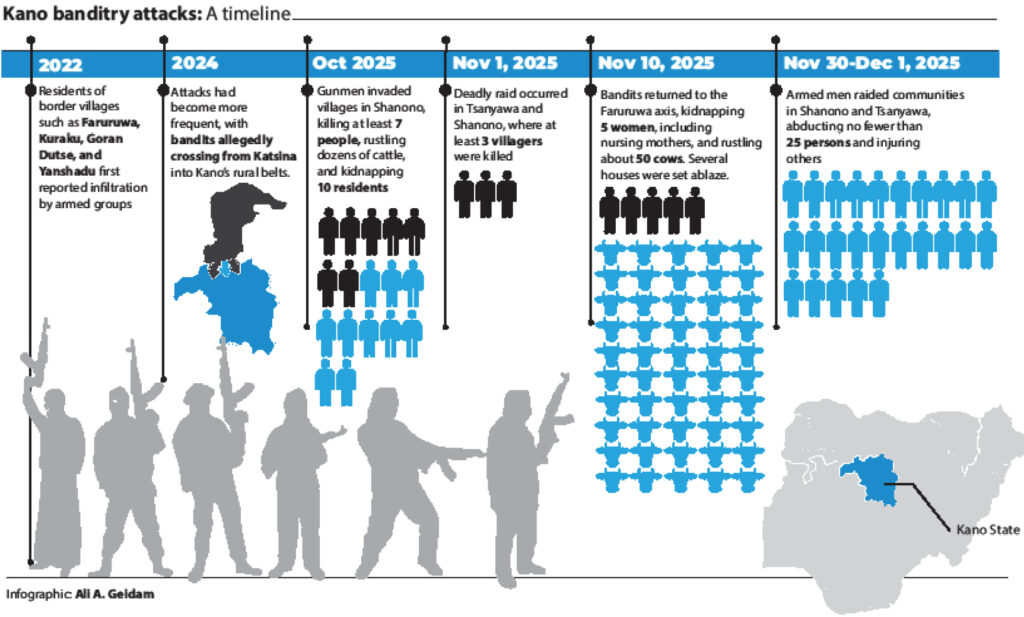
In the past few weeks, bandit attacks in Tsanyawa and Shanono have become a recurrent phenomenon. Yesterday, a fresh raid on border communities in Shanono LGA left at least 25 people abducted and two others injured, after bandits attacked Unguwar Tsamiya in Faruruwa village and the nearby Dabawa community. The night before, gunmen stormed Yan Kamaye in Tsanyawa LGA, reportedly kidnapping three residents.
In a separate incident in November, armed bandits raided Biresawa and Tsundu villages, both in Tsanyawa LGA, abducting about eight people during a late-night incursion. In one of the earlier attacks, five women (including nursing mothers) were abducted in Yan Kwada village, Shanono LGA, following a large-scale assault involving gunfire and house-to-house searches.
While security agencies recorded some successes, including the neutralisation of 19 bandits in Shanono last month and the rescue of several kidnap victims, the novelty, scale, and frequency of attacks have forced many residents of border villages to flee their homes, abandoning farms, livestock, and properties in fear.
Mass burial of victims of an attack at Faruruwa village recently
Mass burial of victims of an attack at Faruruwa village recently
Peace deal in Katsina LGs: The obvious factor
The peace deals that Katsina local governments negotiated with bandits have created unintended consequences for Kano’s border communities, according to local sources and security experts.
Under these arrangements, some communities in Katsina reportedly agreed to serve as transit routes for raids on neighbouring communities in exchange for immunity from bandit attacks. These communities are also expected to shield bandit movements from the authorities. As a result, bandits now operate from Katsina, using these communities as staging points to launch attacks into adjacent Kano areas.
Reports suggest that some border communities in Kano may be negotiating similar pacts with bandits, agreeing not to disclose the movements of criminal gangs. If this pattern continues, the state could find itself facing a deepening security crisis, according to sources.
Kano city lies just 60 to 70 kilometres from Tsanyawa, one of the local government areas now facing repeated bandit attacks.
Security and the changing political landscape
While the peace pact in Katsina has often been generally agreed to be responsible for the incursion into Kano, a more critical dimension of Kano’s current vulnerability lies in the apparent breakdown in the working relationship between the state government and the police.
Under Governor Abdullahi Umar Ganduje (2015–2023), Kano faced similar threats, particularly around 2022, when bandits attempted to penetrate some border communities. Yet the Ganduje administration responded decisively, aided by a strong rapport with security agencies.
During that period, the government handed over the Falgore Forest to the Army for training and operational purposes, securing the axis effectively. The Navy also established a base in Dawakin Tofa, extending its reach beyond coastal areas to address internal security challenges. Moreover, the administration maintained a cooperative relationship with the police, ensuring coordinated responses to emerging threats.
Since the 2023 elections, when the New Nigeria People’s Party (NNPP) under the Kwankwasiyya Movement took power in the state, the political landscape has shifted. The All Progressives Congress (APC), which remains the ruling party at the federal level, became the opposition in Kano.
From its inception, the Governor Kabir Yusuf-led government has had to assert its authority in a standoff with the federal government, with the protracted crisis over the Kano Emirate throne serving as the main flashpoint. The NNPP-led state government reinstated Emir Muhammadu Sanusi II, who had been deposed in 2020 during the Ganduje administration. Meanwhile, Emir Aminu Ado Bayero, Sanusi’s predecessor and a federal government ally, retains significant support from Abuja. The police, perceived to be siding with the federal-backed faction, have become central figures in the dispute.
Since 2023, the relationship between the Kano State government and the police has been tense. There have been repeated accusations that the police are partial in the emirate crisis. Reports indicate that former Police Commissioner Salman Dogo Garba was largely shunned during his tenure, and although current Commissioner Ibrahim Bakori has been formally received, relations remain combative.
This fraught relationship has affected the state’s capacity to respond to banditry, according to sources. Sources indicate that the state government has delegated primary responsibility for tackling border insecurity to the Army’s Brigade Command. Residents told Daily Trust that they had prior intelligence of yesterday’s attack and reported it to the authorities, but no action was taken.
Despite these challenges, Kano residents have historically demonstrated resilience and civic vigilance. The city’s commercial culture is intertwined with community solidarity. Residents have previously provided actionable intelligence that led to the arrest of Boko Haram operatives, disrupting insurgent cells within the city.
The arrest of four suspected bandits at Kofar Ruwa motor park yesterday is widely seen as a testament to this spirit of resistance. It underscores that while governance and security apparatus may be strained, the people themselves remain committed to defending their livelihoods.
Political undertones and implications
Underlying the security concerns are political undertones that could complicate the response. Observers note that the ongoing rivalry between the state government and the APC leadership risks overshadowing a unified approach to border security. If political calculations dominate security strategies, the consequences could be dire.
Kano is more than a state; it is a commercial nerve centre for Northern Nigeria, often likened to Lagos in terms of economic influence. Any prolonged insecurity threatens not only local livelihoods but also the broader regional economy. Northern Nigeria, which relies heavily on Kano’s markets and trade networks, would feel the ripple effects, while the federal government faces pressure to safeguard one of the country’s economic engines amid rising national concerns over economic downturns.
With the 2027 general elections approaching, the stakes are even higher. If partisan interests compromise security operations, the fallout could extend beyond politics to affect commerce, social cohesion, and public confidence in governance.
Kano’s story today is one of both warning and opportunity. Its strategic importance to Northern Nigeria, its entrenched commercial culture, and the resilience of its people provide the tools to push back against insecurity. For centuries, Kano connected West Africa with North Africa and the Middle East, trading indigo dyes, textiles, and grains. Its ancient markets, notably Kofar Wambai, became vibrant centres of exchange, built on skilled artisanship and a deep Islamic heritage. This legacy of commerce laid the foundation for Kano’s modern economic strength.
Consequences for business
A finance expert and academic at the Bayero University, Kano (BUK) has warned that the gradual infiltration of bandits into Kano communities poses a serious threat to the state’s business environment. Dr. Nuruddeen Abba Abdullahi, an associate professor of finance and head of the Department of Finance at BUK, spoke to Daily Trust on the economic implications of rising insecurity.
Dr. Abdullahi said security is a key pillar for a thriving business environment, noting that investors are unlikely to commit resources where risks from criminal activities, including banditry, remain high.
“A key pillar of a business environment has to do with security. The environment has to be secured for investors to be attracted to make investments. Therefore, any issue of banditry or insecurity has lasting repercussions on the business environment,” he said.
The academic explained that repeated attacks and the fear of bandit incursions can reduce business activities and stunt economic growth. “The issue of banditry or insecurity should be seen as one of the challenges to the business environment and to the economy. The key issue here is how do we address it, curtail it and reduce its impact on the business environment? There is no way you have insecurity and you have prosperity,” Dr. Abdullahi said.
He stressed, however, that while insecurity may slow down economic activities, it does not completely annihilate businesses. “It will reduce the volume of activities, but it will not annihilate businesses entirely. Yet, it has a negative effect on growth and development,” he noted.
On how to address the situation, Dr. Abdullahi urged collective responsibility from all stakeholders. “We should be our neighbours’ keepers. All of us — federal, state and local government, the business community, and the general public — have a serious responsibility to ensure a stable and sustainable business environment, particularly in addressing evolving insecurity,” he advised.
The attacks
Kano State yesterday witnessed another wave of attack as bandits kidnapped 11 persons and rustled two cows in Unguwar Tsamiya (Dabawa) village of Shanono LGA, while security operatives arrested four suspected bandits carrying weapons at Kofar Ruwa Motor Park in Kano metropolis.
Residents of Unguwar Tsamiya said the attackers stormed the community around 12am, shooting indiscriminately before taking nine men, two women, and two cows.
A villager who spoke on condition of anonymity said, “They came, shot into the air, beat many people and succeeded in taking 11 people with them. We cannot leave because this is our land. We have nowhere else to go.”
The Chairman of the Faruruwa community security committee, Yahaya Bagobiri, lamented the failure of security operatives to respond on time.
“Since about 7pm on Sunday, we got wind of their movement. They were spotted in Kogari, and we informed security agencies but they said they had not been given any order,” he said.
Bagobiri said among those abducted is a nursing mother, three married men, and seven youths.
The attack occurred barely 24 hours after bandits raided Yan Kamaye in neighbouring Tsanyawa LGA.
Also, four suspected bandits were arrested at the busy Kofar Ruwa Motor Park in Dala LGA around 1:00 pm on Monday.
According to residents, the suspects were attempting to board a vehicle when travellers noticed weapons in their bags.
A witness, Musa Balarabe, said, “people in the park noticed the weapons and alerted security personnel, who immediately arrested them.”
Another resident, Umar Nuhu, described the panic that followed as the suspects were first taken to the Kofar Ruwa Police Division.
“People ran in different directions. Some even called for jungle justice,” he said. The suspects were later moved to the Dala Police Division, Daily Trust gathered.
When contacted, police spokesperson, CSP Abdullahi Haruna Kiyawa, declined to comment, saying the command was still gathering details.
Kofar Ruwa Motor Park serves travellers heading to Katsina, Jigawa, Zamfara, Sokoto, Kebbi, and neighbouring Niger Republic.
Residents speak
Speaking to our reporter, Auwal Aminu, said the ease with which the riders navigate through neighbourhoods and isolated areas has become troubling.
“My concern is especially on how they enter all the nooks and crannies of our city. It is dangerous and government has to do the right thing on time,” he said.
Another resident, Mahmud Mustapha, urged the government to take a cautious approach and discreetly investigate the development.
“We heard rumours that commercial motorcycle operators, whose identity could not be verified, have started trooping into Kano, carrying passengers. That is very dangerous. The issue must be properly addressed to avoid turning into something else,” he said.
He added that residents fear a repeat of pre-2013 attacks linked to unregulated motorcycle movements. “When it was banned in 2013, we felt relief, but they are coming back, which could pose serious danger.”
Similarly, Usman Musa, a resident of Zoo Road, said the suspected return of motorcyclists, coupled with recent attacks in some parts of the state, has heightened public anxiety.
It was security threat that led government to ban their operations, and now they are gradually coming back, which could also be a threat. Authorities should contain it before it gets out of hand,” he warned.
Other residents who spoke to Daily Trust shared similar fears.
Maryam Sani, a trader at Rijiyar Zaki, said news of bandit attacks in neighbouring local governments has left many residents uneasy.
At Gandun Albasa, another resident, Kabiru Abdulmalik, expressed concern that Kano may be experiencing an early phase of bandit infiltration similar to what other states witnessed before the escalation of attacks.
In Dawakin Tofa, Malam Umar Idris, said people are afraid of a possible spillover of insecurity from neighbouring states. “Katsina and Kaduna have suffered enough. Now we are hearing stories of bandits attacking villages close to the Kano border. Government must not allow this to spread,” he noted.
Kano reiterates ban on commercial motorcycles, police begin enforcement
Meanwhile, the Kano State government and the state police command have reaffirmed the ban on commercial motorcycle operations in nine local government areas, warning that violators will face up to six months imprisonment, fines, and forfeiture of seized motorcycles.
The affected LGAs are: Kano Municipal, Gwale, Dala, Fagge, Nasarawa, Tarauni, Kumbotso, Ungogo (Jido area), and Dawakin Kudu (Tambuwal, Gurjiya and Jido wards).
The renewed caution follows rising public concerns about the re-emergence of commercial motorcycle operators—many with unfamiliar faces—reported to be operating suspiciously within Kano metropolis.
Addressing journalists on Monday, the Commissioner for Justice and Attorney-General of the state, Barr. Abdulkarim Maude, stressed that the Motorcycle Riding and Related Activities Law of 2013 remains active and fully enforceable.
He said the law was enacted at the peak of the Boko Haram attacks in 2013 and will continue to be implemented to protect residents and sustain public order.
“The ban has never been lifted. Any person who violates it risks six months’ imprisonment, a N10,000 fine, and complete forfeiture of the motorcycle,” Maude said.
He added that in LGAs where motorcycles are allowed, riders must register with their Ward Head, Local Government Works Department, and the Divisional Police Officer (DPO) to enhance identification and monitor security.
“This registration is for the security of all. We call on riders, passengers, community leaders and transport unions to comply fully,” the commissioner added.
Also in a parallel statement, the Kano State Police Command announced immediate and strict enforcement of both the motorcycle ban and the restriction of commercial tricycle operations between 10pm and 6am across the state.
Police spokesman, CSP Abdullahi Haruna Kiyawa, said enforcement teams have been empowered to arrest, profile, and prosecute violators.
“Anyone found conveying passengers on motorcycles in the restricted areas, or operating tricycles during prohibited hours, will be arrested and prosecuted,” Kiyawa warned.
He said the measures are part of coordinated efforts with other security agencies, including KAROTA, to stabilise the metropolis and prevent criminals from exploiting transportation loopholes.
The Police Commissioner, CP Ibrahim Adamu Bakori, also urged the public to support enforcement efforts by providing credible information via emergency numbers released by the command.
It is a serious threat – Dr Getso
A security and intelligence expert, Dr. Yahuza Getso, has raised concerns over what he describes as the gradual infiltration of bandits into Kano State, warning that recent developments signal an urgent security threat that the state government must address.
Dr. Getso, while speaking to Daily Trust yesterday, said the infiltration did not come as a surprise, stressing that he had repeatedly warned both the state government and security agencies for nearly eight years about the looming danger.
“It is sad, disheartening and a disgrace to have such a challenge coming around Kano, even though it started eight years ago,” he said.
Dr. Getso criticised what he called the government’s “weak response and lack of seriousness,” insisting that action should have been taken long before the situation escalated.
“When you have smoke in your neighbourhood, you should be ready to assist with water or an extinguisher before it becomes fire”, he said.
He also faulted recent political exchanges between Governor Abba Kabir Yusuf and Deputy Senate President Barau Jibrin, saying such confrontations send the wrong signal at a time the state requires unity and clear strategy.
Dr. Getso noted that border local governments in Katsina and Kaduna, as well as parts of Bauchi, have long been linked to bandit routes, making Kano vulnerable if proactive measures are not taken.
He insisted that the state must conduct a proper root-cause analysis, improve intelligence gathering and adopt a community-driven approach that leverages local structures like vigilante groups and community associations.
“There is need to study what happened in neighbouring states and learn from their failures. Intelligence gathering, management and utilisation must be improved. Take advantage of Kano’s population, vigilance groups, and develop a system that prevents escalation,” he advised.
From Salim Umar Ibrahim, Sani Ibrahim Paki, Kano & Dalhatu Liman, Abuja.
DAILY TRUST.