Political analysts, diplomats and Civil Society Organisations (CSOs) have identified bad governance, sit-tight syndrome, among others, as the reasons for the rising spate of coups in the West African sub-region.
This followed the attempted coup in the Republic of Benin on Sunday, which threatened to throw the country into chaos.
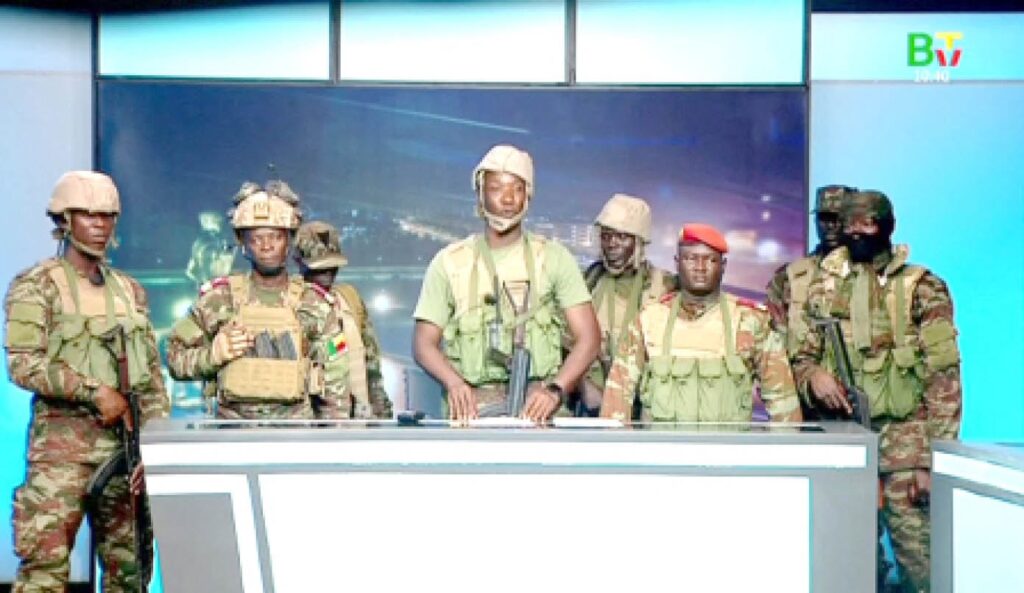
Benin’s government said it had thwarted the attempted coup, after a group of soldiers announced on state television that they had ousted President Patrice Talon. This is coming a few weeks after a coup in Guinea-Bissau.
Military and security sources said around a dozen soldiers were arrested, including those behind the foiled coup.
Talon, a 67-year-old former businessman dubbed the “cotton king of Cotonou”, was due to hand over power in April next year after 10 years in office marked by economic growth but also a surge in jihadist violence.
Early on Sunday, soldiers calling themselves the “Military Committee for Refoundation” (CMR), said on state television that they had met and decided that “Mr Patrice Talon is removed from office as president of the republic.”
But shortly after the announcement, a source close to Talon told AFP that the president was safe and condemned the coup plotters as “a small group of people who only control the television”.
“The regular army is regaining control. The city (Cotonou) and the country are completely secure,” they said. “It’s just a matter of time before everything returns to normal. The clean-up is progressing well.”
On the streets of Cotonou early Sunday, AFP correspondents reported hearing gunfire while soldiers blocked access to the presidential offices and to the state television building, although residents elsewhere went about their business.
Benin’s Interior Minister, Alassane Seidou, described the soldiers’ announcement as “a mutiny” aimed at “destabilising the country and its institutions.
Talon, who came to power in 2016, was due to reach the end of his second term in 2026, the maximum allowed by the constitution.
The main opposition party has been excluded from the race to succeed him, and instead, the ruling party will vie for power against what is referred to as a “moderate” opposition.
Talon has been praised for bringing economic development in Benin, but is regularly accused by his critics of authoritarianism.
Atiku describes attempt ‘reckless’
Former Vice President Atiku Abubakar has condemned the coup in Benin Republic, saying the “trend is dangerous for the health of democracy.”
Atiku, in a statement he personally signed and made available to journalists in Abuja on Sunday, said it is concerning that these coups are happening around election times in the affected countries.
He further stated that the development raises fears that some political operators may be using the military to cancel the democratic processes.
He said, “I condemn, without reservation and in the strongest possible terms, the coup d’état in the Benin Republic. This reckless trend of assault on constitutional order is utterly unacceptable, not only because of its dangerous proximity, but because the era of military interference in governance is long over in Africa and our sub-region.
“Soldiers have no business anywhere outside their barracks, and every decisive measure must be taken to crush any emerging appetite for subverting democracy.”
Why coups are returning – Diplomat
Speaking to Daily Trust on the resurgence of coups in West Africa, Ambassador Suleiman Dahiru, who has served as envoy to several countries in the sub-region, said the trend is rooted in weak democratic institutions and poor governance.
“The coups are taking place in West Africa, and we have to ask ourselves why they are taking place in West Africa and not in other regional bodies. The answer is that in West Africa, there is a problem that democracy has not taken root the way it should. That is number one.
“Number two, there is too much mismanagement or misgovernance. The leaders elected are not running their countries properly. So, there is too much disenchantment among the people.”
Ambassador Dahiru stressed that elections have lost credibility in many states. “Elections have become totally useless. We go into elections, but the leaders that are ruling are not ready to step down,” he said, citing examples such as Cameroon, where “a 92‑year‑old man winning an election” reflects entrenched leadership, and Gambia, where leaders “do not seem to be ready to step down.”
“Faced with this situation, the Beninese Armed Forces and their leadership maintained control of the situation and foiled the attempt,” he added.
NAF assists Benin to foil coup
The Nigerian Air Force is said to have played a key role in foiling the attempt to take over the democratic government of President Patrice Talon of Benin Republic.
The Nigerian Air Force deployed fighter jets to restore democratic order in the neighbouring country, it was gathered.
There are reports that the Nigerian fighter jets launched airstrikes against the Togbin military base in Cotonou, capital of Benin Republic.
Commenting on the role of the Air Force in the coup attempt, Air Commodore Ehimen Ejodame, confirmed that the Nigerian Air Force conducted operations in Benin.
“The Nigerian Air Force has operated in the Republic of Benin in line with ECOWAS protocols and the ECOWAS Standby Force mandate,” AFP quoted him to have said.
President Bola Ahmed Tinubu has commended the Nigerian Air Force for its role in foiling the coup in the Republic of Benin.
Giunea Bissau coup plotters
Giunea Bissau coup plotters
AU, ECOWAS condemn attempt
The Economic Community of West African States (ECOWAS), of which Benin is a member, called the soldiers’ actions “unconstitutional” and a “subversion of the will of the Beninese people.”
The African Union said it “unequivocally condemns” the attempted coup and urged soldiers to return to their barracks. Meanwhile, ECOWAS has deployed a standby force in the Republic of Benin.
The US embassy in Cotonou, in a social media post, advised its nationals to avoid the area around the presidential compound and “keep a low profile.”
France’s embassy recommended its citizens in Benin remain indoors.
Spain’s honorary consulate urged citizens to avoid any non-essential travel, while other countries, including Italy, posted numbers for emergency hotlines.
Benin’s political history has been marked by several coups and attempted coups since its independence from France in 1960.
“Now, at least four ECOWAS countries are under military regimes. If the Benin coup had succeeded, we would be talking about five. Because of these persistent coups, three countries have already left ECOWAS, and there is no guarantee that more will not leave if the coups continue. This is a very serious challenge for ECOWAS,” he said.
According to him, Nigeria bears a special responsibility in ensuring the survival of the bloc. “If ECOWAS doesn’t succeed, each of the countries in the community will find it extremely difficult to survive alone.
“The big challenge is on Nigeria to ensure that ECOWAS survives. Whatever it takes, Nigeria has to bear this burden in spite of its own difficult economic and political situation,” Ibrahim said.
He added, “I understand that Nigeria played a very big role in quelling the coup attempt in Benin, which took place on Sunday. I think this is a sign of what will continue to happen if ECOWAS is to survive.”
On the question of suspending members where the military has taken over, Ibrahim acknowledged the debate within the bloc. “There are some who insist that ECOWAS must respect its protocol on democracy and good governance, even if it means half of the countries leaving ECOWAS. Those in this school of thought believe that the countries that are leaving ECOWAS will eventually come back,” he said.
He continued: “On the other hand, there is another school of thought which believes that the protocol on democracy and good governance is really very strict, very stringent, and ECOWAS is not able to pass the test. Other sub‑regions in Africa have a different approach to unconstitutional change of government.
Their approach is dialogue, not zero tolerance, and not asking the country to leave immediately. So, we have to look at these two schools of thought and see which one is realistic.”
Ibrahim made clear his own position: “I belong to the school of thought that believes democracy and good governance should continue to be the guideline for ECOWAS. It doesn’t matter if half of the ECOWAS countries are leaving. ECOWAS cannot develop through unconstitutional change of government.
“Integration cannot succeed if it’s not based on the yardstick of democracy and good governance. Even the countries that are helping ECOWAS in terms of development assistance will not continue providing the necessary funds if there is no democracy and no effort to have good governance in ECOWAS.”
He also reflected on why coups seem more frequent in West Africa compared to other regions. “One, the institutions of democracy are very weak. Sadly, and ironically, sometimes even good governance is not a guarantee against coups. That is the case of Niger Republic.
The economy of Niger and its political development were at a very high rate, better than any time in its history, yet there was a coup.
“Another reason is poverty and challenges in the sub‑region. In the whole Sahel countries, there are serious issues of insecurity, and people are suffering. There is no end in sight. So, most of these countries, any time a government comes or a group of military officers who promise change or a better life, human nature dictates that people will succumb and welcome that promise even if it’s not realistic.
“So, there are political reasons, economic reasons, and insecurity reasons, and they are all taking place at the same time in almost every country. One cannot say that there is a single African country that has passed the stage of being hit by an unconstitutional change of government,” he said.
African leaders need to make democracy meaningful – ADC
The African Democratic Congress (ADC) has frowned at the emergence of coups in some African countries, saying “ADC will not support any form of unconstitutional takeover of power anywhere.”
Speaking on the situation in the Benin Republic, on Sunday, National Publicity Secretary of the party, Bolaji Abdullahi, told Daily Trust that African leaders must begin to make democracy meaningful to citizens in such a way that “citizens have to believe that democracy has a meaning and it serves a purpose in their lives.”
The ADC spokesman, who said democracy is not a theoretical concept, but a system of government that should improve the life and livelihood of the people, explained that elected governments and democracy must also be built on legitimacy derived from free, fair, and transparent elections.
He said, “When a party comes to power, outside a process that people don’t consider to be free, fair, and transparent, then it undermines the legitimacy of such a government.
“Also, the government has to start making democracy have meaning for the people; democracy by itself is no longer an end. People are now asking themselves, what is democracy doing for me? Especially young people who constitute the majority of the population. Most of them never lived under military rule.
“And because they’ve never lived under military rule, they think that maybe it is probably an option. So, we have to make democracy meaningful to them. That’s the only way they can commit to democracy.
“But for us, we don’t support any form of unconstitutional takeover of power anywhere in Africa or anywhere else”.
Erosion of electoral credibility causing coups – BUK don
A lecturer in the Department of Public Administration at Bayero University, Kano (BUK), Dr Sa’idu Ahmad Dukawa, attributed the resurgence of military coups in West Africa to governance failures, erosion of electoral credibility, and a growing contagion effect sweeping through the region.
Speaking in an interview, Dr Dukawa said three major factors are fuelling the wave of unconstitutional changes of government across the sub-region.
“First and foremost is the failure of many civilian governments to deliver on good governance. The second is when people yearn for change, but free, fair and credible elections become far-fetched. When changing government through the ballot box becomes impossible, the alternative that remains is military intervention,” he said.
He added that the third factor is the “contagion effect,” noting that each successful coup emboldens actors in neighbouring countries to attempt the same.
“When one country succeeds, another wants to attempt it. That is how it spreads across the polity of the region,” the scholar explained.
Dr Dukawa said the only sustainable solution is for governments to “sit up” and deliver genuine good governance that addresses human development and restores public trust.
According to him, good governance is not complicated.
“It is simply about reducing corruption, investing resources in human development, improving education, healthcare, and job opportunities, and making the environment conducive for self-employment by providing the necessary infrastructure. When people are engaged and see progress, there will be no appetite for unconstitutional changes,” he said.
Also speaking, the Convener, Situation Room, Yunusa Ya’u, described happenings in the West African region as “a complete disappointment”.
He said coups were becoming more popular in the sub-region because “We elected leaders who are performing badly, who are unaccountable, very dictatorial.
“You have leaders who manipulate elections and cling to power by all means. You have leaders who change the constitution at will in order to prolong their own stay.
“So, what this means is that if you refuse to allow peaceful transfer of power, then people would simply look for other options. And so, what we’ve been seeing is that when you come out as a military man to oppose unpopular regimes, nobody is likely to oppose you within the public because everybody is frustrated.
“For me, it’s a dangerous trend that is happening. It will set back the region democratically. And each time that the military comes, all the lessons that we have learned would have been erased.”
Coups in West Africa
West Africa has experienced several coups and attempted coups in recent years, including Benin’s northern neighbours Niger and Burkina Faso, as well as Mali, Guinea and, most recently, Guinea-Bissau.
Meanwhile, Guinea‑Bissau’s collapse added to a list including Mali, Burkina Faso, Niger, and Guinea, where coups have toppled elected governments in rapid succession. Each case reflects a convergence of recurring problems: weak institutions, governance fatigue, economic distress, and security breakdowns.
West Africa was jolted in November when the military in Guinea‑Bissau announced it had seized total control of the country.
Soldiers arrested President Umaro Sissoco Embaló, shut down borders, suspended institutions, and halted the electoral process.
The takeover followed a bitterly contested presidential election in which both Embaló and his main rival claimed victory before official results were declared. Gunfire rang out near the presidential palace and the national election headquarters
Days later, the junta moved to consolidate power, announcing a 28‑member transitional government, including five army officers and four women. Embaló, meanwhile, arrived in Brazzaville, Republic of Congo, after first leaving for neighbouring Senegal.
In Mali, President Ibrahim Boubacar Keïta was removed by officers led by Assimi Goïta after widespread public anger over security failures. Later, the transitional leadership under Bah N’Daw and Moctar Ouane was again deposed by Goïta.
In Burkina Faso, deteriorating security prompted officers to oust Roch Marc Christian Kaboré, replacing him first with Paul‑Henri Sandaogo Damiba, then later with Ibrahim Traoré after the initial junta failed to contain the insurgency.
Similarly, in Niger, President Mohamed Bazoum was ousted by military elements led by Abdourahamane Tchiani amid worsening insecurity and governance breakdown.
In Guinea, a controversial constitutional amendment enabling a third term for Alpha Condé led to public outrage before his overthrow by Mamady Doumbouya. Guinea‑Bissau’s coup differs in that it was not triggered by a collapsed security sector but by a contested election.
DAILY TRUST.