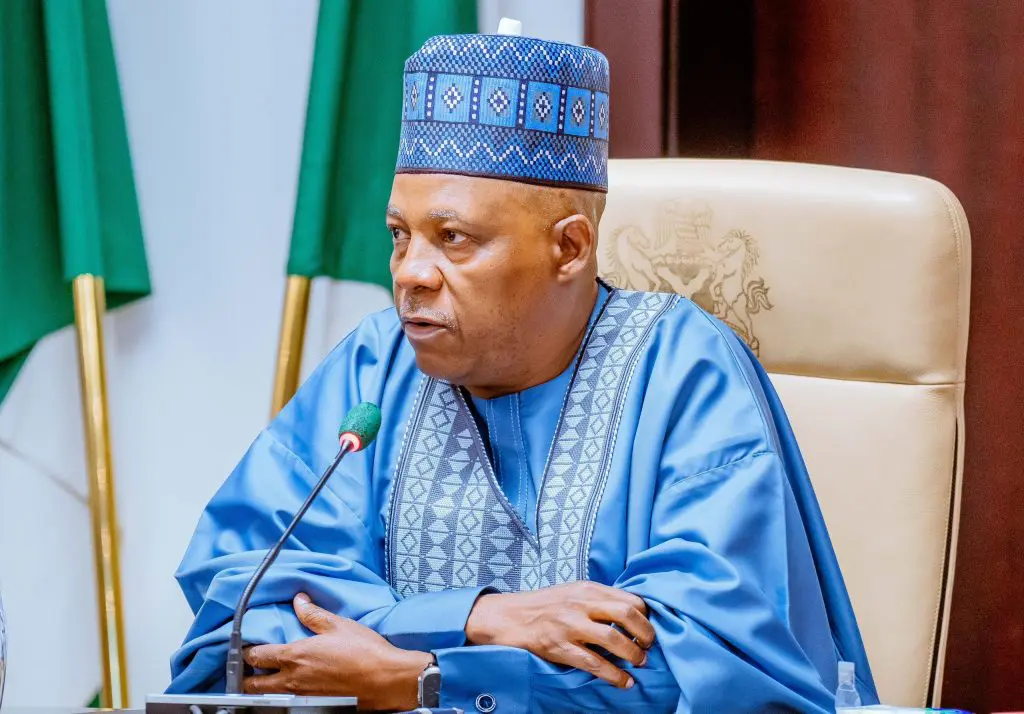
Vice President Kashim Shettima has described the rising number of out-of-school children in the country as a national emergency requiring unified and sustained action from all tiers of government and critical stakeholders.
Speaking in Abuja at the 2025 Nigeria Education Forum (NEF) organised by the Nigeria Governors Forum (NGF), in collaboration with the Federal Ministry of Education and other partners, Shettima said the crisis in the education sector could not be solved by government efforts alone.
“The millions of out-of-school children represent a national emergency requiring joint action by the federal government, the states, local governments and community stakeholders,” he said.
The vice president, who was represented by his Special Adviser on General Duties, Aliyu Modibbo Umar, stressed that teachers must receive proper training, welfare and professional recognition for Nigeria to achieve meaningful learning and outcomes.
He said technical and vocational education must be expanded to equip young people with market-ready skills, adding that achieving the reforms required predictable, diversified and sustained financing.
Shettima noted that though the federal government had significantly increased investments in education, raising allocations from N1.54tn in 2023 to N3.52tn in 2025, funding gaps remained too large for the government to shoulder alone.
He cited notable increases in TETFUND, UBEC and NELFUND allocations, including N86.3bn already disbursed to over 450,000 tertiary students under the student loan scheme.
But he insisted that building a resilient education system required co-investment from the private sector, industry leaders, alumni associations, philanthropists and communities.
Poor implementation undermines education budgets – Governors
In his welcome address, Kwara State Governor and Chairman of the Nigeria Governors’ Forum (NGF), AbdulRahman AbdulRazaq, warned that Nigeria must urgently overhaul its education financing and delivery systems to secure its future.
AbdulRazaq said the country’s young population presented a huge opportunity that could be lost without strategic investment.
“With 43 per cent of our population under 14 and another 33 per cent between 15 and 24, Nigeria cannot afford underinvestment in education. National education spending remains at 3 per cent of GDP, far below the global benchmark of 4–6 per cent,” he said.
He noted that while states had significantly increased education budgets, from N1tn in 2022 to a projected N3.6tn in 2025, poor implementation continued to undermine progress.
“In 2024, only 67 per cent of budgeted funds were utilised, leaving an N800bn execution gap,” he disclosed.
AbdulRazaq listed Lagos, Kano, Enugu, Kaduna, Katsina and Abia as states projected to allocate a combined N1.8tn to education in 2026, with several meeting or surpassing the 15 per cent global benchmark.
He, however, warned that debt servicing in some states still exceeded total education spending
DAILY TRUST.