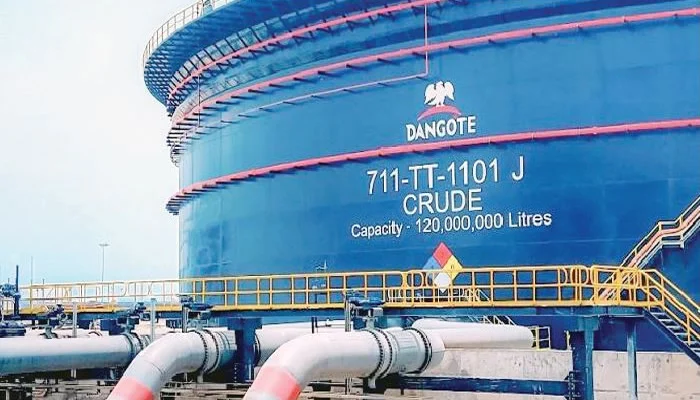
Nigeria’s downstream petroleum sector has descended into what industry players describe as a full-blown price war following the decision by the Dangote Petroleum Refinery to slash the gantry price of Premium Motor Spirit (petrol).
The move has triggered massive losses for fuel importers, depot owners, and retail marketers, even as the refinery itself admits it is bleeding financially.
Findings by The PUNCH show that petrol importers are on the verge of losing as much as N102.48bn monthly after the Dangote refinery reduced its gantry price from N828 per litre to N699.
At the same time, the refinery is also projected to lose about N91bn in a month as a direct consequence of the price cut, underscoring the intensity of the competition currently reshaping Nigeria’s downstream oil market.
While many Nigerians have welcomed the price reduction as a major relief, especially during the Yuletide season, fuel marketers running filling stations across the country say they are counting heavy losses, as they would be forced to sell existing stocks purchased at higher prices below cost.
The development has exposed deep fault lines in the deregulated petroleum market, with winners and losers emerging almost simultaneously.
The PUNCH reports that the Dangote refinery announced the N129 per litre reduction in petrol gantry price on Friday, cutting the ex-depot rate from N828 to N699 per litre.
This came just days after the refinery assured Nigerians of sufficient fuel supply to avoid queues at filling stations during the festive period. The company also announced a 10-day credit facility for marketers, stating that the new price regime took effect from December 12.
At a press briefing on Sunday, President of the Dangote Group, Aliko Dangote, vowed to enforce the new pricing regime, insisting that filling stations must sell petrol at N739 per litre nationwide from today (Tuesday). He disclosed that MRS filling stations would begin implementation immediately, with other partner stations expected to follow.
Depots cut prices
To remain competitive, importers and private depot owners have been compelled to slash prices to align with Dangote refinery’s rates, triggering sharp losses across the supply chain.
Market checks conducted by The PUNCH using data from Petroleumprice.ng revealed that private petroleum depots in Lagos had slashed PMS prices by about 14 per cent within days of Dangote’s announcement.
Several major depots in Lagos were found to be selling PMS at N710 per litre, down from an average of N828 per litre barely a week earlier. Dangote-linked marketers were selling PMS around N703 per litre, forcing nearby depots to recalibrate their prices to avoid weak sales and stock overhang.
At MENJ private depots, the price of PMS dropped from N828 per litre on December 8 to N710 per litre on December 15, representing a reduction of N118. Integrated and Bovas depots also reduced PMS prices from N826 per litre to N710, a N116 drop. A.A. Rano Depot recorded the steepest cut, with prices falling from N829 to N710 per litre, amounting to a N119 reduction.
At Dangote Depot, PMS was selling at N702.5 per litre, while Automotive Gas Oil sold at N916 and Liquefied Petroleum Gas at N815 per litre. Pinnacle Depot offered PMS at N710 per litre and AGO at N941.
Menu and Bovas depots aligned their PMS prices at N710 per litre, while Matrix Depot sold PMS at N800 per litre. Rainoil had PMS priced at N803 per litre, with other depots focusing largely on AGO and LPG supplies.
In the AGO segment, NIPCO sold at N930 per litre, Duport at N944, Ibachem at N930, while African Terminal and Gulf Treasure depots sold at N944 per litre. Bono Depot recorded the highest AGO price at N945 per litre.
Overall, the adjustments reflected an average 14 per cent reduction across Lagos depots, driven largely by competitive pressure from Dangote refinery’s aggressive pricing.
The losses
According to data from the Nigerian Midstream and Downstream Petroleum Regulatory Authority, Nigeria consumes an average of 50 million litres of petrol daily, translating to about 1.5 billion litres monthly.
The data showed that the Dangote refinery supplies about 23.52 million litres per day, equivalent to 705.6 million litres monthly, while fuel importers supply the remaining 26.48 million litres daily, amounting to 794.4 million litres monthly.
A report by the Major Energies Marketers Association of Nigeria indicated that the landing cost of petrol stood at N828 per litre as of December 12, meaning that importers’ ex-depot prices were about N129 higher than Dangote’s price. Market pressure, analysts say, could force depot owners to sell petrol at the same rate as Dangote, resulting in losses of about N129 on each litre sold.
Based on consumption figures, this would translate to losses of about N3.41bn daily and N102.48bn monthly for importers. Similarly, if the 705.6 million litres supplied monthly by Dangote refinery is multiplied by the N129 reduction, it means the refinery itself would lose up to N91.02bn in one month.
Speaking with The PUNCH, the spokesman of the Independent Petroleum Marketers Association of Nigeria, Chinedu Ukadike, painted a grim picture for fuel importers, particularly those whose cargoes were still on the waterways.
“For importers, I will wish them good luck because most of them who have imported petrol and whose cargoes are still on the waterways have not been discharged. I don’t know how they are going to manage it this time around. But I wish them good luck, and I will also recommend high blood pressure medicines for them,” Ukadike said.
Ukadike disclosed that filling stations could lose over N80bn as they would be compelled to sell existing stocks below cost once cheaper products flood the market. While commending Dangote for slashing petrol prices and congratulating Nigerians for enjoying the benefits of local refining and deregulation, he said marketers had begun counting their losses.
“It is a welcome development. We marketers have since been anticipating that since crude prices and the exchange rate are stabilising, we should also gain meaningfully from the Dangote refinery as the largest producer of petroleum products in Nigeria, and it has come to pass,” he said.
On the downside, Ukadike said marketers who bought petrol at about N828 per litre would “continue to lick our wounds” as soon as the new product starts circulating in the market.
“Marketers will lose over N80bn on this reduction. We will lose more than N80bn. And now that this reduction is there, you will see that the pump price will start dropping gradually from N900 towards N750 per litre,” he said, adding that consumers would naturally flock to stations selling cheaper fuel.
Ukadike urged Dangote refinery to consider compensating marketers who bought petrol at the old rate, suggesting discounts on future purchases as a way of cushioning losses.
Dangote, however, insisted that the refinery was also losing heavily each time it reduced prices. During the Sunday briefing, he disclosed that the refinery lost about N60bn in November alone after reducing gantry prices by N49.
“For the marketers, I pray, and I wish they would even lose more because I’m not printing money. I’m also losing money; it’s not that I’m making money,” Dangote said.
He added, “They want imports to continue. I don’t think it is right. They want to continue to dump imported petrol, so I must have a strategy of how to survive because N20bn of investment is too big to fail. We are in a situation where we will continue to play cat and mouse, and at the end of the day, somebody will give up. It is either we give up, or they will give up, and I don’t think I will give up.”
The President of the Petroleum Products Retail Outlet Owners Association of Nigeria, Billy Gillis-Harry, also expressed concern over the impact of the sudden price cut on retailers holding existing stocks. He described the N129 reduction as a “big shock” to filling stations with substantial PMS volumes in their tanks.
“Dangote has announced it, and we commend him for making Nigerians happy. The only concern we have is that we have members who have stocks of their last purchases that are not within that bracket. What are they going to do? How are they going to cope?” Gillis-Harry asked.
He said abrupt price changes without adequate information flow create serious difficulties across the supply chain, noting that refining, transportation, and retailing are interconnected activities that require better coordination.
“This is a big shock now in the system, but we congratulate him for being focused on making Nigerians happier,” he added.
Energy security threat
The Chief Executive Officer of Petroleumprice.ng, Jeremiah Olatide, warned that rising tension between regulators and industry players could undermine energy security and destabilise the downstream sector.
He described the Dangote refinery as a “big blessing” to Nigeria’s economy, noting that its operations helped reduce PMS prices to N739 per litre during the festive period.
“For me, I don’t think this is the right time for a blame game or rancour between NMDPRA and Dangote Refinery, because the regulators and those being regulated need a cordial and working relationship to achieve energy security,” Olatide said.
He acknowledged the regulator’s role in ensuring a balanced energy mix, stressing that Nigeria should not rely on a single refinery despite Dangote’s scale. He warned that continued rancour would not help the downstream sector or the wider economy.
Reps intervene
The crisis took a political turn on Sunday when Dangote accused the Chief Executive of the Nigerian Midstream and Downstream Petroleum Regulatory Authority, Farouk Ahmed, of sabotaging the economy by granting import licences “despite enough local production.”
He also challenged Ahmed to explain how he allegedly paid $5m for his four children’s secondary school education in Switzerland.
Following the allegations, the House of Representatives Committee on Petroleum Resources (Downstream) intervened, summoning both Dangote and the NMDPRA leadership. Committee Chairman, Ikenga Ugochinyere, said the move was necessary to address what he described as “growing tension” threatening the stability recently achieved in the downstream sector.
“We can only find sustainable solutions when we identify the critical issues leading to this tension,” Ugochinyere said. “By the time Alhaji Aliko Dangote, the NMDPRA, and other stakeholders meet with the committee, we will get the real gist of what is happening.”
Despite the escalating conflict, Dangote reiterated his resolve to crash petrol prices further, insisting that transportation costs from the refinery do not exceed N15 per litre. He questioned why pump prices should rise as high as N900 per litre and accused the regulator of issuing 47 import licences to bring in more than seven billion litres of petrol in the first quarter of 2026.
For now, as MRS filling stations begin selling petrol at N739 per litre and private depots continue to slash prices, Nigerians may enjoy temporary relief at the pumps. However, beneath the celebrations lies a brutal price war that has left importers, depot owners, and marketers bleeding financially, with no clear resolution in sight.
PUNCH.