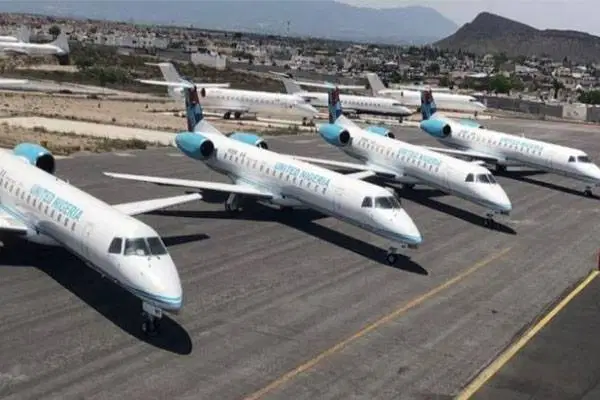
There are fresh worries among domestic operators over a sustained decline in passenger traffic on local routes.
The development, which has also become troubling to industry stakeholders, has raised questions about what could be done to stimulate local travel in Nigeria.
The discussion comes amid domestic throughput figures released by the Federal Airports Authority of Nigeria, FAAN, and made available to Vanguard.
Data showed that passenger traffic at the country’s local airports declined by 11 per cent over three years, from 14,057,060 passengers in 2022 to 13,409,701 in 2023 and further to 12,543,153 in 2024.
Vanguard gathered that increasing air fares caused by inflationary pressures, poor living standards and lack of disposable income due to the harsh economy were some factors leading to the drop.
A breakdown of the figures showed that in 2022, 4,345,840 travelled through Murtala Muhammed Airport in Lagos, while 5,108,388 travelled through Nnamdi Azikiwe Airport in Abuja.
In 2023, the domestic terminal at Nnamdi Azikiwe Airport recorded more passenger movement from January to December with 4,851,761 than Lagos with 4,348,927.
In 2024, Lagos airport recorded 4,134,211 passengers, Abuja logged 4,372,091, while Port Harcourt and Kano airports recorded 1,026,060 and 493,510 passengers, respectively.
Trouble
These bleak figures come less than five months after the Managing Director of Ibom Air, Mr George Uriesi, disclosed that passenger traffic also declined by 27 per cent in the first few months of 2025, compared with the same period in 2024.
Speaking in Lagos during the Airport Business Summit and Expo, ABSE, organised by the Nigerian Aviation, NIGAV, at the Murtala Muhammed Airport, MMA, he said: “We are down by 27 per cent from 2024. We are in trouble, we have to find a way to get people flying again.
‘’Nobody will earn kobo if airlines do not fly. In the aviation ecosystem, the driver is the airline. Everybody talks about money because airlines are flying.”
Stimulate market
Also, in a recent chat with Vanguard, the Managing Director of Aero Contractors, Captain Ado Sanusi, said airlines, the aviation industry and federal government must collaborate to ensure that more people travel by air.
Sanusi said: “For leisure travel and tourism that are declining, it is because the price of tickets has made it a bit difficult for passengers to travel. When they see that it is not a must travel, they decide not to travel.
“But we need to see how we can organically stimulate the market within the space of aviation and the airlines’ ability. How can we do that? Reducing fares through promos. Most importantly, we need to look at the taxes. Aviation fuel is fixed, but the multiple taxes contribute a lot to ticket prices.”
Wake-up call
Meanwhile, Managing Director of Travelden, a subsidiary of Finchglow Holdings Ltd, Mr Gbenga Onitilo, warned that the dip in traffic, especially 2024, was not an economic story, but a commercial wake-up call for airlines.
Onitilo, in a statement, titled, ‘’Why Domestic Airlines’’, Fortunes Dipped in 2024: Beyond the Economy, a Commercial Strategy Deficit,’ said the market did not just shrink, but exposed structural fragilities papered over by demand spikes and fare hikes.
He stated: “Until Nigerian domestic airlines adopt harmonised fleet strategies, benchmark staffing models, data-led route planning, and professional revenue management, powered by real subject matter expertise, the sector will continue to underperform its potential. The runway is there. The demand exists. What is missing is execution at global standards, run locally with discipline.”
Turnaround
Industry observers, however, said while domestic airlines might have recorded lower passenger numbers in the first and second quarters of 2025, figures from the third and fourth quarters suggest the sub-sector could be poised for a turnaround.
An operator at one of the country’s major airlines who spoke at a public forum, said: “The declining annual passenger numbers in ‘23 and ‘24 reversed in ‘25, significantly. I think a lot of that had to do with the stability in the exchange rate and the bottoming out of the rising inflation curve.”
VANGUARD.