The National Assembly has come under pressure from civil society organisations and other electoral stakeholders over delay in passing the Electoral Amendment Bill 2025, as the country inches closer to the 2027 general elections.
The concerns come amid growing anxiety that the prolonged legislative process could undermine preparations by the Independent National Electoral Commission (INEC).
Representatives considered and passed the Electoral Amendment Bill in December 2025, before proceeding on the Christmas and New Year holidays, the Senate failed to complete work on the legislation before lawmakers went on recess.
Senate defers action, cites need for scrutiny
Senate President Godswill Akpabio announced the decision during Wednesday’s plenary after the Senate Leader, Opeyemi Bamidele (APC, Ekiti Central), requested that senators be allowed to take home copies of the report prepared by the Senate Committee on Electoral Matters for “a detailed, clause-by-clause study”.
Akpabio agreed with the request, stressing that the upper chamber must avoid rushing legislation with far-reaching implications for Nigeria’s democratic process.
“This is a very important bill, considering the fact that we’re about to go into elections. If we rush it, we’ll meet at the tribunal. But if we do it right, then all Nigerians will smile that we have free and fair elections,” the Senate president said.
Daily Trust gathered that debate on the general principles of the amendment bill had been listed on the Order Paper for consideration on Wednesday before it was eventually stepped down.
The situation was compounded by the absence of the Chairman of the Senate Committee on Electoral Matters, Simon Lalong (APC, Plateau South), who was expected to present the committee’s report.
His absence triggered brief consultations among Senate leaders, after which it was agreed that both the presentation and debate on the bill be deferred to the next legislative day.
Bamidele subsequently moved a motion to step down the bill until Thursday (today), explaining that a short closed-door executive session would precede open deliberation on the proposals. The motion was put to a voice vote and adopted.
CSOs protest at N/Assembly
Meanwhile, the delay has continued to generate reactions from election observers and civil society groups, many of whom argue that passing the amendments well ahead of the 2027 elections is crucial to improving the conduct and outcome of the polls.
Yesterday, protesters drawn from various civil society organisations stormed the National Assembly complex in Abuja, calling on the Senate to pass the Electoral Act Amendment Bill 2025 without further delay.
The protesters carried placards bearing inscriptions such as “No more delay, pass the bill now”, “Prioritise the Electoral Act 2025”, “Electoral reform now”, “Make our elections better”, “Don’t alter the bill, pass it”, and “Take legislative action on the Electoral Act Amendment Bill now”.
They raised concerns over what they described as unnecessary delays by the National Assembly, particularly the Senate, in passing legislation they said was central to delivering free, fair and credible elections in 2027.
Executive Director of Kimpact Initiative (KDI), Bukola Idowu, one of the organisers of the protest, warned that continued delay would have serious implications for INEC’s preparations for the 2027 general elections
According to him, the National Assembly, especially the Senate, had delayed the amendment process for nearly three years, despite the fast-approaching election timeline.
He noted that with just about a year to the 2027 elections, the delay has created uncertainty for INEC, which by law is required to issue the election timetable at least one year in advance.
“As it is now, INEC cannot release any timetable because it does not know whether critical provisions of the Electoral Act will be changed or not,” Idowu said.
“Everybody is just hanging — INEC, political parties, security agencies, the judiciary and even the international community”.
He said the delay has serious implications for election planning and could ultimately affect the credibility of the 2027 polls.
Allegations of vested interests
Idowu also alleged that the slow pace of the amendment process might be deliberate, suggesting that some political actors may prefer to retain existing provisions that benefit them.
“There are very important reforms contained in the amendment bill. Some people appear to be afraid of these new provisions and may prefer the old order,” he said.
He alleged that some current lawmakers benefitted from loopholes in the existing law which the proposed amendments seek to close.
According to him, lawmakers have a constitutional responsibility to amend electoral laws in the national interest rather than for personal or party gain.
“They are representatives of Nigerians and are supposed to make laws for Nigeria, not for themselves or their political parties,” Idowu added.
He also called on Nigerians to sustain pressure on their elected representatives, insisting that credible elections depend on timely and effective legal reforms.
The group vowed to continue its protest until the Senate passes the bill. “We will continue protesting until they do the right thing,” he said.
Also present at the protest, Members of the Movement for the Transformation of Nigeria (MOTION) through its leader, Omole Ibukun, said they “believe that no law is perfect, but the amendments contained in this bill will move the electoral process forward and strengthen our democracy.”
He expressed concern over the delay, warning that further postponement could prevent the bill from being applied ahead of the 2027 general elections.
Ibukun cautioned that failure to pass the bill in good time could deepen Nigeria’s political challenges, particularly the shrinking space for opposition politics.
“If this bill is delayed further, it might not be applied to the 2027 elections. That is dangerous, especially at a time when Nigeria is gradually becoming a one-party state,” he said.
For his part, the Director of the Media Advocacy and Technologies Centre, Musa Aliyu, said Nigerians had expected the Tinubu administration to prioritise electoral reforms, especially after lessons from the 2023 general elections.
“Unfortunately, this important bill that should address the shortcomings in our elections has not been attended to, even as the 2027 election approaches,” Aliyu said.
He described electoral reform as central to strengthening Nigeria’s democracy.
“Whether one likes it or not, electoral reform is a key pathway towards strengthening Nigerian democracy,” he said.
Aliyu added that the continued delay suggests a lack of commitment to democratic values.
“This clearly shows that this administration does not believe in democracy but believes in power and does not respect people’s choices but forceful rule,” he said.
Senior lawyers highlight legal implications of delay
Senior lawyers have also weighed in on the implications of delayed passage of the electoral amendment bill, particularly in relation to election timelines.
Speaking on the issue, Salman Jawondo (SAN) said failure to pass and secure presidential assent to the bill before February would mean that the existing Electoral Act would regulate the 2027 elections.
“The implication is that if it is not passed and signed by the President by February, then the existing Electoral Act will regulate the 2027 elections,” Jawondo said.
“Under the Electoral Act 2022, INEC is required to issue a notice of election 360 days ahead. If elections are to hold in February or March next year, then the notice must be issued by February.”
Jawondo, however, said the window for amendment is not completely closed, noting that changes that do not affect election timelines could still be made even after INEC issues its notice.
“If the areas to be amended do not affect the timeline for the election, such as notice of election, submission of candidates’ lists or party primaries, amendments can still be carried out,” he explained.
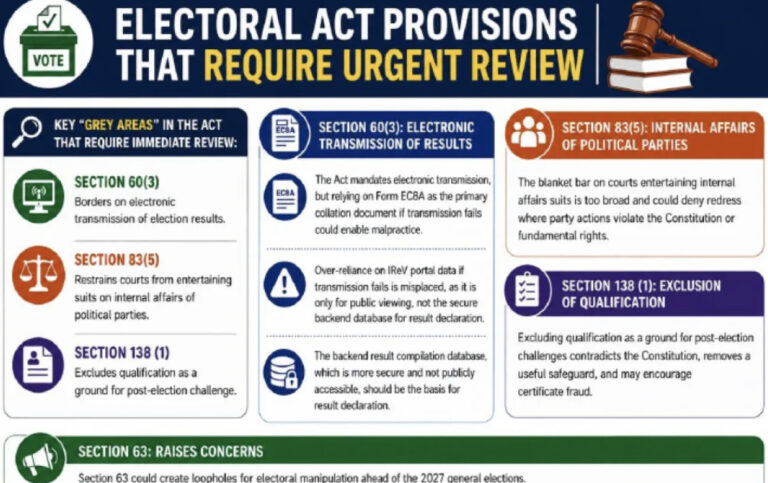
“Substantive matters like electronic transmission of results, online reporting and legitimising internet-based processes do not necessarily affect the timetable.”
He identified transmission and collation of results as the most critical challenges in Nigeria’s electoral process.
“The real issue today is transmission and collation of results. Polling unit procedures have largely been taken care of, but collation and transmission remain major challenges,” Jawondo said.
“Nigerians want instant electronic transmission of results and continued reliance on the INEC Result Viewing Portal.”
He also warned against abandoning biometric accreditation, cautioning that a return to manual, card-only voting would encourage widespread electoral malpractice.
“My advice is that even if lawmakers are unable to conclude the amendment before February, INEC should still issue the notice of election to comply with the law, while the National Assembly continues with the amendment process, provided it does not affect election timelines,” he said.
Another senior lawyer, Taiye Oniyide (SAN), said the delay raises serious perception and integrity concerns, stressing that any country serious about democracy ought to have corrected electoral deficiencies long before the next election cycle.
“It is unfortunate that we are now this close to the next election before attempting to correct statutory deficiencies,” Oniyide said.
“Those protesting are right, and it is within their constitutional right to do so.”
He argued that the slow pace of work on the Electoral Act contrasts sharply with the speed at which the National Assembly addresses some other issues.
“Look at how quickly the Senate corrected the tax laws. If that can be done, why are we still talking about amending the Electoral Act at this time,” he said.
Oniyide said the delay could fuel public perception that loopholes in the existing law favour the incumbent government.
“If the government is sincere about democracy and the national interest, this amendment is long overdue and must be treated as urgent,” he said.
Delay will erode public confidence in electoral process – CISLAC
Also, the Civil Society Legislative Advocacy Centre (CISLAC) has warned that prolonged inaction on the bill could further erode public confidence in the electoral system and undermine the credibility of future elections.
Speaking in an interview, CISLAC’s Executive Director, Auwal Musa Rafsanjani, said the proposed amendments were critical to strengthening transparency and accountability in the conduct of elections, noting that many Nigerians were already losing faith in the electoral process.
“Nigerians are gradually losing confidence that elections are not just ceremonial, where people win elections and others decide to take those mandates through fraudulent means,” he said.
According to him, one of the central demands by Nigerians is the mandatory use of technology in the electoral process to eliminate ambiguities that have characterised past polls.
He also called for reforms that would strengthen the independence of INEC, warning that persistent delays in amending the law could result in more disputed and discredited elections.
“It is sad that some legislators appear comfortable with a system that produces disputed elections. That is the interpretation Nigerians are giving to this continued delay,” Rafsanjani said.
The CISLAC executive director further alleged that the lack of urgency within the National Assembly, particularly the Senate, was linked to what he described as perceived disinterest from the executive arm of government.
“If there was genuine interest from the president in electoral transparency, we have seen how laws can be passed within days,” he said.
“The silence from the president sends a signal that electoral reform is not a priority, and that is why the legislature is not proactive.”
Rafsanjani appealed to President Bola Ahmed Tinubu to prevail on the National Assembly to act in the national interest and restore confidence in Nigeria’s democratic institutions.
He warned that failure to amend the Electoral Act in good time could lead to growing voter apathy and the continued waste of public resources on elections that citizens no longer trust.
“If this is not done, Nigerians will continue to stay away from elections, and the country will continue to spend huge resources on a process people have lost confidence in,” he said.
INEC plays down concerns
In contrast, the Independent National Electoral Commission (INEC) said it is not worried by the delay in the passage of amendments to the Electoral Act 2022, maintaining that the existing law still provides sufficient time for preparations ahead of the 2027 general elections.
INEC’s Deputy Director of Publicity, Wilfred Osilama Ifogah, said in an interview with Daily Trust that there was “no apprehension within the Commission on the likely amendments to the Electoral Act 2022”.
Responding to concerns that the delay could affect INEC’s election timetable and schedule of activities, Ifogah explained that the law clearly stipulates the timeframe for issuing election notices.
“The Commission still has time to release the schedule of activities for the 2027 general elections because the Electoral Act 2022, Section 28(1), provides for not later than 360 days to the election for the Notice of Election to be published,” he said.
He added that INEC is currently operating strictly within the provisions of the existing law, pending any formal changes.
“More so, as it stands, the Electoral Act 2022 is what the Commission is using, except there is an amendment,” Ifogah stated.
According to him, no amendment has so far been passed or signed into law to warrant any operational shift by the Commission.
“For now, no amendment has been passed nor signed for the Commission to operate with,” he said.
While acknowledging concerns raised by stakeholders over uncertainty in election planning, Ifogah insisted that INEC’s preparations remain on course under the current legal framework.
What the bill seeks to change
The Electoral Act amendment bill contains about 20 proposals aimed at reforming Nigeria’s electoral framework and addressing weaknesses identified in previous elections.
One of the major proposals seeks to make the Permanent Voter Card (PVC) non-compulsory for voting.
Under the proposed amendments to Sections 18 and 47, other forms of identification — including the National Identification Number (NIN), international passport and birth certificate — could be used for voter accreditation, given that the Bimodal Voter Accreditation System (BVAS) does not depend on the PVC microchip.
Another key proposal seeks to amend Section 60(5) to make electronic transmission of election results mandatory.
Section 71(2) is also proposed to be amended to criminalise the distribution of unstamped or unsigned ballot papers and result sheets, with penalties of at least one year imprisonment, a fine of N1 million, or both, for any presiding or collation officer found culpable.
The bill further proposes an upward review of campaign spending limits across all elective offices.
Presidential candidates would be allowed to spend up to N10 billion, up from N5 billion, while the ceiling for governorship candidates would rise from N1 billion to N3 billion.
Spending limits for senatorial candidates would increase from N100 million to N500 million, while House of Representatives candidates would move from N70 million to N250 million.
For state House of Assembly candidates, the cap would rise from N30 million to N100 million. Local government chairmanship candidates would be permitted to spend up to N100 million, while councillorship candidates’ limit would increase from N5 million to N10 million.
DAILY TRUST.