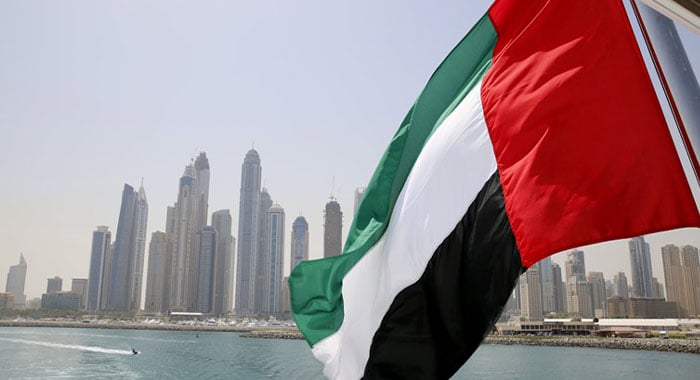
The United Arab Emirates has positioned Nigeria as a major destination for multi-billion-dollar investments spanning agriculture, technology, infrastructure, mining and trade, with the country’s Minister of Investment, Mohamed Alsuwaidi, admitting that Gulf capital is currently underexposed to Africa’s largest economy.
Alsuwaidi said this at the first Investopia Africa event held in Lagos on Monday, where discussions surrounded a wide range of opportunities that could translate into investments running from hundreds of millions to several billions of dollars, depending on sector readiness, regulatory clarity and the availability of credible local partners.
The PUNCH reports that as of 2025, trade relations between the UAE and Nigeria reached $4.3bn for non-oil commodities.
Speaking during a fireside chat with Nigeria’s Minister of Industry, Trade and Investment, Dr Jumoke Oduwole, the UAE minister said, “Opportunities around agriculture. The UAE has big interests in companies like Louis-Dreyfus and Unigroup. So, investment in agricultural land is for the export of products. You know, that’s a couple of hundred million, maybe. I think investment around infrastructure, whether it’s in public transport, utilities, power, water or wastewater recycling, is crucial.
Again, it depends on legislation and opportunities. It could be in the tens of millions if I look at it from that perspective. I think in terms of connectivity and trade facilitation, whether it’s through capital or whether it’s through infrastructure like warehousing or others. A few billion there. I’m throwing out the billions here, just quantifying numbers in my head.
“I think the technology space is huge. We talked about smart metering, fibre-optic laying, small data centres, and cloud solutions. Again, in the billions. You can’t build a data centre for less than $100m today. Then mining. Again, huge opportunity. Requires a lot of infrastructure. I see a lot of opportunity.”
However, he cautioned that the pace at which investment commitments materialise would depend largely on information flow, market familiarity and the ability to identify reliable partners.
“Now, translating that is getting information, being able to find either a private sector or a government to be a partner with a government or private sector on my side,” he said. “Making sure that they have all the information to make the right decision.”
Alsuwaidi trashed the notion that trust was the primary barrier to deeper UAE–Nigeria investment ties, arguing instead that market understanding and partner identification were the real challenges.
“I don’t think trust is an issue. I do think understanding markets is an issue,” he said. “You’re not familiar with the market. You don’t know how to approach it. You don’t know who the partners are.”
He stressed that private-sector engagement would be central to unlocking deals, describing business-to-business interactions as more effective than government-led initiatives.
“I think there are more deals to be done at the private-sector level,” he said. “These events are the most crucial. Because you gather 300 people in a room. You exchange cards. You make some friends. And you have a good dinner. And that leads to a lot of money made with partners.”
Earlier, the Chief Executive Officer of Investopia, Dr Jean Fares, described the UAE’s role as a global investment and trade hub capable of helping Nigerian producers, exporters and technology firms access markets across Asia, Europe and beyond through its logistics, digital and financial infrastructure.
“When you look at the UAE, its strong suit is the connectivity,” Fares said. “When you look at sea and air, with the carriers and with the ports; when you look at digital infrastructure, some of the fastest high-speed internet, the number of landing cables, the access to capital, and the access to data centres.”
He said the credibility of the UAE’s financial system and regulatory environment was a key attraction for investors.
“The financial services and the credibility of them that we built, both in DIFC and ADGM; the rule of law and the enforcement of that; and the protection of investors,” he said.
Fares added that the UAE had evolved beyond being a regional hub to becoming a global connector linking Africa with Asia and Europe.
“The UAE is becoming a dominant hub in the GCC, but also a connector of places like Africa to Asia and Asia to Africa and Europe,” he said. “If you’re trading with Asia, then you should have some kind of representation in the UAE.”
He noted that while the UAE continued to attract global capital, it was increasingly focused on deploying capital abroad, particularly in under-represented markets such as Nigeria.
“While we want to attract capital into the UAE, we’re also keen on moving capital out,” Fares said. “We’re very conscious that we’re underweighted in Nigeria. And we need your help to identify those opportunities where we can place short-term and long-term capital to grow.”
Oduwole, speaking with journalists after the fireside chat with her UAE counterpart, said, “So key businesses are here; you’ll be hearing from them all through the afternoon. It’s a short, crisp half-day event, and the afternoon is B2B. And then there’ll be follow-up meetings. There’s an Investopia session at the end of March in Abu Dhabi. And then there’s a session in Milan, which is focused on Africa. Nigeria is leading the charge. We’re already talking about it. We listened to the minister, my counterpart, the Minister of Investment from the UAE. He was actually pulling out ballpark figures of where he thinks solid minerals, critical rare earths, lithium, and tin are – areas where Nigeria is really ready to absorb that capital. So, we’ve assured them that we’re here for them. And this is what we’re going to be doing throughout this year.
“You see the FMITI family behind me. We’re going to be bringing in key investors. We’re going to be pushing out our nano-exports across the region through the UAE as a hub. And so surely the best is yet to come. We are excited. The subnationals are involved.”
The role of states was highlighted, with Lagos State cited as a key example. Oduwole said, “This ministry is an enabler. We work with all arms and levels of government. We’re here today. Investopia has been hosted in Lagos State. It’s a federal thing; you know, a number of other state governments are represented. We put Governor Sanwo-Olu on the infrastructure panel to speak to the UAE audience. We cited the Lagos–Calabar Coastal Road. First Abu Dhabi, a UAE bank, was one of the first to put in capital. And we have the promise of all that the real estate down that corridor will become. So, you look at Abu Dhabi, you look at Dubai, and just imagine what that coast is going to look like in a few years.
“Sub-nationals: every business is domiciled in one state or city or another. And the way FMITI works, whether it’s from small businesses (you have SMEDAN) or from NEXIM, is they’re working across businesses all across the country. So that is what we do. That is who we are. And we’re ready.”
On tracking investment outcomes, officials said Nigeria relies on clear metrics to measure traction. These include public investment announcements, capital inflows recorded by the Central Bank of Nigeria, and data from the National Bureau of Statistics. They added that job creation figures and multiplier effects are also used to assess impact.
Infrastructure projects were cited as clear examples of measurable economic impact. Using the Lagos–Calabar Coastal Road as a case study, the minister said the project has already created livelihoods, generated informal economic activity, and demonstrated the tangible, quantifiable multiplier effect of construction and infrastructure spending.
Oduwole told the UAE minister and investors, “I’m glad to hear you say you’re ready to take the plunge and to deploy that capital. And you’re looking at the African region and Nigeria in particular.”
She assured investors of government support in structuring and executing deals: “We’re here for you. We’re here to take the capital. Every challenge is an opportunity. I’m committing personally on behalf of my president and on behalf of the private sector that we will facilitate these deals to make sure that they’re done properly.”
Lagos State Governor Babajide Sanwo-Olu, who sat on a panel discussion themed ‘Infrastructure and Logistics for Africa’s Next Phase of Trade’, said the state had focused on creating a secure, efficient and business-ready environment capable of absorbing large-scale investments.
“How do we ensure that the environment in which those investments are going to happen is safe and secure and has the ability to receive that capital?” Sanwo-Olu said. “We’re business-ready, we’re safety-ready, and we’re equipped.”
He highlighted transport, digital and infrastructure projects undertaken to improve mobility and productivity.
“In the last four years, we’ve activated two rail projects. We’ve activated our waterways. Just two weeks ago, we signed a commitment with one of the telecoms that wants to do about 30,000 kilometres of fibre optics in Lagos,” he said.
Sanwo-Olu also noted that the state would soon be unveiling the Lagos International Financial Centre.
“We’ve had extensive conversations around the path of the Lagos International Financial Centre. The Lagos State government is cooperating with EnterpriseNGR. We started this journey about eight months ago. We still have about another eight months to go before finally unveiling it. But the beauty of it is the amount of global support that we have. It’s like we’re trying to put the Abu Dhabi Financial Centre and Dubai Financial Centre, or even the London Financial Centre, apart from the Lagos International Financial Centre. So that’s the level of audacity that we’re bringing.
“We’re trying to learn from all of these various regions to bring about a model that will be a true African model that will work for everyone, but it will also be a Nigerian model. So, I’m here to let you know that we are actually thinking global. We’re thinking about how to remain competitive, how to remain resilient, and how to be able to play on the same level of profit with other big cities and other big markets in the world. So, Lagos is positioning itself, leading the Nigerian competition, and we’re getting tremendous support from the federal government,” he said.
Also speaking, the Managing Director of the Nigerian Ports Authority, Abubakar Dantsoho, said Nigeria’s port infrastructure had not kept pace with its population and economic size but that reforms were underway.
“The biggest economy, with the highest population on every continent, has the biggest seaport,” Dantsoho said. “Nigeria is doing two million TEUs with over 250 million people.”
He said the Federal Government had approved major port modernisation projects to address the gap.
“The Federal Government has given approval for the port modernisation of Tin Can Island and Apapa Port,” he said. “In the near future, Nigerian seaports are going to be number one in Africa, which is where we naturally belong.”
The Investopia Africa event brought together senior government officials, investors and private-sector leaders from Nigeria and the UAE, with participants emphasising that sustained engagement, credible partnerships and project readiness would determine how quickly stated commitments translate into capital deployment.
PUNCH.