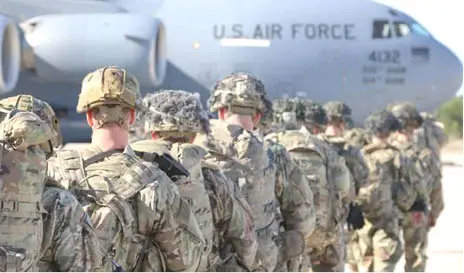
Questions are being asked over the latest revelation that the United States will deploy 200 troops to Nigeria. Many stakeholders are expressing fears that the Americans may be on their way to having a base in Nigeria.
The troops will train Nigeria’s armed forces in their fight against jihadist groups, Nigerian and US officials said Tuesday, as Washington increases military cooperation with the West African country.
“We are getting US troops to assist in training and technical support,” Major General Samaila Uba, a spokesman for Nigeria’s Defence Headquarters, told AFP.
The Wall Street Journal was the first to report the deployment, which will supplement a US small team already in the country to aid the Nigerians with air strike targeting.
The additional troops, expected to arrive in the coming weeks, will provide “training and technical guidance,” including helping their Nigerian counterparts coordinate operations that involve air strikes and ground troops simultaneously, the US daily said.
A US Africa Command spokeswoman confirmed the details of the report to AFP.
Nigeria has been under diplomatic pressure from the United States over insecurity in the country, which US President Donald Trump has characterised as “persecution” and “genocide” against Christians.
Although there are instances where Christians are specifically targeted, Muslims are also killed en masse, with Trump’s senior advisor on Arab and African affairs, Massad Boulos, saying last year, Boko Haram and Islamic State “are killing more Muslims than Christians.”
Abuja rejects allegations of Christian persecution in Nigeria, a framing long used by the US religious right.
So do independent analysts, who point to a broader state failure to curb violence from jihadist groups and armed gangs across swaths of sparsely governed countryside.
Despite the diplomatic pressure, Nigeria and the United States have found common ground in increasing military collaboration.
The US targeted militants in North-West Sokoto State with strikes in December, in a joint operation with Nigeria, officials from both countries said.
Going forward, the US military has said it will supply intelligence for Nigerian air strikes and work to expedite arms purchases.
While the 200-troop deployment represents a scaling up of that collaboration, “US troops aren’t going to be involved in direct combat or operations,” Uba told the Journal.
Nigeria requested the additional assistance, he added.
Africa’s most populous country is battling a long-running jihadist insurgency concentrated in its North-East, while non-ideological “bandit” gangs conduct kidnappings for ransom and loot villages in the North-West.
Across the centre of the country, violence erupts among mostly Christian farmers and Muslim Fulani herders – though researchers say the main cause is access to dwindling land and resources.
Peep into US/Nigeria security deal
An official familiar with the conversations between both countries told TheCable that the US had demanded to have a station in Nigeria where they can refuel their drones after trips from Accra.
Drones can be refuelled in multiple ways, depending on their design and fuel type, extending their operational range beyond battery or fuel limits.
Most consumer and commercial drones (battery-powered or fuel-based) are routinely recharged or refuelled on the ground at stations.
Hydrogen-powered unmanned aerial vehicles (UAVs), for example, use methods like blowdown filling from high-pressure sources or boost compression to top up compressed tanks quickly.
According to TheCable, discussions on the subject have progressed, and a North-eastern state has been designated as the station host.
“We’re not going to have boots on the ground. We’re not going to have a military leg operation. They are only going to support Nigeria either in equipment or intelligence or something like that, not in a fighting capacity,” the official told TheCable.
“It would possibly be an advisory capacity — maybe training or things like that — which are already ongoing.”
The official noted that the US proposed Lagos or Abuja, which was rebuffed on sensitive grounds.
The source added that the north-east was chosen because it hosts Nigeria’s drone operations.
The station would allow US officials to fly in from Ghana, which is a hub for America’s military logistics network in Africa, to strategise on supporting Nigerian troops.
Earlier deployment
Last week, Dagvin Anderson, the general in charge of US Africa Command (AFRICOM), said the US had dispatched a “small team” of troops to Nigeria following recent security cooperation between both countries.
Anderson’s disclosure sparked an uproar, seeing as it was the first official acknowledgement of US boots on the ground in Nigeria since the Christmas Day strike.
But an official familiar with the operation downplayed the gravity, saying, “AFRICOM has always collaborated with Nigeria; there have always been US troops on the ground. The only thing that changed is the scope of their assignment.”
That new scope has now been assigned to the US 3rd Special Forces Group, a former US official told TheCable.
The 3rd special forces group is designed to deploy and execute nine doctrinal missions: unconventional warfare, foreign internal defence, direct action, counter-insurgency, special reconnaissance, counter-terrorism, information operations, counter-proliferation of weapons of mass destruction, and security force assistance.
The group was primarily responsible for operations within the AFRICOM area of responsibility, as part of the Special Operations Command, Africa (SOCAFRICA). Its core area of operation is now Africa as part of a 2015 SOCOM directive.
In the past, the group has engaged in missions in Afghanistan, Iraq, Mali, Ethiopia, the Congo, and Jordan.
Following Anderson’s statement, Christopher Musa, Nigerian minister of defence, explained that the US personnel are not combat troops.
Musa described the group as a small advisory team supporting intelligence gathering and training initiatives.
He did not disclose details regarding the size of the team, their arrival date, location, or stay duration, but an official familiar with their operations said the team played a role in coordinating the Christmas Day bombing.
Nigeria must tread cautiously – Major Galma (Rtd)
Meanwhile, in an interview with Daily Trust on Tuesday night, Major Bashir Galma (Rtd) cautioned the Federal Government to exercise caution over the reported deployment of United States troops to Nigeria.
The security expert and retired senior military officer said the reported number of foreign troops was significant, noting that 200 personnel is gradually approaching what is considered a battalion-sized presence in military terms.
“Initially, we thought it was going to be a minimal number. But from all indications, 200 military personnel amount to about one-fifth of a battalion. That is not a small training team as we have been told. A battalion consists of about 1,000 soldiers. So, one-fifth of a battalion of US soldiers is coming,” he said.
Galma questioned whether such a number could be considered a routine training mission when compared with established military practice.
“What I am trying to say is that we were told they are coming for training. Two hundred may not appear too large for training purposes, depending on the scope, but it should not be that 200 soldiers will come and form a camp or base. What we expect are training teams, as we have had with other countries,” he added.
He stressed that Nigerians should be fully informed about the arrangement, particularly regarding the number of troops involved.
“These are issues the population of this country should have been told, especially concerning the numbers. It should not be that when a certain percentage has already arrived, we are then informed. We may hear again that another 300 are coming, and before we realise it, a battalion has been deployed,” he said.
Speaking further, the retired officer argued that it would be difficult for 200 foreign troops to operate in Nigeria without establishing a base either within the country or in a neighbouring state. He urged the government to be transparent and carry citizens along.
According to him, such a deployment could not occur without the knowledge and approval of the President, who is the Commander-in-Chief of the Armed Forces.
“This is what worries people. What is the objective? That is the question many are asking. If there are plans to grant them a base, or if they already have one in a neighbouring country, the government should say so instead of presenting it as a temporary training arrangement,” Galma said.
“Honestly, if that number comes in, I doubt it will be for a short stay. Everything happening is with the approval of the Nigerian government.
“If the government believes 200 is too large and that the population is uneasy about it, it has the authority to say so. But we have seen that the Commander of US AFRICOM recently visited the Commander-in-Chief of Nigeria’s Armed Forces. Perhaps everything has already been ratified.
“That is the nature of the presidential system of government. The Commander-in-Chief has the constitutional authority to make such decisions, and subsequent discussions may only amount to debate.”
He added that it would have been preferable for the government to openly inform Nigerians of the full details.
“It would have been better if the country had been carried along and properly informed — for instance, by stating that due to prevailing security concerns, the United States is seeking a base, possibly around the Gulf of Guinea, which Nigeria had previously rejected,” he said.
‘Military not aware of US plan to establish base’
When contacted, the Director of Defence Media Operations, Major-General Micheal Onoja, told Daily Trust that the military high command was not aware of any plan to establish a base for foreign troops in Nigeria.
“We’re not aware of that plan,” the senior military officer told one of our correspondents during a telephone interview.
However, civilian sources who spoke to our correspondent claimed that arrangements had already been concluded to create a base for the foreign troops to complement the efforts of Nigerian forces in tackling insecurity.
“A lot of things are happening which are not yet open to the public. When US boots arrive on Nigerian soil, there will be a need to station them somewhere. I won’t say more than that,” one of the sources said.
But military sources dismissed the claims, describing the alleged plan as “impossible.”
“This remains a rumour. This type of information is speculative. Something like this cannot happen without the knowledge of the military,” one source said.
Major Bashir Galma (Rtd) argued that historical experience shows that the presence of American troops in developing countries often brings far-reaching consequences.
He cited South Korea as an example of a country that benefited from hosting US troops but noted that concerns persist due to outcomes in other parts of the world.
“It is the negative experiences elsewhere that are making people jittery. In some cases, when they come, they exert their global influence and sometimes disregard local laws and traditions. History has shown that,” he said.
He added that while the deployment might turn out to be peaceful, Nigerians remain cautious about possible long-term implications.
“For whatever reason they are coming, perhaps they may have a peaceful stay, provided they do not interfere in how we live — our culture, religious matters and other aspects of our society.
“We do not want anyone to impose their ideology on us. We want to move at our own pace. With foreign ideas, we do not know how it may eventually end,” he said.
Nigeria must interrogate implications for national sovereignty — Don
An analyst on political and international affairs, Professor Abba Sadiq of the Department of Political Science, University of Abuja, has stressed the need to carefully examine the implications of any US military deployment for Nigeria’s sovereignty and foreign policy.
“If this is at Nigeria’s request, it must be clearly defined within the framework of the Nigerian government’s objectives. Before seeking assistance, there should have been an internal analysis and assessment,” he told Daily Trust.
According to him, any such arrangement must be situated within the context of formal bilateral agreements.
“Military cooperation — whether in training, strategy or counter-insurgency — depends entirely on the formal agreements between Nigeria and the United States. That is standard practice globally,” he said.
However, he questioned the potential benefits for Nigeria.
“Do we stand to benefit from this? In what specific ways? What is the level of expertise the American military brings to address Nigeria’s unique security challenges?
“At a time when some neighbouring countries are asking foreign troops to leave, Nigeria appears to be considering accepting them. What does that signal?” he asked.
Professor Sadiq also raised concerns about Nigeria’s ability to regulate the presence of foreign forces.
“Will Nigeria be able to enforce its internal rules and sovereignty? Are there clearly defined no-go areas? These are critical questions. If properly structured, it could serve as a workable model, but clarity is essential,” he said.
On the broader foreign policy implications, he noted that the development could affect Nigeria’s relations with other global powers such as Russia and China.
“Foreign policy is driven by national interest. That interest must be clearly articulated — whether in trade, security or geopolitical positioning. It should not be based solely on the preferences of the current leadership.
“For a growing nation like Nigeria, there must be a defined national objective and coherent policy direction,” he said.
Diplomat dismisses BRICS fallout concerns
In a phone interview, a Nigerian former ambassador to several West African countries and the United Nations mission, Ambassador Mohammed Ibrahim, dismissed concerns that Nigeria’s alliance with the United States could negatively impact its ties with BRICS.
He emphasised that many Middle Eastern countries maintain strong military partnerships with the US while also being leading members of BRICS.
“Countries like Egypt, the UAE, and Saudi Arabia are BRICS members, yet they simultaneously uphold strong military alliances with the United States—some even host US military bases.
“Nigeria’s decision to accept or embrace foreign troops is a sovereign one, even as many neighbouring countries in the sub-Saharan region are expelling foreign forces.”
Meanwhile, the Office of the National Security Adviser (ONSA), which has been coordinating the activities of the US team, has not made an official statement since the AFRICOM commander visited Nigeria.
Efforts made last night to get the Head, Strategic Communications at the National Counter-Terrorism Centre (NCTC) in ONSA, Michael Abu, proved abortive as calls to his mobile phone did not connect.
He was yet to reply to a text message sent to him as at when filing this report.
DAILY TRUST.