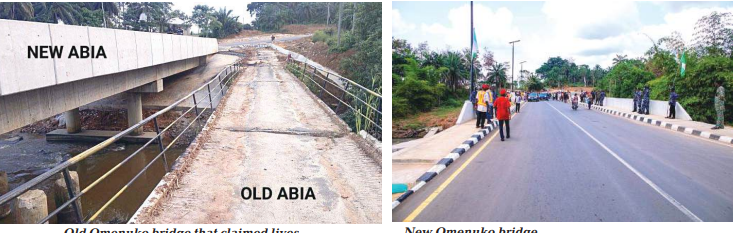
For the people of Abam and the countless commuters who crossed the Igwu River, Omenuko Bridge was not just a stretch of concrete, it was a place of fear. Mothers said quiet prayers before stepping on it.
Drivers tightened their grip on the steering wheel. Traders calculated the risk before loading their goods.
For years, that narrow bridge stood like a cruel gatekeeper between hope and tragedy.
It had witnessed too many tears.
In 2007, hope sank beneath its shadow when a bus carrying 17 young students on their way to write the Unified Tertiary Matriculation Examination plunged into the river. None returned home alive. Their dreams, like the vehicle, were swallowed by the waters. Other families would also grieve at other times. Among them Mr. Maxwell Uduma, his wife, Victoria and their driver.
As recently as December 2024, eight Christmas travellers lost their lives in yet another fatal crash at the same spot.
Beyond the accidents and broken vehicles, the bridge became a painful symbol of abandonment, a daily reminder that some communities were left to fend for themselves.
But today, the story has changed. Where fear once lived, relief now breathes. Where sirens once wailed, jubilation echoed as a new Omenuko Bridge rose in place of the old — wider, safer, and carrying with it the weight of memory and the promise of a different future.
It took the courage and resolve of Governor Alex Otti to say ‘enough!’ Six months after flagging off the project, he delivered the bridge – saving lives where neglect and insensitivity once killed. No wonder the unprecedented mammoth crowd that welcomed him at the inauguration.
Today, its reconstruction alongside the rehabilitation of the 30-kilometre Abam–Ndioji–Ndiokereke–Arochukwu road, has rewritten that narrative, offering a compelling case study of how infrastructure can recalibrate history, economy and collective memory.
The agrarian communities of Abam Onyerubi clan, one of Abia State’s most productive food baskets, erupted in jubilation following the completion of the projects by the administration of Gov. Otti. For residents and commuters alike, the intervention has ended decades of anguish and nightmares associated with crossing over the Igwu River, along the Bende-Ohafia federal road.
History, commerce and a forgotten waterway
Ironically, the same Igwu River once served as a commercial artery. Long before motor roads, it linked Abam and neighbouring communities to the Atlantic world. Canoes ferried palm oil, kernels and other produce to coastal trade routes, returning with manufactured goods. The bridge itself bears the name – Omenuko, a well known slave merchant whose real name was Chief Igwegbe Odum, from Arondizuogu in today’s Imo State. According to history, he suffered tragic loss at the bridge, hence it was named after him.
The Traditional Ruler of Okorie Ogori Abam Autonomous Community and Chairman of the Onyerubi Atita Akpo Council of Traditional Rulers, Eze Evangelist Ogbuka Origa, traced the bridge’s evolution from a wooden log laid over a century ago by Abam’s founding patriarch, to a narrow concrete structure built around 1959 under the government of Michael Okpara. That bridge, he recalls, outlived its relevance and became a death trap.
According to him, the bridge became historically significant during the movement of the warrior clan led by Abam Onyerubi, first son of Onyerubi Atita Akpo, alongside his younger brothers—Ezema Atita Akpo, founder of the Ohafia clan; Ebegbu Atita Akpo, founder of the Edda clan in present-day Ebonyi State; and Obom Atita Akpo, whose descendants are now in Akwa Ibom State.
At the time, the Igwu River was far more turbulent than it is today, posing a major challenge to the migrating clan, which included men, women, children and the elderly. To enable safe passage, Onyerubi Atita Akpo cut down a massive tree trunk and, with the help of his brothers, laid it across the river. This wooden log became the first known crossing point and served all travellers along the route.
The monarch said his people had suffered so much crossing the narrow bridge and plying the bad road. Abam is the major producers of rice, cassava, palm oil and plantain. It is also home to the largest rubber plantation in the state.
A turning point under Otti
What makes the current intervention significant is not merely its completion, but its timing, scope and symbolism. By reconstructing the bridge and opening up the Abam–Arochukwu axis, the Otti administration has effectively restored Abam’s economic relevance. Produce that once rotted due to inaccessible roads can now reach urban markets within minutes. Traders now come directly to the farmers. This simply translates to economic boom.
“We have the strength and good soil to farm but there was no road to take our produce to the cities. But now, traders come to us and buy whatever they want. Our people are happy because we will now begin to make money through farming,” the monarch enthused.
The project has also punctured a long-held local saying that there is no short route to Arochukwu, the historic Aro Kingdom. That adage, rooted in decades of poor access, no longer holds.
Community leaders, clergy, women groups and professionals speak with unusual unanimity. Rev. P. K. Emeaba, a prominent Abam indigene, recalled how the river once functioned as a mini seaport, bustling with up to 40 canoes at a time. To him, the new bridge is not just concrete and steel, but a restoration of dignity.
The Rev. Emeaba narrated how renowned Abiriba traders exported their wares including palm kernels, palm oil and other products to Opobo, Cotonou, Cameroon, Panya and other parts of the world through the Igwu River. According to him, up to 30 to 40 canoes loaded at the mini Onu Anyim sea port in those days.
“When they were coming back, they brought tobacco, hot drinks, carbide, gun powder, cigarette, clothes and some other products from overseas. When their canoes birthed at the sea port, the merchants carried their wares home from Abam through the pathways to their various communities.”
Emeaba said the mammoth crowd at the inauguration ceremony of the projects showcased how the people cherished the governor’s gesture. “Since I was born, I have never seen that type of crowd in Abam before. That was to show how the people appreciated what the governor did for us,” he said.
The cleric noted that people from the area had held various positions in government before but none of them could bring any meaningful intervention on the bridge or road despite several appeals by the people.
On the economic impact of the interventions, Emeaba said farmers in the area would earn more money through farming as they can now easily evacuate their produce to urban areas. He declared that Governor Otti would harvest more votes in the area than he did during his first tenure.
“From what has happened, it will be very difficult for any other governorship candidate outside Otti in 2027 to get any vote in Abam. Somebody has already pledged a seed money of N500 million to his campaign project.”
President of the Inyom Abam Development Union, Lady Nne Oriona Ukaike Ukeh, framed the intervention in clear economic terms, saying it would reduce post-harvest losses, boost household income and improve families’ ability to educate their children.
She said the joy of Abam women would endure for generations, describing the bridge as a long-standing nightmare that had claimed many lives.
“Otti has done so well for us. Within six months, he fixed a problem that defeated governments for decades. Our farm produce will no longer get spoilt; we can now sell and support our families,” she said.
Ukeh added that the massive turnout at the project’s commissioning reflected the depth of appreciation among the people, recalling years of unfulfilled promises and abandoned equipment at the site.
“Otti has finished every campaign he needs to do here. In 2027, he does not need to come to Abam to campaign—his works will speak for him,” she declared.
Lawmakers, academics and stakeholders from the area described the intervention as a legacy project that future administrations would be measured against.
Dr Isaac Nkole, an Abam man said Otti had disproved past leaders who made promises to construct the bridge and the road but never fulfilled them.
The chieftain of the Peoples Democratic Party, said Otti had engraved himself on the heart of the entire Abam people, adding that the projects would remain enduring legacies in his memorial for many years to come.
“Other governors before him could not do that for us despite their promises. Otti has shown he truly came to work for the people of Abia and not just a section. He did it out of passion for the masses and not for politics. As an Abam man, we will never forget this legacy for ever. He has done what no governor could do for us.”
Nkole narrated his near-death experience at the bridge during his secondary school days as the items he bought fell into the river although he was lucky enough to survive. “I had my own experience at that bridge when I was schooling at Abam High School. I went to Umuahia to buy some goods but when I got to the bridge everything fell inside the river when the motorcyclist conveying me became nervous at the sight of the narrow bridge.”
Speaking also, the lawmaker representing the constituency at the Abia State House of Assembly, Hon. Uchenna Okoro, said the projects would remain indelible in the minds of his constituents.
He recalled that past administrations repeatedly awarded, flagged off and even “commissioned the bridge and road only on air,” noting that “when you visited the site, there was nothing on ground.”
Expressing joy over the completion, Okoro said: “This is the best time to be a lawmaker from Abam. I am the happiest person because the governor has done what our people will never forget in their lifetime.”
He added that posterity would be kind to the governor, saying the projects had defied the old adage that there was no easy road to Arochukwu, “because many easy roads have now been provided to Aro.”
Another Abam stakeholder, Engr . C. K Okoro, said the projects had lifted thousands of farmers in the area out of poverty, while also ending frequent road carnages and opening new tourism opportunities.
Describing Omenuko Bridge as historic, he noted that its reconstruction would attract visitors familiar with Omenuko from literature, especially now that the bridge has become a landmark. He commended Governor Otti for ending the long-standing woes of the people and for his unprecedented efforts to close the state’s infrastructure gap.
At the inauguration, Governor Alex Otti acknowledged the painful past while placing the projects within a broader reform agenda anchored on ending neglect, restoring hope and aligning leadership with community aspirations.
He framed the intervention not as charity, but as justice long delayed.
He said the projects reflected his administration’s resolve to establish “a new governance standard, one that empowers communities and enables prosperity,” describing them as a symbol of resilience in what he called “the long-drawn battle for the soul of Abia State.”
Otti explained that his entry into politics was driven by the collapse of public infrastructure and the frustration it caused across urban and rural communities. “We stepped out with the conviction that we had what it takes to restore hope. Though risky, that decision was the right one,” he said.
The governor paid tribute to victims who lost their lives at the former bridge, stressing that progress must not erase memory.
“While we have turned the corner, we must acknowledge the pain families endured due to leadership failure,” he said, declaring that deceptive promises of the past would have no place in Abia again.
“Today, we have turned the page. The nightmare is over, the siege has collapsed, the jinx is forever broken,” he declared, announcing “a new era of prosperity.”
It therefore, suffices to say that Omenuko Bridge reconstruction marks a clear governance shift, from symbolic flag-offs to tangible delivery. While Abam is the immediate beneficiary, the ripple effects now stretch across Abia North, reviving agriculture, tourism and confidence.
For the Abam Onyerubi clan, the declaration that “the nightmare is over” is no longer rhetorical—it is now reinforced by concrete and renewed faith in governance. And observers believe the political dividends may crystallise in 2027.
VANGUARD.