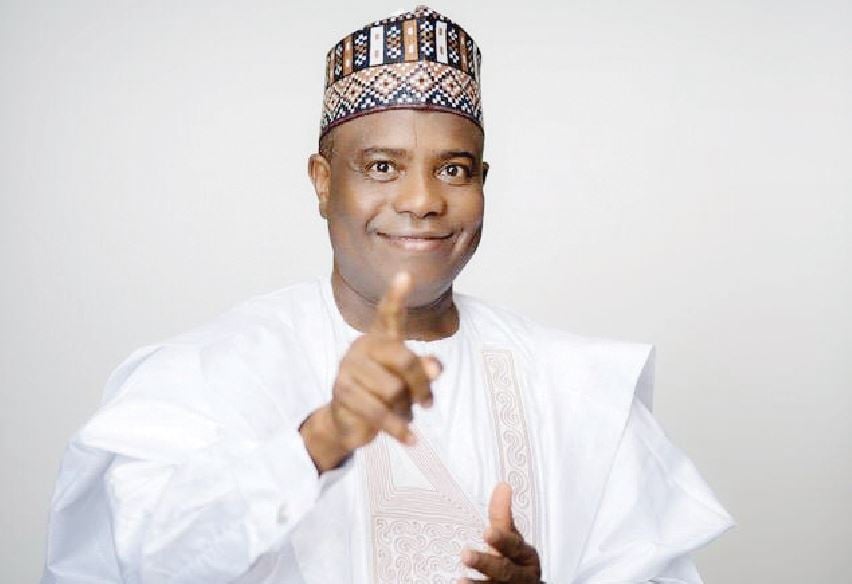
Former Governor of Sokoto State, Senator Aminu Waziri Tambuwal, speaks with journalists in Sokoto shortly after announcing his defection from the Peoples Democratic Party to the African Democratic Congress. In this interview, he explains the reasons behind the move, his views on Nigeria’s political future, the Electoral Act, and allegations of political victimisation. ANIMASAHUN SALMAN brings the excerpts…
Nigerians woke up to the news of your defection to the African Democratic Congress. For many Nigerians, the ADC is not as vibrant as the PDP used to be. Why did you choose ADC among other options?
First and foremost, consultations, reviews and studies of Nigeria’s political environment that led to this decision did not start yesterday. They began over two years ago when some of us started projecting into the future and examining the trajectory of Nigeria’s political system. At that time, we observed certain developments which suggested that the country might gradually drift towards a one-party state if deliberate steps were not taken by democratic forces to strengthen alternative political platforms. Because of this concern, we commissioned a number of experts, including seasoned politicians, political analysts and professors from reputable universities within and outside Nigeria, to study the country’s evolving political environment and advise us on the most viable direction to take. Their assignment was to carefully analyse the major political parties in Nigeria — including the PDP, which many of us belonged to; the Labour Party, which made significant electoral gains in the 2023 general elections; and other smaller political parties that have structures across the country. After months of study and consultations, the conclusion presented to us was quite revealing. They noted that the PDP, unfortunately, was facing deep-rooted internal challenges which might threaten its long-term survival if not properly addressed. They also observed that the Labour Party, despite its impressive showing in the last election, might struggle to sustain its current momentum due to organisational and structural limitations.
Based on these findings, many of us, who had previously been leaders in the PDP, the APC and even the Labour Party, began to explore other platforms that could provide Nigerians with a credible political alternative. After examining several options, we collectively agreed that the African Democratic Congress offered a platform that could be rebuilt, strengthened and repositioned as a truly national party capable of representing the aspirations of Nigerians who desire genuine democratic governance. That is essentially why we chose the ADC.
With less than a year to the next general election, do you believe the ADC can realistically dislodge the ruling APC?
Ultimately, politics is about the people. The strength of any political party lies not necessarily in the number of office holders it controls but in the level of support it enjoys among the citizens. Today in Nigeria, there are essentially two broad groups of people. There are those who are benefitting from the current system and are therefore comfortable with the status quo. Then there are millions of Nigerians who are clearly dissatisfied with the current state of affairs in the country. If you conduct even the simplest public opinion survey anywhere in Nigeria today, you will find that a significant majority of citizens are unhappy with the way the country is being governed. People are worried about insecurity. Communities across different parts of the country continue to experience attacks from bandits, terrorists and other criminal elements. Families are living in fear and many livelihoods have been destroyed. Beyond insecurity, there is also widespread concern about economic hardship. Poverty levels are rising, unemployment remains high, and the cost of living has become extremely difficult for ordinary Nigerians. There are also persistent allegations of corruption, abuse of office and weak institutions. All these factors combined have created a sense of frustration among many citizens. So, when people ask whether the ADC can defeat the ruling party, my response is simple: the real power lies with the Nigerian people. If Nigerians decide that they want change, no political structure can ultimately stand in their way. We have seen instances in our political history where sitting governors with enormous influence lost senatorial elections in their own states because the people decided otherwise. Democracy gives the final decision to the electorate.
The Electoral Act and the timeline proposed by the Independent National Electoral Commission for party primaries have generated considerable debate. Are you comfortable with the current arrangement?
To be honest, I had certain reservations when aspects of the Electoral Act were being discussed during the legislative process. However, once a law has been duly enacted, it becomes the responsibility of all citizens and political actors to operate within its provisions. That said, I must admit that I am not entirely comfortable with the timeline currently being suggested by INEC, particularly the proposal that party primaries should hold between April and May. During our discussions in the National Assembly when the Electoral Act was being processed, some of us expressed the view that party primaries should ideally take place around August or September. The reason for this position is quite straightforward. Once the primary election season begins, governance tends to slow down significantly because political office holders and aspirants shift their attention towards political campaigns and internal party contests. Governors, ministers, legislators and other political leaders become preoccupied with political calculations rather than the day-to-day responsibilities of governance. If primaries were scheduled later in the year — say August or September — elected officials would have more time earlier in the year to focus on delivering governance before the political season fully begins. Unfortunately, the current timeline means that political activities will begin to dominate the national space much earlier than necessary, which could have implications for governance across the country.
Some analysts believe the early timeline could particularly be a disadvantage to emerging parties like the ADC. What is your view?
There is indeed a school of thought which believes that the timeline may inadvertently create difficulties for newer or reorganising political parties. When a political platform is undergoing restructuring or welcoming new members, it requires time to consolidate its leadership structures, harmonise different interests and organise internal processes effectively. If deadlines are too tight, it may appear as though certain parties are being placed under pressure to meet requirements that may be difficult within the available timeframe. Some observers have even suggested that the arrangement could function like a trap for emerging political coalitions.
However, regardless of these concerns, we are committed to working strictly within the framework of the law. We will do everything necessary to ensure that the ADC meets all the requirements and deadlines set by the electoral commission.
How do you intend to change the current political narrative in Nigeria through this new platform?
Again, everything comes back to the people. Since 2003, by the grace of God and the support of the electorate, I have had the opportunity to win elections under different political platforms. That experience has taught me that what ultimately matters in politics is not the name of the party but the trust and confidence that the people place in a leader. When citizens believe in your vision, your credibility and your capacity to serve them, the platform you stand on becomes secondary. Therefore, the focus going forward is to build a platform that truly reflects the aspirations of Nigerians — a party that promotes accountability, good governance, security and economic prosperity. If we are able to present a credible vision and convince Nigerians that we are committed to genuine reform, then the political narrative will naturally begin to change.
There have been growing concerns about political victimisation in Nigeria. What is your perspective on this issue?
Nigerians are very intelligent people and they are not easily deceived. They can see developments around them and draw their own conclusions. If the fight against corruption is truly sincere, then it must be applied fairly and consistently across board.
Unfortunately, there are situations where individuals who should ordinarily be answering serious questions about public conduct appear to enjoy easy access to the corridors of power simply because they belong to the ruling party. But the moment someone leaves the ruling party and joins the opposition, that same individual suddenly becomes the subject of investigations, harassment or prolonged legal scrutiny. Such perceptions, whether accurate or not, can undermine public confidence in democratic institutions and the rule of law. For democracy to thrive, institutions responsible for enforcing accountability must operate independently and without political bias.
Are you planning to seek re-election under the ADC or pursue a higher political office?
At the moment, I am still consulting widely with political associates, stakeholders and supporters across the country. Politics requires careful deliberation and consensus-building, so I have not taken a final decision regarding any future political ambition. When the time comes and consultations are concluded, Nigerians will be duly informed of whatever decision is reached.
Do you still support the presidential ambition of Atiku Abubakar?
Politics is dynamic and circumstances evolve over time. For now, I believe it is premature to make definitive statements on such matters. As I said earlier, consultations are still ongoing among various political stakeholders. When the time comes to make decisions regarding alliances, endorsements or political support, we will cross that bridge.
Some observers noted that the crowd at your defection event appeared smaller than expected. What does that indicate?
That situation was actually deliberate. The gathering was not intended to be a large public rally. It was essentially a procedural step in a broader political process. I intentionally kept the event modest because the real formal ceremony will be organised at a later stage. When that time comes, Nigerians will witness a much larger gathering of supporters and stakeholders from different parts of the country.
There have also been reports suggesting that the ADC in Sokoto State is experiencing internal disagreements. Are you aware of any crisis within the party?
To the best of my knowledge, there is no internal crisis within the ADC in Sokoto State. Anyone who is genuinely interested in verifying the situation can simply consult the authentic records available with the Independent National Electoral Commission. INEC maintains official documentation of recognised party leadership structures across the country, and those records clearly indicate the legitimate leadership of the ADC in Sokoto State. From what I know, the party’s structure in the state remains intact, functional and united. Therefore, claims of internal crisis are largely unfounded and do not reflect the true situation within the party.
PUNCH.