The United Kingdom and Nigeria have sealed new export agreements as both countries committed to taking their economic partnership to another level, UK Prime Minister Keir Starmer said on Thursday.
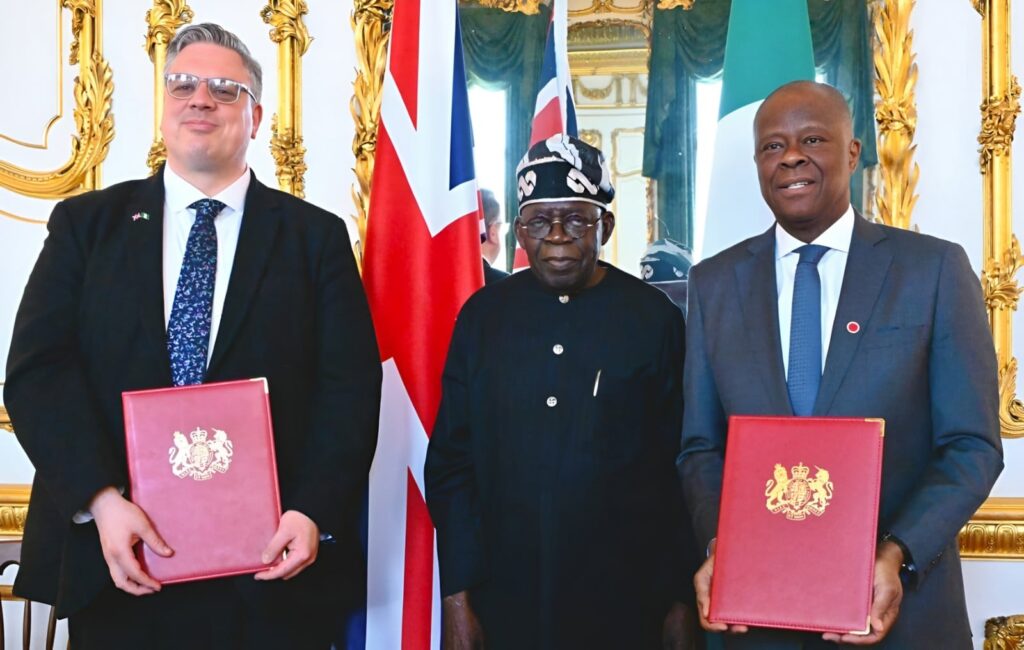
Starmer made the disclosure during a bilateral meeting with President Bola Tinubu at 10 Downing Street on the second day of the Nigerian leader’s historic state visit to Britain.
“Today is the opportunity to take that to another level with the agreements that we’ve been able to reach on exports, and I think that shows we can go even further than we’ve already gone,” the British Prime Minister stated.
Tinubu, in his remarks, revealed that Nigeria is currently undergoing “very strong reform of the economy” and linked the terrorism challenges facing West Africa to climate change conflict.
“We need more trade agreements and economic relationships that we build between nations. Nigeria is currently going through a very strong reform of the economy,” Tinubu said during the meeting at 10 Downing Street.
The President described Nigeria as facing significant challenges, stating, “The largest country in West Africa, and on the continent, is challenged by terrorism coming from the conflict of climate change.”
Tinubu emphasised that both countries face global economic challenges, noting, “Currently, the entire world is challenged. Nigeria is not immune. Britain is not immune.”
He said the discussions focused on the “economic welfare of the people and how we can work together to improve livelihood” amid economic volatility.
The President affirmed that Thursday’s bilateral discussions would address what Britain can do to “accelerate the friendship, partnership and collaboration” between both nations.
On his part, Prime Minister Starmer described the visit as historic, noting it was the first inward state visit for 37 years by a Nigerian leader.
“The long and shared history between our countries is obvious and much valued, as is the people-to-people contact and engagement that enriches lives here in the United Kingdom,” Starmer said.
He noted that both countries already collaborate on economy, defence, and security matters but expressed determination to deepen the partnership.
“Today is the opportunity to take that to another level with the agreements that we’ve been able to reach on exports,” the Prime Minister stated.
Nigeria became the United Kingdom’s biggest export market in Africa in January 2026, with bilateral trade continuing to expand.
King Charles III had disclosed on Wednesday night at a state banquet that visitors from Nigeria spent £178m in Britain in 2024, while 251,000 people from Britain travelled to Nigeria and spent just as much in return.
The state visit, which began on Wednesday, March 18, saw the signing of several memoranda of understanding and agreements covering trade, investment, defence, and cultural cooperation.
A major outcome already announced is a £746m financing deal involving UK Export Finance, the Nigerian Ports Authority, and the Ministry of Finance for the refurbishment of Lagos Port Complex (Apapa) and Tin Can Island Port.
The bilateral meeting at Downing Street followed Wednesday night’s state banquet at Windsor Castle, where King Charles III acknowledged “painful marks” in the shared history between both nations while praising Nigeria’s transformation and the contributions of the Nigerian diaspora to British society.
The state visit, the first by a Nigerian president since 1989 when former military leader Ibrahim Babangida was hosted by Queen Elizabeth II, concludes on Thursday with President Tinubu expected to return to Nigeria.
PUNCH.