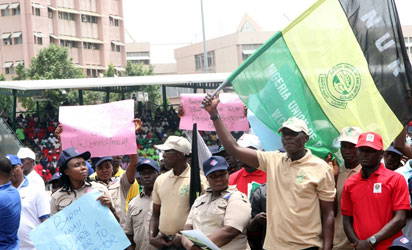
Nigerian workers today joined their counterparts across the world to mark the May Day under a cloud of anxiety, frustration, and economic strain, as rising insecurity, deepening poverty, and persistent inflation continue to erode the value of labour and the dignity of work.
Across sectors, from factories to farms and offices to informal markets, workers said the promise of a better life and renewed hope feels increasingly out of reach. Wages are being stretched thin by soaring food prices, transport costs, and energy expenses, while fears over personal safety and job security weigh heavily on daily life.
Labour leaders echoed these concerns, lamenting what they described as a failing system where economic reforms have yet to translate into real relief for ordinary citizens. They warned that without urgent action to stabilise prices, secure communities, and protect livelihoods, the condition of Nigerian workers could deteriorate further.
For many, this year’s May Day is less a celebration and more a moment of reflection and quiet protest, a reminder that behind the ceremonies and speeches are millions struggling to survive.
President of the Nigeria Labour Congress, NLC, Joe Ajaero, on the Day, lamented the high level of insecurity, poverty, hardship, inflation, and the devaluation of the national currency, which he said had inflicted pain and misery on citizens.
He warned: “Unless insecurity and poverty are urgently addressed, the nation will continue to struggle with rising unemployment and the collapse of decent jobs. About 90 per cent of jobs in Nigeria are in the informal sector, where workers lack security, pensions, and decent conditions.
“Decent jobs are gradually vanishing across industries, and this trend is worsening inequality and poverty. If insecurity is tackled, farmers will return to their farms, food production will improve, and jobs will expand.”
Acting General Secretary of the National Union of Electricity Employees, NUEE, Dominic Igwebike, on the Day, said: “Nigerian electricity workers are facing various economic challenges manifesting in arbitrary sackings, non-negotiation and implementation of conditions of service, salary stagnation, insecurity, unsafe work environments, casual and contract appointments, poor salaries, weak currency, and hyperinflation as we mark the 2026 May Day.
“In addition, we work under very unsafe environments and circumstances. Our linemen and technicians in the transmission sector are threatened daily by kidnappers and bandits, while distribution engineers and technicians are beaten daily by hoodlums and community youths. Our sales and marketing teams also face severe harassment, intimidation, and abuse while rendering services to the public.
“Across the nation, insecurity has continued to cast a long shadow over our workplaces and communities. From attacks on critical infrastructure to threats faced by workers on duty, many of our members in the electricity sector operate under dangerous and uncertain conditions.
“Transmission lines are vandalised, substations are attacked, and technical employees are exposed to life-threatening risks simply for doing their jobs. No worker should have to choose between earning a living and staying alive.
“Equally troubling is the deepening poverty affecting workers. Despite their dedication and resilience, many Nigerian workers can barely meet their basic needs. Rising inflation, stagnant wages, and the increasing cost of living have eroded the value of honest labour. Decent work defined by fair wages, safe conditions, and dignity is gradually slipping out of reach for too many.”
Earlier, during a Pre-May Day lecture organised by the Nigeria Labour Congress, NLC, and the Trade Union Congress of Nigeria, TUC, development expert, Dr. Toyin Olawunmi warned that rising poverty and deepening insecurity are pushing Nigeria toward a dangerous tipping point, threatening national stability, economic productivity, and the future of decent work.
According to him, “Nigeria cannot build decent work on frightened communities, hungry households, collapsing purchasing power, and weak public institutions.” He stressed that millions of Nigerian workers are no longer merely earning wages but struggling to survive under multiple invisible burdens, including what he described as insecurity.
, inflation, transport, energy, healthcare, and corruption “taxes,” as well as the psychological toll of uncertainty.
Olawunmi maintained that insecurity was no longer merely a policing or military issue but a direct economic threat. He noted that when farmers are unable to access their land, traders cannot move goods safely, and essential workers avoid vulnerable communities, the entire economy becomes destabilised.
VANGUARD.