ABUJA/JOS—The meeting between the Federal Government and the non-academic staff in the nation’s public universities yesterday ended in a deadlock as the nationwide strike by members Senior Staff Association of Nigerian Universities, SSANU, and the Non-Academic Staff Union of Educational and Associated Institutions, NASU, continued to paralyse public universities across the country.
The industrial action is being coordinated by Joint Action Committee, JAC, of SSANU, and NASU.
The indefinite strike has crippled activities in public universities, shutting down clinics, administrative blocks, hostels and academic support services nationwide.
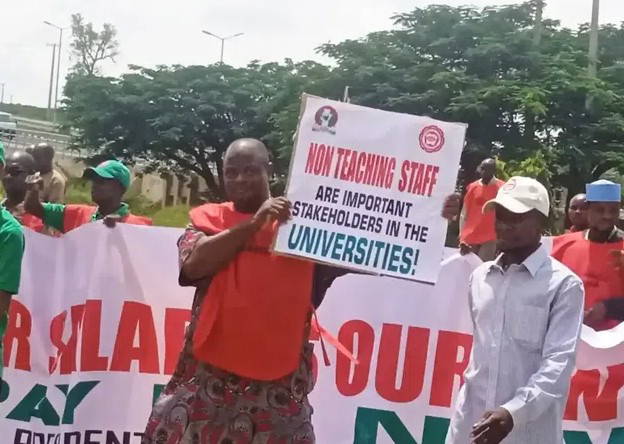
The University of Maiduguri, UNIMAID, has already postponed its e-examinations due to the ongoing industrial action, while workers at the University of Jos, UNIJOS, on Monday staged a peaceful protest over unresolved welfare issues and delays in the renegotiation of agreements with the Federal Government.
The strike, which began on April 30, followed the expiration of a one-month ultimatum issued by SSANU and NASU to the government to conclude the renegotiation of the 2009 agreement with non-teaching staff unions.
The unions rejected the Federal Government’s unilateral 30 per cent salary increase, insisting on a 40 per cent adjustment and accusing the government of failing to follow the collective bargaining process required by labour laws.
Sources at Monday’s meeting said government representatives explained the circumstances surrounding the withdrawal of the earlier 30 per cent offer and appealed to the unions to suspend the strike while efforts continued to resolve the issues.
However, the union leaders reportedly declined to make such a commitment without consulting their respective organs, leading to the adjournment of the meeting.
Speaking earlier on the strike, SSANU National President, Mohammed Ibrahim, described the industrial action as a total shutdown with full compliance nationwide.
“It’s very effective — total shutdown for now,” Ibrahim said. “All clinics, administrative blocks, hostels, departments, faculty offices, admin offices, finance offices, even those providing so-called essential services, have been ordered to withdraw.”
He maintained that the unions were demanding fairness and equity, stressing that the minimum benchmark for negotiation remained a 40 per cent increase.“Our position remains the same: we’ve asked for equity”.
“, consideration and fairness, so nothing has changed,” he said. “We will go and listen to them at the meeting, but the strike is on.”
In a memo issued by the Office of the Vice-Chancellor, UNIMAID said the postponement of examinations became necessary because of the strike.
“In view of the non-teaching staff strike, the above exams will be rescheduled until the current strike is suspended,” the directive signed by the Exams and Time-Table Coordinator, Prof. Dani Mamman, stated.
At UNIJOS, members of NASU and SSANU marched from the university’s main gate to the Senate Building, chanting solidarity songs and displaying placards to press home their demands.
SSANU Chairperson at UNIJOS, Anthony Jauro, criticised what he described as disparity in staff welfare and delays in addressing the concerns of non-teaching staff.
“Our advice to government is that creating division among staff welfare in the university system is not good. Why create disparity? Are you trying to create a crisis?” he asked.
He said while negotiations with some unions had been concluded earlier in the year with partial implementation, others were still being neglected.
Also speaking, NASU Chairperson at UNIJOS, Monday Danjuma, accused the Federal Ministry of Education of bias in its dealings with university unions.
“My call is that the Federal Government should do the needful. We want them to know that the Minister of Education is taking sides and creating division within the university system,” Danjuma said.
The unions insisted that the strike would continue until their demands were met and negotiations on the 2009 agreement were fully concluded.
How I want to be remembered
Governor Agbu
Kefas of Taraba State, weekend said his administration is focused on building a lasting legacy, stressing that he does not want to be remembered as a leader who made no meaningful impact.
He noted that his government is prioritising long-term development strategies aimed at positioning the state for sustainable growth, adding that leadership should go beyond occupying office to laying foundations for future administrations.
“Taraba was created over 29 years ago, and I don’t want to be remembered as a governor who just passed through. There must be a legacy. Even if it is setting up the state for others to build on, it matters,” he said.
Kefas identified the demand for quick results as a major challenge, given the state’s size and complexity.
He highlighted Taraba’s strategic location, noting that it shares boundaries with several states as well as an international border.
“People are often in a hurry to see results,” he added, stressing that governing the state requires a deliberate and structured approach.
According to him, leadership demands passion, systematic planning, and a strong commitment to protecting lives and property, which he described as his primary responsibility.
The governor revealed that the absence of a development framework was a major setback when he assumed office.
“When I came in, Taraba had no development master plan. What can you achieve without a plan?” he asked.
He noted that despite the state’s abundant natural resources and vast arable land, poor planning and lack of data had hindered its development.
“Taraba is richly endowed with solid and liquid minerals and fertile land, but without proper data and planning, you cannot harness these resources effectively,” Kefas said.
To address this gap, he said his administration developed a comprehensive master plan covering the entire state, including all local government areas.
Kefas reiterated his commitment to leaving a meaningful legacy, emphasising that sustainable development requires patience, proper planning, and consistency in policy implementation. He added that ongoing reforms are aimed at delivering tangible benefits to the people of the state.
LACN, alumni visit FCT, Keffi prisons, support inmates
The Legal Aid Council
of Nigeria, LACN, has carried out its second-quarter visit to correctional centres in the Federal Capital Territory, FCT, and Keffi, Nasarawa State, to identify awaiting-trial inmates without legal representation for possible assistance.
The visit covered both the old and new correctional facilities, where officials interviewed and documented 63 inmates — 54 males and nine females — whose cases are to be handled in Nasarawa State.
The inmates, mostly aged between 21 and 40, are facing charges ranging from criminal breach of trust and assault to theft. Officials described the situation as concerning, noting that many of the affected persons are youths who should be contributing positively to national development.The delegation was led by the Head of Department, Prison Decongestion, Mrs. Ogechukwu Ibenegbu, an Assistant Director in the Council.
Also on the visit was the Abuja Unity Chapter of the Edgerly Memorial Girls Secondary School Alumni Association, made up of April-born members, who partnered with the Council on the humanitarian outreach.
The leader of the group, Mrs. Diva Ivy Atimbang, paid N277, 000 to secure the release of two male inmates through the settlement of fines. The group also donated gift items to female inmates at the old Keffi correctional centre.
Speaking during the visit, an alumni member, Diva Esther Iwu, urged the inmates to remain hopeful and take advantage of rehabilitation programmes within the facilities to prepare for reintegration into society..
The officer in charge of the facility, Aya Luka, commended the Legal Aid Council for its continued interventions, noting that its activities had contributed significantly to prison decongestion and inmates’ welfare.
The LACN, led by Aliu Abubakar, reaffirmed its commitment to providing legal assistance to indigent Nigerians despite funding challenges.
St Raphael Hospital orders clinical review over patient’s death
The management of St
Raphael Divine Mercy Specialist Hospital, Ikorodu, has expressed grief over the death of one of its patients, Mrs. Faith Odaodu-Korode, and announced the commencement of a clinical review to determine the circumstances surrounding the incident.
In a statement issued yesterday, the hospital extended condolences to the deceased’s family.
“The Management and Staff of St Raphael Divine Mercy Specialist Hospital, Ikorodu, are deeply saddened by the passing of Mrs. Faith Odaodu-Korode. We extend our profound condolences to her husband, children, family and loved ones,” the statement read.
The hospital disclosed that it immediately commenced a comprehensive internal review in line with standard medical protocols.
“Following her death, the hospital immediately commenced a comprehensive clinical review of the incident. This review is being conducted in line with standard medical protocol to ensure it is thorough, objective and fair to all parties,” it stated.Reaffirming its commitment to patient safety and quality healthcare.
, the management said it remained committed to strengthening its systems and learning from every clinical outcome.
The hospital also disclosed that it was in direct and ongoing contact with the deceased’s family.
Reacting to discussions surrounding the incident on social media, the management urged the public to avoid speculation and allow due process to take its course out of respect for the family and the integrity of the review process.
VANGUARD.