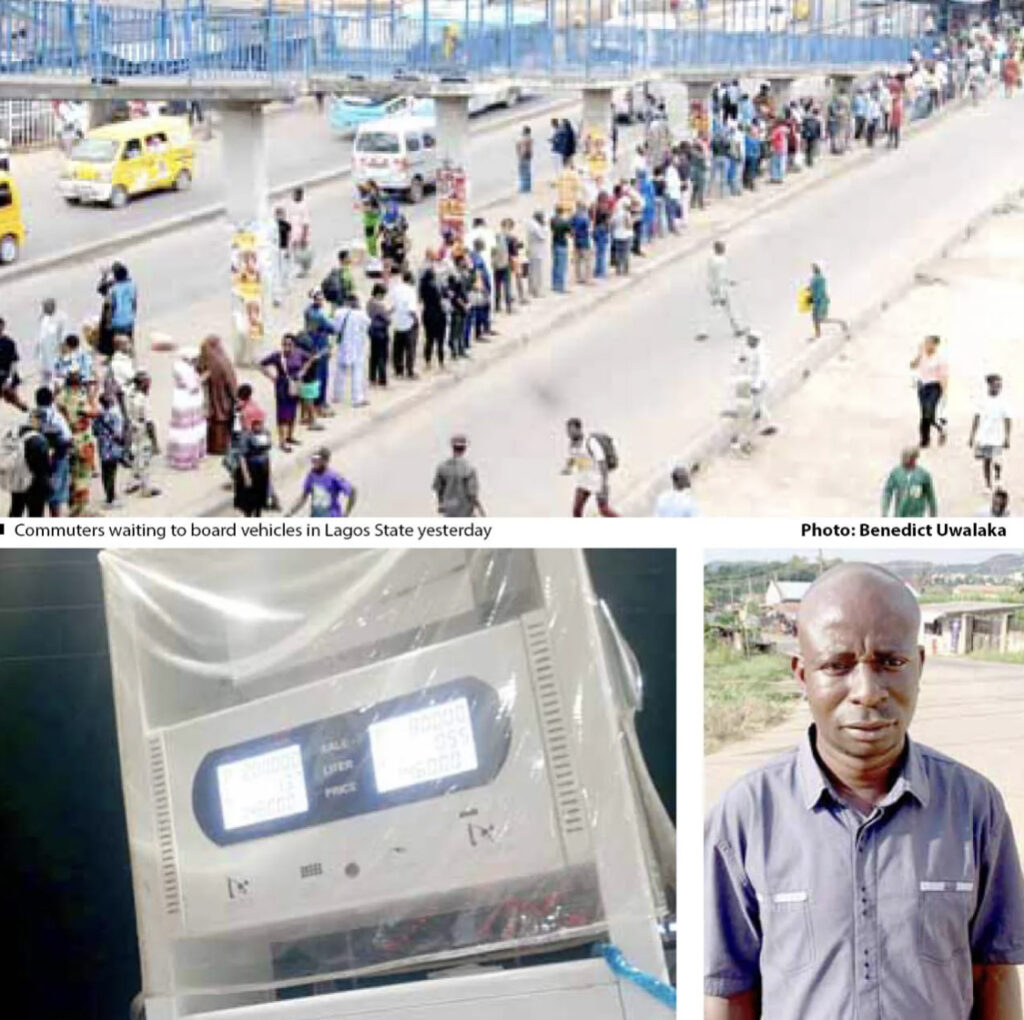
Rising petrol price and increasing transport fares are forcing Nigerians to change how they move around, with workers, parents, traders and other commuters cutting down on journeys, trekking longer distances and combining different means of transportation to reduce daily expenses, findings by Daily Trust have shown.
The Dangote Petroleum Refinery had recently raised its gantry price by N85 per litre amid a sharp rise in international crude oil prices.
The refinery increased its PMS ex-gantry price from N1,265 to N1,350 per litre, representing a 6.7 per cent increase and bringing the product closer to the N1,500 per litre threshold in parts of the country.
The adjustment immediately triggered a fresh round of price increase by filling station operators, with motorists in different parts of the country now paying between N1,395 and N1,460 per litre.
This is even as the crude oil price increased further to $108 per barrel yesterday as the gulf war deepened.
With petrol prices now hovering around N1,500 per litre in some locations, the cost of mobility has become a major concern for households already grappling with the high cost of living.
For many car owners, regular use of private vehicles has become increasingly difficult as the cost of filling their tanks continues to rise.
Some have resorted to using their vehicles only for essential journeys, while others have parked their cars and turned to public transportation.
Commuters who depend on commercial buses, tricycles, motorcycles and taxis are also feeling the impact as operators adjust fares to reflect higher fuel and maintenance costs.
For some Nigerians, the adjustment has gone beyond cutting down on trips. They are now walking portions of their journeys, leaving home earlier and waiting longer for cheaper transport options.
‘My car is now mainly for school runs’
Mrs Abisola Pedro, an entrepreneur and mother of three in Lagos, said the rising cost of petrol had significantly changed the way she uses her car.
Pedro said she now uses her vehicle mainly to take her children to and from school and to attend religious activities on Sundays.
According to her, the cost of fuelling her vehicle has become too high to justify using it for regular movements around Lagos.
She explained that she drops her children at school in the morning and leaves the car there until the afternoon when they close, instead of driving home and returning later.
‘We now trek to save transport money’
Another Lagos resident, Rehoboth Caleb, said rising transport fares were pushing some commuters to walk distances they would previously have covered by public transport.
Caleb said trekking had increasingly become a necessity for some Nigerians who could no longer afford regular transport fares.
“Transport fares have continued to rise, leaving workers, students, traders and other low-income earners with difficult choices to make: spend a large portion of their daily income on transportation, reduce the number of trips they make, or simply walk long distances,” she said.
According to her, some commuters now leave home earlier and walk part of their journey before boarding a vehicle for the remaining distance.
Caleb said the situation was particularly difficult for workers whose incomes had not increased in line with the rising cost of transportation, food and other necessities.
“The question is no longer just, ‘How much is transport?’ It is, ‘How much of my daily income will remain after I get to work?’” she said.
“Nigerians are not coping as much as they are surviving,” Caleb added, saying people were making sacrifices and walking longer distances “not because they want to, but because they have no choice.”
Workers in Akure, Ondo State, said rising fuel prices and transportation costs were putting additional pressure on their incomes.
Some workers said they were now trekking portions of their journeys to work, while others have had to review their spending on food and other household needs to accommodate higher transportation expenses.
Olusegun Hosea, a civil servant with the Federal Ministry of Education, said he spends about N2,000 daily on transportation to and from work, leaving very little from his N70,000 minimum wage for other necessities.
Hosea said the situation was particularly painful for workers with families and other responsibilities, adding he sometimes trekked part of the distance to reduce his daily transportation expenditure.
“You need to trek some distance to reduce the transport fare that you are spending. I used to trek some distance and, as I’m doing it, I believe it is similar to what other people are doing too,” he said.
He called on the government to prioritise workers’ welfare and introduce measures capable of reducing the impact of rising transportation and living costs.
Hosea suggested that government-owned transport services should be provided at subsidised rates to ease the burden on civil servants.
He also called for welfare packages and support for essential expenses such as food and school fees.
According to him, many civil servants are not only responsible for themselves but also support relatives and extended family members.
“An average civil servant is not feeding himself alone,” he said.
Ayodele Alabi, a worker in a private industry in Akure, said rising fuel prices were also affecting his ability to commute to work.
Alabi described fuel as an essential commodity because it is required directly or indirectly for transportation and other economic activities.
He disclosed that he spends about N5,000 on fuel every day, translating to approximately N150,000 monthly.
‘I now walk before taking a tricycle’
For Fagbemi Bukola, a worker at a public canteen in Akure, the increase in transportation fares has forced her to change the way she commutes to work.
“I used to take a commercial tricycle to work for N700 per day, but now, with the increase in fuel price, I now take a commercial tricycle for N1,500 per day,” she said.
Bukola said she earns N40,000 monthly and said her salary had not increased despite the sharp rise in transportation costs.
As a result, she now walks some distance before boarding a tricycle in an effort to reduce the amount she spends each day.
“There’s no plan to increase my salary. This makes me walk some distance before I take a commercial tricycle to cut costs. It is really painful,” she said.
She appealed to the government to introduce measures to cushion the impact of rising transportation costs on low-income workers.
‘Govt should cushion effect of high fuel price’
A transportation analyst and former commissioner in Lagos, Professor Bamidele Badejo, in a chat with our correspondent, said the government should have come up with a framework to cushion the consequences of high fuel prices.
He stated that the high cost of PMS would add to the hardship and the cost of living crisis facing Nigeria.
He said, “What is happening is not a good occurrence; it will add more to the hardship and cost of living crisis, people would be absent from work, and it will trigger insecurity.
“How are people going to cope? Yet you are increasing the cost of rent; electricity is going up. All is not well.”
Why fuel remains expensive in Nigeria — Dangote
Meanwhile, President of Dangote Industries Limited, Aliko Dangote, has attributed the high price of petrol in Nigeria partly to continued smuggling of the commodity to neighbouring countries where it sells at significantly higher prices.
Dangote said petrol prices in neighbouring countries were between 30 and 50 per cent higher than in Nigeria, creating a strong financial incentive for traders to move the product across the borders.
He stated this in an interview aired on Arise TV on Tuesday while speaking on petrol prices and product availability amid the ongoing crisis in the Middle East.
Explaining why Nigerians may consider petrol expensive despite the country producing the commodity locally, Dangote said the price must be viewed in relation to prices in neighbouring countries.
“You know, expensive is relative. In the sense that today, maybe, you know, a lot of them, there’s ignorance also. What they need to do is ask, what is the neighbour’s price?”
He said the significant price difference was encouraging the continued movement of Nigerian petrol across the borders.
“I don’t know if you know that there’s still a lot of smuggling of the same petrol we are producing to our neighbouring countries.”
Dangote specifically cited Niger, where he said petrol was selling at a premium of between 20 and 25 per cent compared with Nigeria.
Using a petrol price of N1,350 as an example, he said the difference offered traders an immediate financial incentive to move the product across the border.
“So, what business are you going to do that will make you have an instant 25 per cent return?” he asked.
He explained that petrol meant for domestic distribution could allegedly be diverted to border communities and sold to buyers in neighbouring countries at higher prices.
“So, it means that, yes, you take the [petrol], you go and take it across the border. You pretend you are taking it to Sokoto, you go and just take it to Ilela, and you sell it.”
According to Dangote, such diversion could reduce the volume of petrol available to Nigerian consumers.
Beyond the issue of price, however, Dangote warned that the ongoing crisis in the Middle East could create a different challenge for Nigeria’s downstream petroleum market.
He said the major concern could shift from the price of petrol to the availability of sufficient volumes.
“And the problem now, going forward, I must also warn that this crisis in the Middle East is not even about price; it’s about availability,” he said.
Asked whether Nigerians should be worried about petrol supplies, Dangote assured consumers that his refinery was prepared to continue meeting domestic demand.
“We will deliver to Nigeria. Nigerians don’t need to worry. There will not be any shortage from our own part.”
“There won’t be any shortage. There will not be any queues. We will make sure that we keep satisfying the market, despite all odds,” he added.
Don’t push Nigerians, ADC tells Tinubu
The African Democratic Congress (ADC) said President Bola Ahmed Tinubu’s economic policy is pushing Nigerians “dangerously close to the limits of human endurance.”
The party’s spokesperson, Bolaji Abdullahi, said in a statement that with petrol now selling for as much as N1,470 per litre, every journey had become more expensive, while food and even basic education are being priced out of the hands of citizens.
“President Tinubu has turned the petrol pump into an instrument of punishment for everyday Nigerians. Food, transportation, electricity, education, and everything Nigerians need to survive respond directly to the price of fuel and combine to make life difficult for the majority of Nigerians,” the party said.
The ADC noted that the widespread reports of private schools increasing fees by between 30 and 40 per cent, while incomes have not increased anywhere near that margin, is another evidence of how life has become progressively worse under the APC government.
The party said it does not blame school proprietors who, it said, are themselves “struggling” with rising taxes, electricity bills, fuel costs, rent, and salaries. “Parents, workers, and businesses are all casualties of Tinubu and the APC’s economy.”
The opposition party said, “At N1,470 per litre, petrol is no longer simply a commodity. It is Tinubu Tax, which has made life unbearable for the majority. Under Tinubu and the APC, Nigerians have been tightening their belts. Now, there are no more holes left, and people have started to choke. Families are now skipping meals, withdrawing children from school, abandoning medical treatment and shutting down businesses.
“The government could not continue demanding sacrifice from ordinary Nigerians while public officials funded extravagant lifestyles from the same public purse.
“A reform that continuously makes the people poorer is not working. An economic policy that produces impressive figures at government briefings but hunger in Nigerian homes is a failure.
“When parents must choose between feeding their children and educating them, the government has failed spectacularly in its most basic responsibility.”
The ADC said the 2027 election would present Nigerians with a clear choice between “carrying on with enduring President Tinubu’s punishment and embracing the relief programme proposed by the ADC presidential candidate, Alhaji Atiku Abubakar.”
The party restated its presidential candidate’s commitment to reducing the price of petrol by bringing back subsidy to support domestic production of fuel, which would, in turn, ease the cost of food, transportation and production.
“Unlike Tinubu and APC, we recognise that economic reform must serve the people, not sacrifice them. Nigeria cannot be an oil-producing country whose citizens experience every visit to a filling station as punishment,” he said.
The party therefore warned the ruling party not to mistake the patience of Nigerians for approval or surrender.
“Their resilience must not become an excuse for continued cruelty. Tinubu has had enough time and inflicted enough pain. The people are suffering, businesses are dying, and hope is becoming increasingly expensive. President Tinubu must act now. Don’t push Nigerians to their limits,” the party said.
Daily Trust