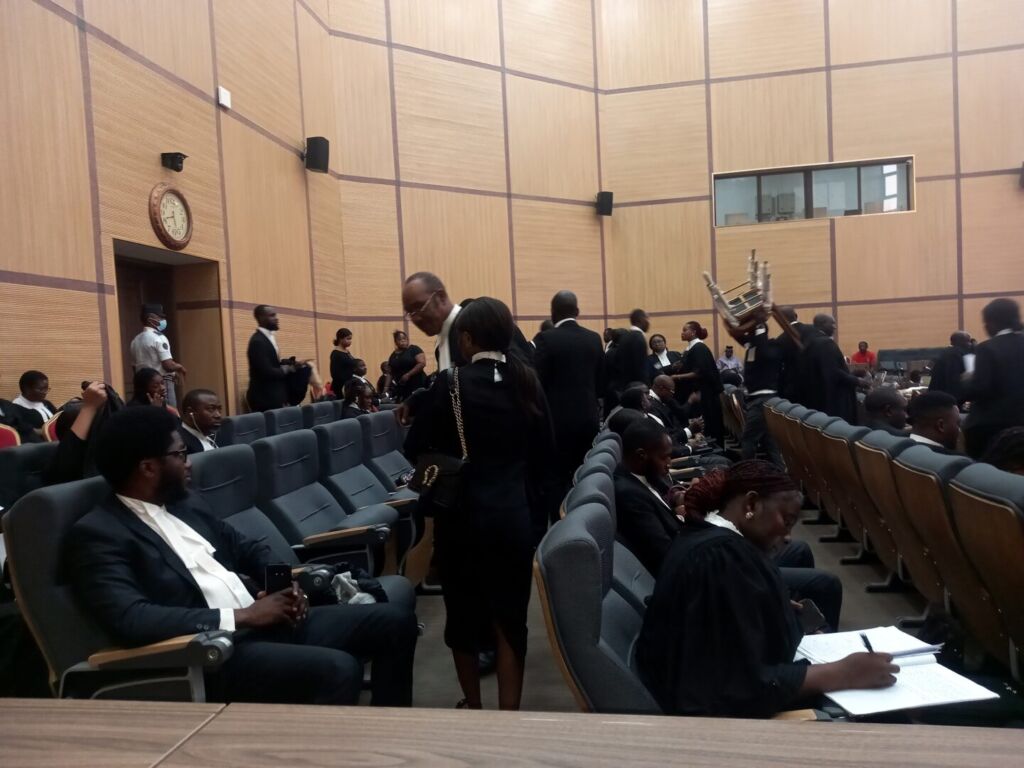
The Supreme Court delivered judgement on the suit filed by some state governments to challenge the federal government’s naira redesign policy today (Friday).
A seven-member panel of the Supreme Court had on 22 February heard the case and adjourned till today for judgement.
Members of the panel led by John Okoro are filed into the courtroom at 9 a.m. Friday.
The controversial monetary policy being challenged at the Supreme Court had last year introduced newly redesigned 200, N500, and N1,000 notes with tight deadline to mop up the old notes from circulation.
The policy has led to scarcity of currency notes, bringing untold hardship to millions of citizens in an economy significantly driven by the informal sector with a large proportion of unbanked persons.
At 31January deadline intially set for ending the legal tender status of the old notes was extended to 10 February as the supply of the new notes fell far short of the volume needed by citizens to meet their most basic needs across the country.
On 3 February, three statement governments – Kaduna, Kogi, and Zamfara – citing the hardships the continued scarcity of naira notes brought to their people, sued the federal government at the Supreme Court for a reversal of the policy.
Five days later, the court issued an interim order suspending the implementation of the deadline set by the federal government, and directed that the old and new notes should continue to circulate pending the resolution of the case.
Unmoved by the court’s order, the CBN insisted that the old notes had stopped being legal tender after the 8 February deadline while the scarcity of the new notes persisted.
In defiance to the Supreme Court’s order, Mr Buhari on 16 February, restored the validity of the old N200 notes, insisted that the N500 and N1000 notes had ceased to be legal tender.At the resumed hearing of the suit on 22 February, the number of plaintiffs rose to 16 after six new states were added to the three initial plaintiffs.
The 16 states now on the list of plaintiffs include: the original plaintiffs – Kaduna, Kogi, Zamfara – and the seven that were joined on 15 February – Cross River, Sokoto, Lagos, Ogun, Katsina, Ondo, and Ekiti states.
The rest are the six others that were joined on Wednesday – Nasarawa, Niger, Kano, Jigawa, Rivers and Abia states.
Rivers and Abia states had filed separate suits that were consolidated with the main one.
Before then, two states – Edo and Bayelsa – joined the side of the federal government to oppose the suit.
The six-member panel of the Supreme Court promised during the 22 February hearing that it would do justice in the suit.
SUPREME COURT JUDGEMENT
The Supreme Court, faulted President Muhammadu Buhari’s decision to redesign the N200, N500 and N1,000 banknotes without consulting the 36 states of the federation.
The apex court held that though President Buhari could exercise Executive Powers on behalf of the federation, he ought to have given reasonable notice to the federating units before executing the new monetary policy through the Central Bank of Nigeria, CBN.
It held that reasonable notice was not given to the states as required under section 20(3) of the CBN Act, before the old Naira notes were withdrawn.
Consequently, the Supreme Court, in its lead judgement that was delivered by Justice Emmanuel Agim, held that the approval that President Buhari gave the CBN to withdraw the old banknotes was invalid.
The apex court also nullified the Federal Government’s naira redesign policy, declaring it as an affront to the 1999 Constitution.