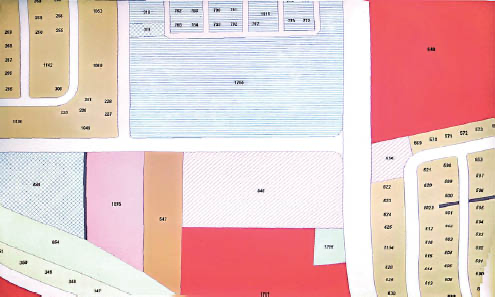
The Federal Capital Territory Administration (FCTA) has converted an expansive plot of land designated for building of a hospital for Wuye District in the Abuja Master Plan to a private residential estate.
Abuja Metro reports that the designated site with Plot number 546 Cadastral Zone B03 Wuye District, Abuja, sitting on 3.171 hectares, was awarded to a private developer, Full Moon Estate Developers Ltd, for a residential development.
The plot, which lies directly opposite the Wuye Ultra-Modern Market and beside the Wuye Police Station, has been fully fenced with barbed wires, while construction has begun by the developer.
The details on the project’s signboard show the project title as “Residential development”; site as “plot no. 546 CAD Zone B03 Wuye”; developer as “Full Moon Estate Developers Ltd”; file number “FCDA/DC/BP/RSD/PHSII/31854;” approval date as 05-March-2026 and the Site Engineer as: Engr Ose Peter Afeanaje.
When our reporter visited the area on Wednesday, he observed that constructions were ongoing in earnest, with trucks bringing in various materials and equipment for work.
Abuja Metro reports that a careful review of the Abuja Master Plan for Wuye District revealed that the said Plot 546 was originally designated for the building of a health facility in the district as is obtainable in other districts within the territory.
When our reporter approached one of the site engineers to speak on the matter, he simply told him, “just forget it”.
Disquiet trail conversion of hospital land to estate development
Meanwhile, residents of Wuye District and other stakeholders have expressed worry over the conversion of the plot of land designated for a health centre to a private residential estate.
A resident, Ahmed Usman, said he was disappointed when he discovered that the place had been allocated to a private developer for construction of something other than what was initially intended.
“Initially, when they started fencing the place, I thought that the FCTA was coming in to begin the construction of our health centre which we have anticipated for many years. It was disheartening when I later saw a project signboard showing that it was going to be for the development of a private residential estate,” he said.
He said the conversion of a land meant for a public health centre showed that the FCT Administration prioritized private interest over the public health interest of the people.
Another resident, Okonkwo Ferdinand, condemned the conversion, which he said, will not serve the interest of the people.
He described the action as insensitive to the wellbeing of the people, urging the FCT Minister. Nyesom Wike and other concerned authorities in the administration to revert the plot to the original purpose.
Also speaking, the Executive Director of the Civil Society Legislative Advocacy Centre (CISLAC), Auwal Musa Rafsanjani, condemned the conversion of a plot designated for a public hospital in Abuja’s Wuye District into a private housing development, describing it as “land corruption” and a violation of the Abuja Master Plan.
Rafsanjani, whose organisation is the Nigerian chapter of Transparency International, said the development reflects a troubling pattern of abuse of due process and disregard for public interest within the Federal Capital Territory Administration (FCTA).
“Land clearly marked for public use is now being handed over for private interest. This runs contrary to the principles guiding the Abuja Master Plan, where every district is expected to have designated social amenities such as hospitals, schools, police stations and health centres.
“What we are witnessing is a violation of that plan and a clear case of prioritising private gain over public good.”
He said the situation raises serious concerns about governance under the current FCT administration, alleging a pattern of questionable decisions.
“This is deeply troubling. Previous FCT ministers did not personalise or privatise public assets in the manner we are seeing today. The current trend represents a significant departure from established standards of governance,” he said.
Rafsanjani called for urgent intervention by anti-corruption agencies to address the situation and prevent further erosion of public trust.
“Relevant anti-corruption agencies must act swiftly. Delayed intervention often allows damage to become irreversible before accountability mechanisms are triggered,” he said.
‘It’s a breach of master plan and violation of humanity’
Speaking on the development, a town planning expert and former Coordinator of the Abuja Metropolitan Management Council (AMML), TPL Umar Shuaibu, condemned the act, describing the development as both a breach of the Abuja Master Plan and “a violation of humanity.”
Shuaibu, who spoke against the backdrop of the ongoing development on land originally earmarked for a district hospital, said the action undermines decades of structured urban planning and denies residents access to critical healthcare services.
Providing historical context, he explained that the Abuja Master Plan clearly outlines the facilities to be provided within each district centre, including general hospitals, schools, police stations, and commercial hubs.
“In every district centre, specific facilities are carefully allocated. You see this in Area 10, Garki, where you have a general hospital, a secondary school, a police station, and a commercial centre all coexisting as part of a deliberate plan,” he said.
According to him, the land in question had, for over 30 years, been reserved strictly for a district hospital, with successive administrations respecting its designated purpose.
“Once land is earmarked for critical services like hospitals or schools, it is rarely tampered with because of its importance to human life. This particular land has been protected from the beginning of the district’s development, out of respect for the master plan,” he noted.
He expressed dismay that the current administration altered that long-standing designation.
“Now, that same land has been converted into a housing estate. This is not just a violation of the master plan; it is a violation of humanity. Health is life. Anyone tampering with a facility meant to safeguard lives is directly tampering with the survival of the people,” Shuaibu said.
He further explained that the siting of district hospitals is not arbitrary but based on population projections and urban planning calculations.
“A district is made up of several neighbourhoods, with populations ranging from 20,000 to 80,000 people. The master plan specifies that such districts should have hospitals of at least 120-bed capacity to cater for emergencies and general healthcare needs,” he said.
He stressed that replacing such a facility with private housing deprives residents of essential public healthcare.
“You are denying an entire district access to a government hospital. This is a public facility meant for everyone, especially those who cannot afford private healthcare. It is not something that should be commercialised,” he said.
Shuaibu also raised concerns about the nature of the housing development, noting that it caters primarily to high-income earners.
“The estate being built is not for low-income residents. Meanwhile, there are already many unoccupied houses in Abuja. If housing is the priority, there are numerous other locations suitable for such developments,” he argued.
He added that public land designated for critical services should not be repurposed for profit-driven ventures.
“If the government wants to build estates, there are lands allocated for that purpose. But not every land can serve as a hospital. Once you lose that space, you lose the opportunity to provide that level of healthcare infrastructure in that district,” he warned.
The planner also touched on the complexities surrounding the land, including the presence of Fulani nomadic settlers who have historically occupied the area.
He explained that their continued presence had delayed earlier development plans, as FCT policy requires the resettlement of original inhabitants before any project can proceed.
“These settlers have been there even before Abuja was developed. Because they were not resettled, the government could not fully take over the land. That was part of what delayed the hospital project,” he said.
Despite this, he questioned how the current development proceeded without addressing those longstanding resettlement issues.
“Now, instead of resolving those concerns and building the hospital, we are seeing a completely different use of the land. That raises serious questions,” he added.
Shuaibu lamented that the affected district currently lacks any government hospital, making the situation even more critical.
“There is no government hospital in that district. That land was the only provision for such a facility. By converting it, you are leaving the entire population without access to public healthcare,” he said.
While declining to comment on any specific community actions regarding the development, he maintained that the issue should be viewed from a broader public interest perspective.
“This is not about individuals or communities; it is about protecting the integrity of the Abuja Master Plan and ensuring that essential services are not sacrificed,” he said.
He called for a reconsideration of the decision, warning that continued disregard for the master plan could lead to long-term consequences for the city’s functionality and residents’ well-being.
“If we continue to violate the master plan in this manner, Abuja will gradually lose its structure and purpose. Urban planning is about sustainability, and once you compromise critical infrastructure like healthcare, the impact will be far-reaching,” he cautioned.
FCT Development Control confirms land meant for health centre
When contacted yesterday, the Acting Director, FCT Development Control Department, TPL Bashir Madaki Sanusi, confirmed that the said plot 546 was actually meant for the construction of a health centre in the Abuja Master Plan.
He, however, said the approval granted by the department for a private housing estate on the land originally designated for a health centre followed an official communication from the Urban and Regional Planning Department of the Federal Capital Development Authority (FCDA) indicating that the plot had been re-designated from a public health facility to residential use
“The land use of the place, originally, is a health centre, that is clear. But I must state that I have never been to the site, so I cannot confirm whether there were any existing structures or if a health project had commenced and was abandoned,” he said.
He explained that the development proposal was submitted to his office earlier this year, though the initial application dates back to the previous year.
“When the submission came to my office and I flipped through it, I was surprised. The land use indicated in our records was for a health centre, yet the design submitted was for residential development. I immediately queried it and sent it back,” Sanusi disclosed.
However, he said the situation changed following an official correspondence from the Department of Urban and Regional Planning, which he described as the custodian of the Abuja Master Plan.
“About one or two months ago, we received a letter confirming that the plot had been converted to residential use. The letter clearly stated that Plot 546, measuring about 3.171 hectares in Wuye District, had been allocated as a private housing estate to a developer, with ministerial approval and a statutory right of occupancy issued by the Department of Land Administration,” he said.
According to him, it was on the strength of that letter that his department approved the ongoing development.
“I am not formulating anything on my own. It is on the strength of that letter from Urban and Regional Planning that I granted approval for the development currently ongoing on site,” he stated.
Sanusi noted that concerns raised internally and externally, including professional opinions questioning the development, prompted further action from his office.
“Some of my colleagues drew my attention to concerns about the development, including an opinion by a senior town planner. Based on that, the first step I took was to order a stop to work on site,” he said.
He added that his department has since initiated a fresh verification process to clarify the land use status.
“Given the sensitivity of the initial designation as a public health facility, I wrote formally to the Urban and Regional Planning to request validation of the change of use and to be furnished with a revised land use map. I intend to personally deliver this letter to avoid any form of interference,” he explained.
He stressed that the outcome of that verification would determine the fate of the project.
Sanusi maintained that his department operates within established procedures and relies on official communications from the appropriate authorities.
“Ordinarily, when we receive a communication like that, we work with it. We do not reconfirm because it is assumed to have come from the appropriate authority, which is the custodian of the master plan,” he said.
Addressing questions on whether Development Control should challenge decisions that appear to contradict the master plan, Sanusi insisted that inter-departmental protocol must be respected.
“The Department of Urban and Regional Planning is the custodian of the master plan. Whatever they communicate to us forms the basis of what we implement, provided it is backed by an official letter,” he said.
While rejecting suggestions that his department’s hands were tied, he emphasised adherence to institutional procedures.
“My hands are not tied. But there is a procedure, and it has been in place long before now. If a letter like this exists, we are obliged to act on it. If it does not, we will not proceed,” he stated.
Meanwhile, efforts to get the reaction of the Urban and Regional Planning Department on the matter proved abortive as of press time last night.
DAILY TRUST.