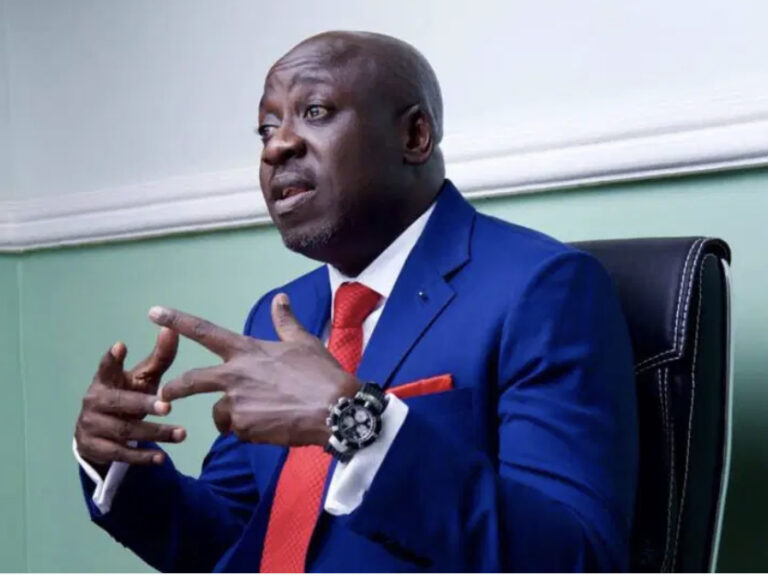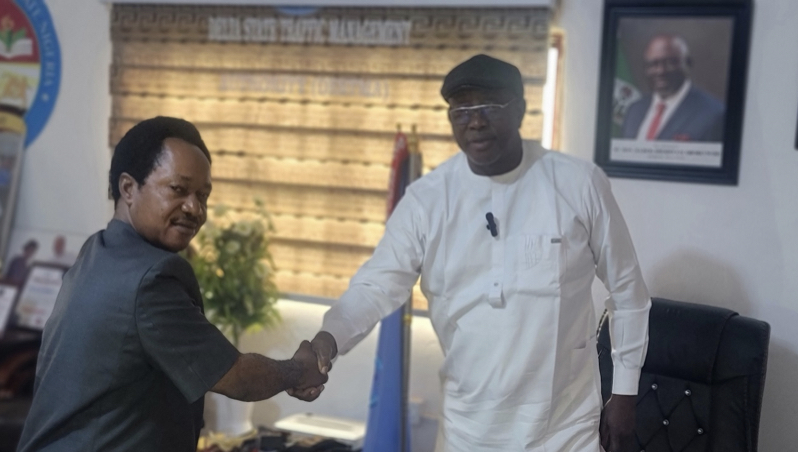
The Director-General of the Delta State Traffic Management Authority (DESTMA), Hon. Dr. Benjamin Essien Okiemute, NN (Rtd), FNIIS, has reaffirmed the Authority’s unwavering commitment to building a safer, more orderly and efficient traffic management system across Delta State through discipline, professionalism, innovation and strategic collaboration.
Speaking during an exclusive interview granted to the Managing Director of Solution Magazine Abuja, Dr. Raphael Okodugha Ayemere, at his office in Asaba on Monday, 27th July, 2026, the Director-General reflected on his leadership journey, the Authority’s mandate, ongoing reforms and his vision for the future of traffic management in Delta State.
Drawing from his years of service in the legislature and the nation’s security architecture, including working under two Heads of State, participating in national and international peacekeeping and security assignments, as well as undergoing professional training in countries such as Israel and Pakistan, Dr. Okiemute said these experiences have equipped him with the capacity to effectively deliver on the mandate entrusted to him by the Governor of Delta State, Rt. Hon. Elder Sheriff Oborevwori. He explained that leadership is fundamentally about service, discipline and accountability.
According to him, his background has given him a deep understanding of public policy, strategic planning, crisis management and people-oriented leadership, qualities he noted have continued to drive the ongoing transformation of DESTMA.
The Director-General, however, emphasized that the achievements recorded under his administration have been the product of teamwork rather than individual effort. He paid glowing tribute to the Chairman of the DESTMA Governing Board, High Chief Peter Idion, members of the Board, the Directors and the entire management team for their unwavering support, guidance and commitment to the Authority’s vision. Dr. Okiemute acknowledged that their collective efforts, cooperation and dedication have significantly contributed to the successes recorded so far, describing them as dependable partners in the ongoing transformation of DESTMA.
“I came into this office with a clear understanding that traffic management is not merely about controlling vehicular movement. It is about protecting lives, safeguarding public infrastructure, ensuring economic productivity and supporting the overall development agenda of the government,” he stated.
The Director-General disclosed that accepting the responsibility of leading DESTMA was driven by his desire to contribute meaningfully to Governor Rt. Hon. Elder Sheriff Oborevwori’s vision of a more peaceful, secure and prosperous Delta State.
He described the Governor’s MORE Agenda as a practical development blueprint that places the welfare of citizens at the centre of governance, pointing to the recent introduction of a 13th-month salary for Delta State civil servants, which is expected to take effect from December, as one of the administration’s landmark welfare initiatives.
“Our mission is to build a disciplined, responsive and technologically driven traffic management institution committed to promoting road safety, ensuring the free flow of traffic and delivering efficient public service through professionalism, integrity and continuous innovation,” he said.
Dr. Okiemute noted that DESTMA’s operations directly complement the MORE Agenda, particularly its pillars of Enhanced Peace and Meaningful Development, explaining that efficient traffic management contributes significantly to economic growth, security, emergency response and improved quality of life.
He stressed that enforcing a disciplined driving culture does not simply mean sanctioning offenders but fostering responsible road behaviour where every motorist, commercial driver, pedestrian and transport operator understands and obeys traffic regulations.
“The urgency today is clear. As urban centres continue to expand and the number of vehicles increases daily, discipline on our roads has become essential for protecting lives and sustaining development,” he remarked.
Addressing the causes of traffic indiscipline, the Director-General identified impatience, inadequate knowledge of traffic regulations, poor driving habits and disregard for constituted authority as major challenges confronting road management.
To address these issues, he explained that DESTMA has intensified public enlightenment campaigns, strengthened operational patrols, improved officer training and expanded stakeholder engagement across the state.
He emphasized that enforcement alone cannot deliver sustainable results without continuous public education.
“We want motorists to see DESTMA as partners in public safety. While we enforce the law where necessary, we are equally committed to educating road users because prevention remains more effective than punishment,” he explained.
Speaking on modernization, Dr. Okiemute disclosed that the Authority is gradually integrating technology and data-driven strategies into its operations.
According to him, continuous personnel development, improved operational logistics, intelligence gathering and digital monitoring systems are positioning DESTMA to meet the growing demands of modern traffic management across Asaba, Warri, Agbor, Sapele, Ughelli and other major traffic corridors.
The Director-General also highlighted the importance of inter-agency collaboration, noting that DESTMA maintains strong working relationships with the Federal Road Safety Corps (FRSC), the Nigeria Police Force, transport unions, local government authorities and traditional institutions to promote compliance and strengthen public confidence.
He maintained that effective traffic management can only succeed when all stakeholders work together in pursuit of a common objective.
On public concerns relating to extortion and misconduct by traffic officers, Dr. Okiemute reaffirmed his administration’s zero-tolerance policy on corruption, adding that officers have been repeatedly warned against engaging in any form of unethical conduct.
He disclosed that internal monitoring mechanisms, supervisory inspections, intelligence operations, regular ethics training and firm disciplinary measures have been strengthened to ensure officers maintain the highest standards of professionalism.
“We have consistently made it clear that extortion and abuse of office have no place in DESTMA. Officers found wanting will face appropriate disciplinary action because public trust remains one of our greatest assets,” he said.
Reviewing the Authority’s performance since assuming office, the Director-General highlighted several visible achievements that have strengthened DESTMA’s operational capacity.
These include the refurbishment and modernization of the Authority’s headquarters, the procurement and rehabilitation of operational vehicles and recovery trucks, the establishment of specialised operational units, improved officer welfare, enhanced training programmes, rebranding initiatives and the construction of a modern impound facility aimed at improving operational efficiency and transparency.
He observed that motorists and residents across the state are already witnessing improved traffic coordination, quicker response to road incidents and increased professionalism among officers.
Despite these gains, Dr. Okiemute acknowledged that challenges such as increasing vehicular population, manpower requirements, infrastructural constraints and changing public attitudes continue to demand innovative solutions.
He assured that the Authority remains committed to prudent resource management, continuous personnel development and stronger partnerships with government and stakeholders to overcome these challenges.
The Director-General further disclosed that DESTMA is expanding road safety education beyond urban centres by strengthening awareness programmes in rural communities where transportation challenges often require tailored interventions.
He explained that community engagement remains critical to ensuring that every Deltan, regardless of location, benefits from safer roads and responsible road use.
Looking ahead to 2027, Dr. Okiemute expressed confidence that DESTMA will emerge as one of Nigeria’s leading traffic management institutions through improved technology, enhanced operational efficiency, stronger public confidence and sustained institutional reforms.
He envisioned a future where traffic congestion is significantly reduced, emergency response becomes faster, compliance with traffic regulations improves substantially and road users willingly embrace discipline as a civic responsibility.
In his closing remarks, the Director-General appealed to commercial drivers, tricycle and motorcycle operators, private motorists and pedestrians to see road safety as a collective responsibility.
He urged all road users to obey traffic regulations, respect constituted authority, avoid reckless driving and work together with DESTMA in creating safer roads for everyone.
“Our roads belong to all of us. Safety begins with individual responsibility. Let us all play our part in building a disciplined driving culture that protects lives, supports economic development and reflects the values of a progressive Delta State,” Dr. Okiemute concluded.