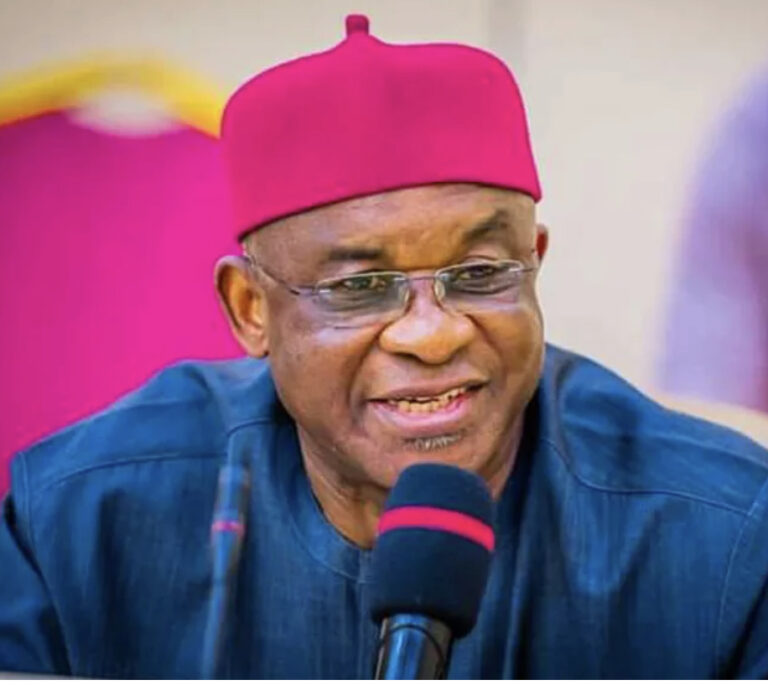
Governor Monday Okpebholo’s pledge to deliver 2.5 million votes for President Bola Ahmed Tinubu in Edo State in the 2027 presidential election has set an ambitious projection for the All Progressives Congress (APC), but the state’s voter statistics suggest it is a tall order.
Okpebholo has repeatedly vowed that Edo would deliver 2.5 million votes for Tinubu, arguing that the “one man, one vote” principle and the impact of the Federal Government’s economic reforms would help the APC achieve the target.
He restated the position in Benin City recently, during a one-million-youth march organised by the City Boy Movement in support of his administration and Tinubu’s re-election.
“We are paying so much on salaries and at the same time, development is ongoing, projects are ongoing. Look at our flyover, if not for the reforms of the president, where will we get money for all this?” Okpebholo said.
The governor also cited his administration’s projects in healthcare and education as evidence of the benefits of the reforms.
He said the state had built more than 108 primary healthcare centres, renovated over 87 primary and secondary schools and increased subvention to higher institutions from N41 million to more than N700 million.
“How could we have gotten this money, if not [for] the man (President Bola Tinubu) that is courageous enough to have removed the fuel subsidy,” he said.
Edo’s voting strength
Edo had 2,501,081 registered voters on the final register used for the 2023 general elections.
The latest figures provided by the Independent National Electoral Commission (INEC) for the 2027 elections put the state’s registered voters at 2,865,263, representing an increase of 364,182 voters, or about 14.6 per cent in four years.
The new register means Edo now has 2.865 million registered voters, making it the 14th-largest electorate among Nigeria’s 36 states and the Federal Capital Territory.
However, Okpebholo’s 2.5 million target would account for about 87.3 per cent of the entire 2027 registered electorate in the state.
Put differently, for Tinubu to receive 2.5 million votes, nearly 87 out of every 100 registered voters in Edo would have to vote for him.
That is where the difference between voter registration and actual voting becomes important.
The 2023 presidential election provides the most recent voting benchmark.
In Edo, Peter Obi who was the presidential candidate for the Labour Party, secured 331,163 votes to win the state in 2023, while Tinubu of the APC received 144,471 votes. Former Vice President Atiku Abubakar of the Peoples Democratic Party polled 89,585 votes, while former Kano State Governor, Rabiu Kwankwaso of the New Nigeria Peoples Party received 2,743 votes.
Tinubu’s 144,471 votes represented about 5.8 per cent of the 2,501,081 people registered to vote in Edo at the time.
His tally was also less than half of Obi’s 331,163 votes.
The APC would therefore need to move from 144,471 presidential votes in Edo in 2023 to 2.5 million in 2027 to meet Okpebholo’s target.
That would mean an additional 2,355,529 votes, or roughly 17 times the number of votes Tinubu secured in the state in 2023.
The picture becomes clearer when voter turnout is considered.
Nationally, about 24.9 million votes were cast from a final register of 93.47 million voters in the 2023 presidential election, representing a turnout of roughly 26.7 per cent.
While Edo’s turnout cannot simply be assumed to mirror the national figure, the national experience demonstrates why the number of registered voters should not be treated as the number of people who will necessarily vote.
If only half of Edo’s 2,865,263 registered voters turned out in 2027, for example, the total number of voters would be about 1.43 million, far below the governor’s 2.5 million target.
Even at 70 per cent turnout, the state would produce only about 2 million voters.
For 2.5 million people to actually vote for Tinubu, turnout would have to be extraordinarily high, with the overwhelming majority of those who participate voting for the APC candidate.
‘It was political rhetoric ’
Professor Atah Pine, a political scientist in the Department of Political Science, Benue State University, Makurdi, said the governor’s statement should be understood primarily as political rhetoric rather than a scientific projection of the number of votes that will be cast.
Pine said Okpebholo was likely using the figure to communicate his intention to deliver Edo to Tinubu by a wide margin.
“I think the idea was to say that he is going to deliver the state with high margins. I want to believe that is the intentionality of that statement, that he is going to deliver Edo with landslides,” Pine said.
“Because to sit and say he is going to give the president over 2 million is a little bit politically hyperbolic.”
According to him, several factors that influence voter participation cannot be determined ahead of the election.
“Because issues of voter aparthy may even come in. These are some of the issues. Voter aparthy may come in and then the citizens may have a distrust in the system and are unwilling to go and vote.
“Or generally other anti-electoral issues may come up that may even inhibit people from coming out to vote,” he said.
Prof Pine said developments between now and the election could also alter voter behaviour.
“So from now to that time for the election, whether the next 60 days or 90 days, you cannot concretely establish the factors,” he said.
He described Okpebholo’s statement as a mere political speech intended to project confidence in the APC’s electoral prospects.
“What Okpebholo said was a political speech. The underlying idea behind what he said was that he was going to deliver Edo State to the president with a landslide victory,” he said.
The political scientist also cautioned against assigning a fixed percentage to the number of votes the governor can deliver, arguing that voters ultimately make individual choices.
“Now it is wrong to put a percentage on the vote because he is not going to commandeer the voters to vote for the president,” he said.
“It’s a political behavior and people’s behavior will be influenced. Voting is a political behavior.”
He added that the factors influencing voters would remain outside the governor’s control.
“And so it’s going to be influenced by a number of factors which are outside his control,” he said.
Daily Trust