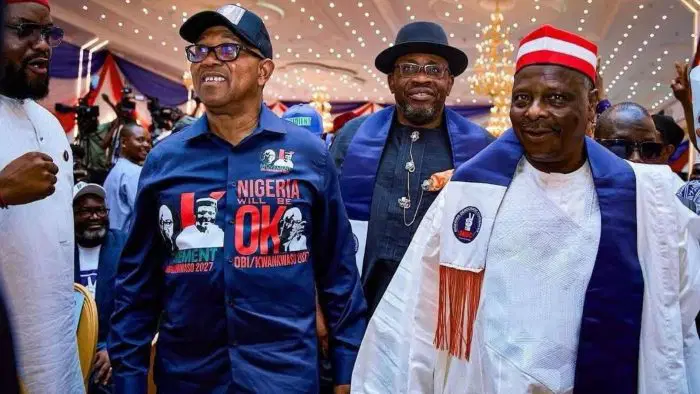
ABUJA – The presidential candidate of Nigeria Democratic Congress, NDC, Peter Obi, has described the kind of leader Nigerians need.
According to the former Anambra State governor, the administration of President Bola Tinubu lacked “competence, capacity, compassion and commitment required to address the country’s problems,” insisting that Nigerians needed a president who would be available and responsive.
He spoke on Monday night in Abuja at the inauguration of the party’s 118-member National Presidential Campaign Council ahead of January 16, 2027, where certificates of return were presented to NDC candidates.
Peter Obi called for a new leadership for Nigeria, saying the country is facing serious challenges under the present administration.
Obi said: “Everything is collapsing. Nigerians are looking for new leadership, and I can assure you that we will provide it.”
Obi, who is contesting the presidency alongside his running mate, Rabiu Musa Kwankwaso, noted that the country needed a fundamental change in leadership, governance philosophy and public resource management, insisting that Nigerians could no longer afford a government that failed to address their most pressing challenges.
NEC meeting
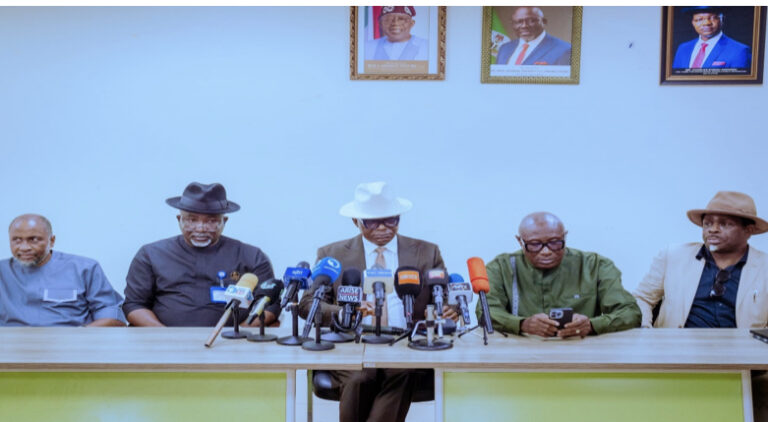
The events followed an emergency meeting of the party’s National Executive Committee, NEC, and the inauguration of the newly acquired national secretariat at 393 Etang Obuli Crescent, Jabi, Abuja, which is expected to serve as the party’s administrative headquarters and presidential campaign coordination centre.
The NDC intensified its preparations for the 2027 general elections with the inauguration of its newly acquired national secretariat in Jabi, Abuja, the formal inauguration of its National Presidential Campaign Council and the presentation of certificates of return to candidates elected to contest on the party’s platform.
The NDC presidential candidate, who warned against electoral malpractice ahead of the 2027 general elections, said the NDC would demand a free, fair and credible election.
He urged supporters to go into the country and campaign for the party, just as he warned those who might harass NDC supporters or attempt to manipulate the election that the party would resist such actions.
Obi said the party would focus on making Nigeria work and restoring the confidence of Nigerians in their country.
Addressing party leaders and supporters at the dinner, Obi painted a grim picture of Nigeria’s socioeconomic conditions, citing poverty, unemployment, insecurity, corruption and the education crisis as evidence of what he described as the failure of the present administration.
He argued that the responsibility of government was to solve problems rather than blame political opponents, insisting that an NDC administration would be judged by the improvements it delivered to citizens.
The purpose of governance is to solve problems, not to blame people. Kwankwaso and I will not blame anybody. We will create that new Nigeria that is possible,” Obi declared.
Economic woes
Obi accused President Bola Tinubu’s administration of presiding over worsening economic hardship and declining national performance. He argued that the resources available to the government had not translated into meaningful improvements in the lives of ordinary Nigerians, said Nigerians were increasingly demanding a different kind of leadership, one capable of responding decisively to the country’s challenges and demonstrating accountability in the management of public funds.
“From my engagements all over Nigeria, Nigerians are looking for new leadership. And we assure you that we will create that new leadership,” he said.
Obi who maintained that the country needed leaders with the competence, capacity, compassion, commitment and physical availability required to address the demands of national governance, argued that the president of Nigeria must be accessible to citizens, responsive to emergencies and willing to visit communities affected by insecurity, rather than remain distant from the realities confronting the population.
Declares war on corruption
The NDC Presidential Candidate who pledged to launch what he described as an unprecedented battle against corruption, which he identified as a major obstacle to economic development, effective public service delivery and national prosperity, argued that corruption undermined the impact of public expenditure, weakened institutions, discouraged productive investment and deprived citizens of essential services.
He maintained that the country’s economic difficulties could not be separated from questions about how public revenues and borrowed funds had been managed, adding, Let me tell you why we must fight corruption head on,” Obi said, questioning the outcomes of the substantial borrowing and expenditure undertaken by the Federal Government in recent years.
Obi who also challenged the Tinubu administration to account for the resources it had raised and explain why, despite the availability of public funds, Nigerians continued to experience widespread hardship, said the country needed a system in which public officials could be held accountable for their decisions and public money was demonstrably applied to projects and services that benefited citizens.
“We must stop people from stealing public money. We must use public money for public good. And that will be seen, it will be shown,” he said.
Obi promised that any public official found culpable of corruption under his proposed administration would be required to answer for their actions, stressing that accountability would be a central principle of his government, just as he called for a fundamental change in the political culture that, in his view, had allowed public officeholders to make promises without being held to measurable standards of performance.
The presidential candidate who explained that the NDC would not seek public office merely to explain the difficulties inherited from previous administrations, argued, the party would ask Nigerians to assess its performance through tangible improvements in public services, economic opportunities and the general welfare of citizens.
“We don’t want you to hire us to tell you about our problem. It’s only in Nigeria that you hire people and they start reminding you of what happened in the past. No, we don’t want you to hire us. We want you to hire us to improve from today,” he said.
Promises emergency measures on security, agriculture
Obi identified insecurity as another critical area requiring immediate and sustained government intervention, promising to prioritise security and ensure that communities affected by violence, kidnapping and other criminal activities received decisive attention.
He criticised what he described as the failure of political leadership to demonstrate sufficient urgency in responding to security emergencies, insisting that a Nigerian president must be willing to confront crises wherever they occur.
Using the kidnapping of large numbers of people as an example, Obi who argued that government officials should not remain detached from operations aimed at rescuing victims and restoring peace to affected communities, said, “If they say there is a problem in Jos, he will go to Jos,” Obi said, outlining his vision of a president who would be physically present and directly engaged when Nigerians faced emergencies.
He added that his proposed administration would take the fight against insecurity to affected areas, particularly communities where residents had been displaced or prevented from engaging in farming and other productive activities.
Obi also pledged to declare an emergency in agriculture, particularly in the northern part of the country, where he said vast agricultural potential remained underutilised because of insecurity and other constraints.
He argued that securing farming communities would enable farmers to return to their fields, increase domestic food production, supply raw materials to industries and reduce Nigeria’s dependence on imported goods.
“We have vast land in the north. When we secure the north, our farmers must go back and produce what we eat and what we use for our industries,” he said.
The NDC candidate linked agricultural recovery to the broader objective of reducing hunger, creating employment, stabilising food prices and strengthening the country’s productive base.
He said his proposed government would also prioritise education, healthcare and electricity, stressing that the challenges confronting those sectors required coordinated interventions backed by clear performance targets.
Education: Obi targets out-of-school children
On education, Obi expressed concern over the number of Nigerian children reportedly outside the formal school system, arguing that the country could not achieve sustainable development while millions of young people were denied access to basic education.
He pledged to make basic education more accessible and improve its quality, promising that his administration would work to drastically reduce the number of out-of-school children.
The former Anambra governor cited his experience in the education sector during his tenure in the state, while also acknowledging the work of other political figures in promoting access to schooling.
He maintained that education policy under an NDC administration would be assessed through measurable outcomes rather than announcements and political declarations.
For Obi, improving access to education is not merely a social welfare commitment but a necessary investment in human capital, economic productivity and the country’s long-term competitiveness.
He argued that children from poor households should not be denied opportunities because of their parents’ economic circumstances or lack of access to influential political connections.
The presidential candidate said the NDC wanted to build a society in which ability, opportunity and hard work would matter more than personal connections.
We must create a society where a child of nobody will be somebody without knowing anybody,” he said, calling for an end to what he described as a culture of exclusion and abuse of public trust.
22-year target for primary healthcare in every ward
In the health sector, Obi renewed his commitment to strengthening primary healthcare, saying that his proposed administration would work towards establishing a functional primary healthcare centre in every ward in Nigeria within two years.
He argued that preventable deaths, particularly those associated with inadequate access to medical facilities and essential services, should no longer be accepted as an inevitable feature of life in the country.
The NDC candidate said his government would prioritise accessible healthcare services and ensure that public resources were directed towards improving the conditions under which Nigerians receive medical attention.
He also linked improved healthcare delivery to the broader need for effective planning, responsible expenditure and accountability across government institutions.
According to Obi, Nigerians should be able to assess progress through visible improvements in healthcare access and service delivery rather than promises that remain unfulfilled after elections.
His pledge formed part of a wider commitment to establish measurable benchmarks across key sectors, including education, security, agriculture and electricity.
Power sector overhaul, industrial revival
Obi also promised an emergency intervention in the electricity sector, arguing that reliable power supply was indispensable to economic growth, industrial expansion and employment creation.
He said an NDC administration would prioritise electricity generation, transmission and distribution, insisting that Nigeria could not achieve its economic potential without a substantial improvement in power supply.
“We will declare emergency on generation, transmission and distribution,” he said.
The former governor argued that unreliable electricity had placed enormous burdens on households, small businesses, manufacturers and service providers, forcing many enterprises to contend with high operating costs and reduced productivity.
He promised that improvements in electricity supply would be measurable and visible to Nigerians, rather than remaining an unfulfilled campaign promise.
Obi also called for the revival of industries across the country, particularly manufacturing concerns that once provided employment and supported local economic activity.
Referring to industrial establishments in Kano, he asked how the country could restore manufacturing capacity and bring abandoned or struggling industries back into productive operation.
He argued that Nigeria’s economic recovery required a shift from excessive dependence on consumption and borrowing towards production, enterprise development and the expansion of domestic industrial capacity.
The NDC candidate said a functioning industrial sector would help create jobs, increase household incomes, stimulate demand for locally produced goods and strengthen the country’s economic base.
He also emphasised the need to support young Nigerians seeking employment and those interested in establishing businesses.
NDC targets greater access to credit for SMEs
Small and medium-sized enterprises (SMEs) featured prominently in Obi’s economic proposals, with the presidential candidate promising measures to improve access to credit and reduce the burdens facing small businesses.
He argued that small businesses were essential to job creation and economic resilience but remained constrained by inadequate financing, high operating costs and multiple taxes and levies.
Obi cited figures indicating that Nigeria had more than 40 million SMEs, while claiming that they received less than five per cent of bank lending and credit.
He promised that an NDC administration would seek to increase the proportion of credit flowing to small businesses to more than 20 per cent, alongside other measures aimed at helping enterprises expand and create employment.
“We will put a mark to it. We will ensure that over 20% of the credits will go to small businesses. We will support them,” he said.
He also promised to explore tax holidays and other forms of relief to enable small enterprises to survive their early stages of operation and grow into sustainable businesses.
According to him, the current burden of taxation and levies on small businesses discourages entrepreneurship and undermines the ability of young Nigerians to create their own employment opportunities.
The NDC candidate argued that a more supportive business environment would help unlock the potential of entrepreneurs, strengthen domestic production and reduce the pressure on government to provide jobs directly for every unemployed person.
His proposals, he said, would form part of a wider effort to make the economy more productive and ensure that growth translated into improved living standards.
Questions Tinubu over borrowing, public expenditure
Obi who also challenged the Federal Government to explain the results achieved with the revenue generated and loans obtained during the Tinubu administration, questioned why the country continued to experience severe economic hardship despite the administration’s claims of improved revenue generation.
The presidential candidate referred to the budgets for 2023, 2024 and 2025, arguing that the level of capital expenditure and the reported difficulties facing contractors raised questions about the implementation of government projects.
He alleged that capital expenditure had failed to reach 20 per cent across the three budget years, while contractors and suppliers working for government were facing payment difficulties.
These claims were central to his argument that corruption and poor management had prevented public expenditure from producing the intended economic benefits.
Obi challenged the government to provide Nigerians with a detailed account of the projects executed, the resources expended and the measurable improvements delivered across the country.
He also criticised what he described as the failure of the administration to communicate adequately with citizens about its performance.
The former governor said his campaign would insist on transparency and accountability, adding that Nigerians deserved to know how public funds were being used and what results they were producing.
He maintained that his proposed administration would not ask citizens to accept excuses where measurable improvements were expected.
Condemns political harassment, calls for issue-based campaigns
Obi also addressed the treatment of NDC supporters and the atmosphere surrounding political mobilisation, warning against the harassment of Nigerians seeking to support the party.
He appealed to political actors to maintain civility and recognise that peaceful conduct should not be interpreted as weakness.
“Humility and civility is not weakness. It is a virtue. Good behaviour is not weakness. It is a virtue,” he said.
He warned against the use of intimidation in political competition, insisting that the 2027 elections should be fought on the strength of ideas, policy proposals and the credibility of candidates.
The NDC presidential candidate pledged to campaign across every state of the federation, saying he wanted to engage Nigerians directly and explain the party’s plans for national recovery.
He also called for free, fair and credible elections, warning against attempts to manipulate the electoral process.
The revolution that is coming is a revolution of the ballot,” he said, emphasising that the party intended to pursue political change through the democratic process.
Obi urged NDC candidates and supporters to take the party’s message to communities across the country, insisting that the presidential contest should provide Nigerians with a clear choice between competing visions for the country.
He also promised that his proposed administration would confront the high cost of living and work towards restoring public confidence in government.
Pledges presidential accessibility, domestic engagement
A recurring theme in Obi’s address was his insistence that the president must be available to respond to national challenges and engage directly with Nigerians.
He criticised what he described as excessive foreign travel by President Tinubu and argued that the country needed a leader who would devote sufficient time and attention to domestic problems.
Obi said that, if elected, he would prioritise engagement with communities affected by insecurity, poverty and economic dislocation, including states where residents had suffered repeated attacks.
He specifically mentioned communities in Plateau, Benue, Zamfara, Sokoto and Borno as places where national leadership should demonstrate solidarity with citizens facing insecurity.
The presidential candidate argued that leaders should not retreat from areas experiencing crises but should demonstrate a willingness to confront the challenges and support affected populations.
He also pledged to spend his holidays within Nigeria, using the opportunity to engage with communities and understand their circumstances.
For Obi, presidential accessibility is closely linked to accountability, responsiveness and the ability to make government institutions work more effectively for citizens.
He maintained that Nigerians needed a president who would not only make promises during election campaigns but remain available to monitor implementation and address failures after assuming office
Earlier in his remarks, the NDC National Leader, Senator Henry Seriake Dickson, said the party was formed to strengthen Nigeria’s multi-party democracy and prevent the country from becoming a one-party state.
The former Bayelsa State governor who criticised the direction of the APC-led government, particularly on security, corruption and the economy, saying the NDC was offering Nigerians a new political alternative, urged party members and candidates to take the message of a “new Nigeria that is possible” to communities across the country, stressing that the party’s campaign would be based on ideas rather than violence.
On his part, the National Chairman of the NDC, Senator Moses Cleopas said the party had demonstrated its capacity by conducting its primaries, selecting candidates and preparing for the 2027 elections within a short period.
Cleopas who noted that the party would not make promises it could not fulfill if elected, said that its candidates must be accountable to Nigerians if elected, adding that the certificates of return presented to the candidates contained security codes, warning that anyone attempting to forge or falsely claim a certificate would be committing a criminal offence.
If we fail to bring water for you in two years, if we open our mouth to say, vote for us again, please don’t vote for us,” he said.
The chairman maintained that the NDC was determined to establish a political culture in which promises would be treated as obligations and voters would have clear grounds on which to assess elected officials.
He urged candidates to approach their campaigns with a sense of responsibility, describing the party’s political mission as an effort to rescue the country from its present difficulties.
“We are going for a rescue mission, that the hope of this country is in NDC,” he said.
Cleopas also invoked religious imagery to emphasise unity within the party, expressing confidence that the leadership would guide the organisation in the right direction.
He called on candidates and supporters to remain committed to the party’s objectives and work to convince Nigerians of the merits of its proposals.
The NDC Gubernatorial Candidate in Adamawa State, Senator Aisha Binani expressed appreciation to the party leadership for giving her the opportunity to contest on its platform, assuring that women would mobilise massively for the party.
Also speaking, former Secretary to the Government of the Federation, SGF, Babachir Lawal whonurged NDC supporters to actively monitor the voting, counting and collation processes during the 2027 elections, advised voters to prepare for a long election day by taking food and essential medication to polling units.
Earlier, the NDC Inaugurated its National Campaign Council for the 2027 general elections, with the party’s National Leader, Senator Henry Seriake Dickson, named chairman and its presidential candidate, Peter Obi, appointed co-Chairman.
The Council also includes the party’s National Chairman and vice-presidential candidate, Senator Cleopas Moses Zuwoghe, as vice-chairman, while its National Secretary, Barrister Ikenna Morgan Enekweizu, will serve as co-vice-chairman.
Recall that on Sunday, October 25, the NDC released a list containing the full names of its long awaited 2027 campaign council.
The Council is populated by 118 members drawn from diverse backgrounds and professions and from across Nigeria’s geopolitical zones.
Others details about the Council show that the campaign council is grouped in three categories, namely; National Causes, National Advisory, and National Directorates, that is made up of business tycoons, experienced professionals, tested politicians and others, including its National Leader, Senator Henry Seriake Dickson who serves as the Council’s chairman, while its Presidential candidate for the 2027 general elections, Peter Obi, will serve as the Co-Chairman of the Council.
The National Chairman of NDC Senator Cleopas Moses Zuwoghe, is the Council’s, Vice Chairman, and the vice-presidential candidate, Senator Rabiu Musa Kwankwaso, Co Vice-Chairman.Ikenna Morgan Enekweizu, Esq. NDC National Secretary, is the Council Secretary.
The Council will provide strategic leadership, coordinate campaign activities across the country, and drive the mobilisation of Nigerians behind the party’s vision of a new, just, and prosperous Nigeria.
The Council is expected to deliver a people-centred and issue-based campaign.
NDC called on all party members, supporters, and well-meaning Nigerians to remain united and focused.
In the inaugurated Council, Mallam Ibrahim Hussain Abdulkarim has been named council secretary and Director-General.
The party said the council would coordinate its nationwide campaign and mobilise support for its vision of a “new, just, and prosperous Nigeria”.
Below is the full list of members.
National Campaign Caucus
His Excellency, Senator Henry Seriake Dickson CON — Chairman / NDC National Leader
His Excellency, Mr. Peter Obi CON — Co-Chairman / NDC Presidential Candidate
Senator Cleopas Moses Zuwoghe — Vice Chairman / NDC National Chairman
His Excellency, Dr. Rabiu Musa Kwankwaso CON — Co-Vice Chairman / NDC Vice Presidential Candidate
Mr. Babachir Lawal — Member / Chairman, National Campaign Advisory Council
Barr. Ikenna Morgan Enekweizu — Council Secretary / NDC National Secretary
Alh. Sidi Bomi Abdul — Member / Deputy National Chairman, North
Mr. Babatunde F. Alli — Member / Deputy National Chairman, South
Senator Ovie Omo Agege CFR — Member
Senator Victor Umeh OFR — Member / Representative NDC Senate Caucus
Mallam Ibrahim Hussain Abdulkarim — Member / DG, Presidential Campaign
Engr. Buba Galadima — Member
Prof. Yakubu Ochefu — Member
Professor Mahmud Gambo Jahun — Member
Hon. Moshood Salvador — Member
Mrs. Dudu Manuga — Member / NDC National Woman Leader
Hon. Victor Ogene — Member / Chairman NDC House of Representative Caucus
Hon. Muktar Usman — Member / Member NDC House of Representative Caucus
National Campaign Advisory Council
Mr. Babachir Lawal — Chairman, Campaign Advisory Council
Senator Moses Cleopas Zuwoghe — Co-Chairman, Campaign Advisory Council
His Excellency, Dr. Sam Egwu CON — Vice Chairman, Campaign Advisory Council
Barr. Ikenna Morgan Enekweizu — Secretary, National Campaign Advisory Council
Dr. Danladi Abdulhameed Tambari — Member / Asst. Secretary, National Campaign Advisory Council
Chief Onyema Ugochukwu CON — Member / Abia State Representative
Obong Ini Okon — Member / Akwa Ibom State Representative
Hon. Oseloka Obaze — Member / Anambra State Representative
Madaki A. Mohammed mni — Member / Bauchi State Representative
Dr. O.O. Osusu OON — Member / Bayelsa State Representative
Dr. Tor Ujah — Member / Benue State
Ibrahim Alhaji S. Matawalle — Member / Borno State Representative
Chief Ugba Murphy — Member / Cross River State Representative
Prof. Pat Utomi — Member / Delta State Representative
Senator Roland Owie — Member / Edo State Representative
Sen. Akinyede Sola — Member / Ekiti State Representative
His Excellency, Dr. Okwesilieze Nwodo — Member / Enugu State Representative
Hon. Uche Okonkwo — Member / F.C.T. Representative
Prof. Iliya Ishaya Jalo — Member / Gombe State Representative
His Excellency, Chief Achike Udenwa CON — Member / Imo State Representative
Mallam Hassan Kabiru — Member / Jigawa State Representative
Joshua Makama — Member / Kaduna State Representative
Nasir Lawan Ahmad — Member / Kano State Representative
Dr. Ismail Iro — Member / Katsina State Representative
Alh. Ahmed Zayyanu Iliyasu — Member / Kebbi State Representative
Mallam Adamu Atta — Member / Kogi State Representative
Arc. Dr. Toma Audu Gana — Member / Kwara State Representative
Hon. Tunji Soyinka — Member / Lagos State Representative
Hon. David Zakaria — Member / Nasarawa State
Alh. Isa A. Kutugi — Member / Niger State Representative
Otunba Tope Niyi Taiwo — Member / Ogun State Representative
Chief Tope Adebambo — Member / Ondo State Representative
Hon. Razaq Mustapha Adeniyi — Member / Osun State Representative
Mr. Kayode Joseph — Member / Oyo State Representative
Manasseh Zakka Watyil — Member / Plateau State Representative
Sen. Ben Birabi — Member / Rivers State Representative
Alh. Jabbi Hassan Sifawa — Member / Sokoto State Representative
Hon. Dr. Philip Kafiya — Member / Taraba State Representative
Engr. Buba Galadima — Member / Yobe State Representative
Hon. Barr. Mohammed Sani Takori mni — Member / Zamfara State Representative
National Campaign Directorates
Mallam Ibrahim Hussain Abdulkarim — Director General
Ebubedike VinMartin Obiora Ilo — Deputy DG Admin, National Campaign Council
Alh. Tijjani Iya — Deputy DG North
Chief Barr. Fred E. Owotorufa — Deputy DG South
Mrs. Ndidi Mbagwu — Director Finance
Dr. Peter Onigah, NDC National Treasurer — Co-Director Finance
Folashade Aliu — Deputy Director Finance
Hon. Oseloka Obaze — Director Logistics and Operations
Mr. Wole Adedapo — Deputy Director Logistics and Operations 1
Ibrahim Tukur Gusau — Deputy Director Logistics and Operations 2
Osa Director, NDC National Publicity Secretary — Director of Communication & Media
Mr. Ikeddi Isiguzo — Deputy Director of Communication & Media
Dr. Constance Ikokwu — Campaign Spokesperson
Sonny Neme — Deputy Campaign Spokesperson 1
Dr. Sam Omale — Deputy Campaign Spokesperson 2
Anulka Rita Modebe — Campaign Spokesperson North Central
Rev. Wesley Gainaka — Campaign Spokesperson North East
Ibrahim Rabi’u Amana — Campaign Spokesperson North West
Nwosu Christopher Maduabuchukwu — Campaign Spokesperson South East
Dr. Isaiah Osifo — Campaign Spokesperson South South
Amb. Makinde Akinlade — Campaign Spokesperson South West
Mr. Zekeri Idris — Director New Media
Theophilus Abu — Deputy Director, New Media
Dr. Obinna Simon — Asst. Deputy Director, New Media
Dr. S.K.C. Ogbonnia — Director Policy, Research & Documentation
Barr. Shehu Muhammad Danmusa — Deputy Director Policy, Research & Documentation
Barr. Reuben Egwuaba — Director Legal Affairs
Barr. Vincent Otaokpukpu — Deputy Director Legal Affairs
Major General John Enenche (rtd) — Director Security and Intelligence
Ali Garba Sarbi — Deputy Director Security and Intelligence
Dr. Danlami Arabs Rukujei — Director Election Monitoring and Vote Protection
Hajiya Bilkisu Shu’aibu — Deputy Director Election Monitoring and Vote Protection
Mr. Daniel Elombah — Director Diaspora
Princess Maryam Tolofari Nyong — Co-Director Diaspora
Dr. Daniel Onifade — Deputy Director Diaspora
Comrade Adamu Abbas Ahman — Director Youth Mobilization
Idris Usman Audu — Deputy Director Youth Mobilization
Mrs. Dudu Manuga, NDC National Woman Leader — Director Women Mobilization
Binta Abba Gana — Deputy Director Women Mobilization
Dr. Maji Peterx — Director Civil Society & Support Groups Coordination
Abduljalal Idris (Aljazeera) — Deputy Director Civil Society & Support Groups Coordination
Dr. Shu’aibu Abdulrashid — Director Election Observers Liaison
Chief Abayomi Kuye Taiwo — Deputy Director Election Observers Liaison
Ms. Jackie Wayas — Director Protocol
Sharon Chukwuobasi — Deputy Director Protocol I
Alh. Abdulrazak Maaji — Deputy Director Protocol II
[Name Missing / Blank in Document] — Director Situation Room Management
Umar Mahmood — Deputy Director Situation Room Management I
Malate Peter — Deputy Director Situation Room Management II
Ms. Chinasa Issac-Oduka — Director Welfare
Mallam Nafiu Umar Dankura — Deputy Director Welfare I
Madaki Muhammad wMisau, mni. — Deputy Director Welfare II
Umar Usman Besse — Director of Organization
Hart Sylvanus Idabelema Handley — Deputy Director of Organization
Dr. Abdulmutallib Alhassan — Director, Information Communication & Technology
Boma N. Williams — Deputy Director, Information Communication & Technology
Brian Jonah Dennis — Asst. Director, Information Communication & Technology
Dr. Pillar Josemaria — Director, Medical
Dr. Ezra Dablet — Deputy Director, Medical
Abdullahi Akilo Jugunnu — Director, Persons with Disability.
State Campaign Coordinators
Senator Nkechi Nwogu, CON — State Campaign Coordinator (Abia)
Bamanga Tukur Jr. — State Campaign Coordinator (Adamawa)
Apostle (Dr.) David Okpon — State Campaign Coordinator (Akwa Ibom)
Hon. Ifeanyi Ibezim — State Campaign Coordinator (Anambra)
Sulaiman Muhammad — State Campaign Coordinator (Bauchi)
Prof. Silva Opuala-Charles — State Campaign Coordinator (Bayelsa)
Hon. (Engr.) Andrew Abba — State Campaign Coordinator (Benue)
Abdulkadir Fema — State Campaign Coordinator (Borno)
Rt. Hon. Eta Mbora — State Campaign Coordinator (Cross River)
Mr. Ken Pela — State Campaign Coordinator (Delta)
Professor Ben Odoh — State Campaign Coordinator (Ebonyi)
Hon. John Yakubu — State Campaign Coordinator (Edo)
Barr Babafemi Adegbite — State Campaign Coordinator (Ekiti)
Bishop Oscar Okwudili Ossai — State Campaign Coordinator (Enugu)
Alh. Garba Zagada Zagada — Gombe Campaign Coordinator (Gombe)
Chief Martins Agbaso — State Campaign Coordinator (Imo)
Alhaji Ado Waziri Kwalam — State Campaign Coordinator (Jigawa)
Ibrahim Mado — State Campaign Coordinator (Kaduna)
Abdullahi Musa — State Campaign Coordinator (Kano)
Dr. Zayyana Shehu — State Campaign Coordinator (Katsina)
Capt. Ladan Soja Bunza (Rtd) — State Campaign Coordinator (Kebbi)
High Chief Peter Ameh — State Campaign Coordinator (Kogi)
Hon. Anthony Dele Abiodun — State Campaign Coordinator (Kwara)
Mr. Ife Salako — State Campaign Coordinator (Lagos)
[Senatorial Candidate — Name Missing] — State Campaign Coordinator (Nasarawa)
[Senatorial Candidate — Name Missing] — State Campaign Coordinator (Niger)
Barr. Abimbola Lanre-Balogun — State Campaign Coordinator (Ogun)
Hon. Idowu Famusipe — State Campaign Coordinator (Ondo)
Hon Kunle Tiamiyu — State Campaign Coordinator (Osun)
Adeola Ebisemiju — State Campaign Coordinator (Oyo)
Prince Rwang Pam — State Campaign Coordinator (Plateau)
Mr. Zubi Nwuke — State Campaign Coordinator (Rivers)
Dr. Ibrahim Abubakar — State Campaign Coordinator (Sokoto)
Alh. Abdullahi Ade — State Campaign Coordinator (Taraba)
Ilu Bello Dambazau — State Campaign Coordinator (Yobe)
Ibrahim Tukur Gusau — State Campaign Coordinator (Zamfara)
Dr. Stephen Knabayi — FCT Campaign Coordinator (FCT).
Vanguard