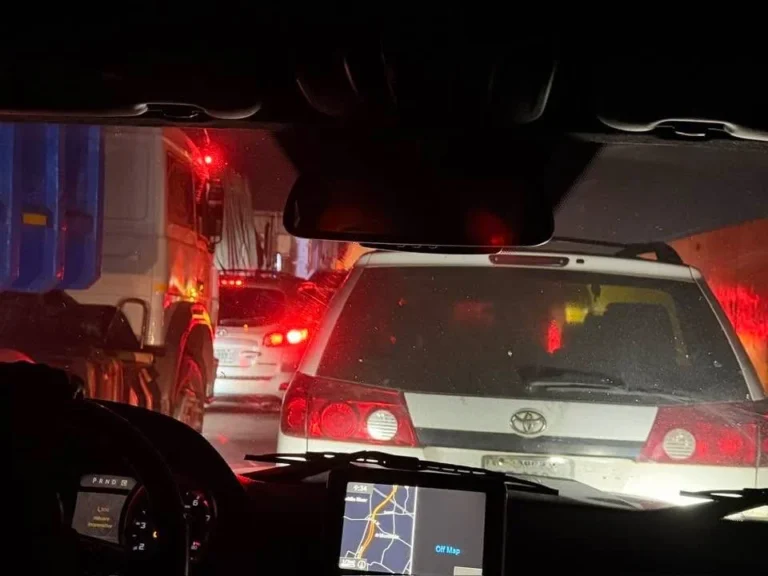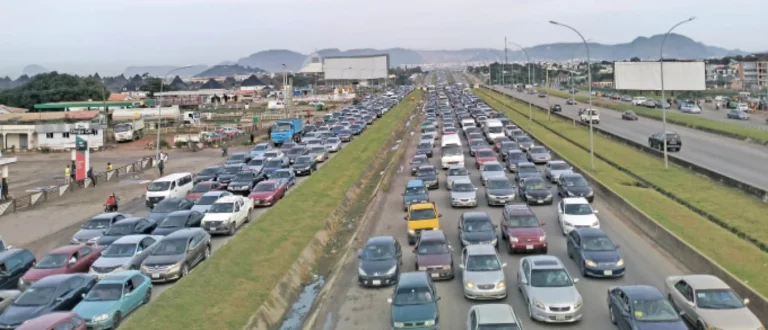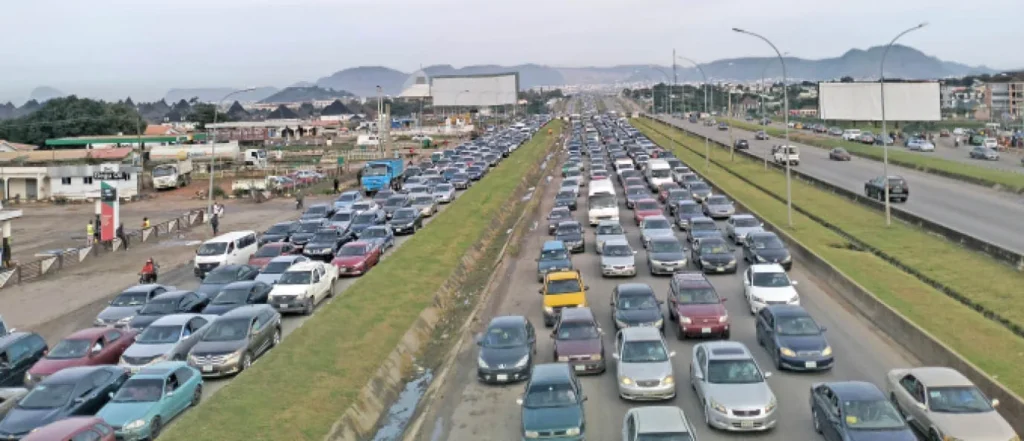
Abuja residents commuting to and from the city centre through the Lugbe/Airport Road axis spent several hours in traffic on Thursday following road closures by security operatives ahead of President Bola Tinubu’s visit to Jabi.
The restrictions left many commuters stranded, while some passengers paid higher fares as motorists struggled to find alternative routes.
Daily Trust reports that traffic movement along the Airport Road axis was disrupted as Tinubu attended the public presentation of a six-volume publication authored by Wole Olanipekun, SAN, at the Body of Benchers in Jabi.
It would be recalled that similar restrictions of movements occured last week Friday when the President attended a Jumu’at prayer at the Shehu Shagari Mosque at Area 1, Garki, Abuja.
The restriction of movement imposed on worshippers triggered reactions, with some of them booing and pelting the President’s convoy as they made their way out of the mosque.
According to eyewitnesses, security operatives prevented people from entering the mosque after the president arrived. Roads leading to the mosque were also blocked, while some security personnel mounted the mosque’s perimeter fences as part of the security arrangements.
The restrictions continued after the prayers, with worshippers prevented from leaving until the president departed, the eyewitness said.
Meanwhile, several motorists and commuters caught in the gridlock yesterday expressed anger and frustration, describing the restrictions as unnecessary and unfair to ordinary citizens going about their daily activities.
A commuter, Adedoyin Ayinde, who was commuting from Lugbe to Jabi for work, said he spent over three hours on a journey that ordinarily takes less than 30 minutes.
He said it was unfortunate that hundreds of citizens were subjected to such a harrowing experience for several hours simply because the President was attending a book launch.
A commercial driver, Obinna Eze, also questioned why a major federal highway in Abuja would be blocked for hours because of the President’s movement.
He said motorists and passengers were left stranded, with many unable to determine when the roads would be reopened.
John Okafor, a commuter travelling from Airport Junction to Jabi, said a journey that would ordinarily take about 20 minutes lasted nearly three hours because of the road closures.
“Normally, I spend about N1,500 commuting to my workplace, but because of the road closures, I had to pay N3,000. This is quite alarming, especially given the current economic situation where every naira counts. A journey that should take just 20 minutes ended up taking almost three hours,” he said.
Another driver, Usman Umar, said motorists had been stranded for more than three hours without knowing when the roads would be reopened.
He said the President’s movement should not bring the entire city to a standstill.
“We have been here for over three hours, and nobody has told us when the road will be cleared. People have businesses to attend to and other important activities, but we have been prevented from going about our normal duties simply because the President is passing,” he said.
Umar added that the prolonged congestion was causing motorists to waste fuel, while some vehicles risked overheating after spending hours in traffic.
Other residents also complained that road closures associated with the President’s movements to and from the airport had become a recurring problem, particularly for commuters along the Airport Road corridor.
They said the practice often leaves motorists stranded for extended periods, affecting workers, schoolchildren, business owners, travellers and people with medical appointments.
Daily Trust reports that during the early days of the administration of the late President Muhammadu Buhari, residents along the Airport Road axis faced restrictions each time he was travelling out or returning to the nation’s capital.
However, the late Buhari, after observing the inconvenience the restriction of movement had on residents, decided to use helicopters to and fro the airport.
Some residents called on the Presidency and security agencies to reconsider the approach, arguing that adequate security could be provided without subjecting thousands of road users to prolonged hardship.
Daily Trust