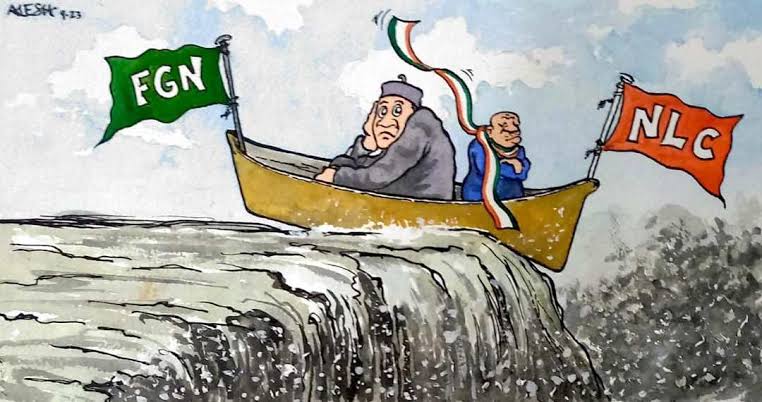
The stage for heightened expectations was cleverly set in such a way that even the discerning leaders of organised labour fell for it. Maybe they could not help it because the date chosen for the deal was May 1, an occasion of significant importance to workers all over the world.
So, on March 23, 2024, a month and a half before the Workers’ Day celebration, an unidentified government source who was quoted in media reports titled, “Tinubu May Announce New Minimum Wage on Workers’ Day,” said the National Minimum Wage Committee would meet to collate and consider reports from the zonal town hall public hearings and give President Bola Tinubu an idea of what to announce on Workers’ Day.
Our target is to ensure that Mr President announces the minimum wage by May 1, which is Workers’ Day, for it to take effect from April. So, we are working to meet the timeline,” the source was quoted as saying in many of the reports on radio, TV and newspapers as well as online publications.
In another instance, another government official was quoted as saying, “I don’t think the government will be able to wait until May 1 before announcing the minimum wage. The law says it should be concluded by early April.
“If the parties agree, why do they have to wait to make the announcement? Because they are negotiating and the law says negotiations should be completed by April.”
Everything appeared set. The 37-member Tripartite Committee comprising representatives of federal and state governments, the private sector and labour which was inaugurated by the Vice President in January 2024 had gone about their work. Zonal public hearings were held in Lagos Kano, Enugu, Akwa Ibom, Adamawa and Abuja, where workers in the North-West requested N485,000; North-East, N560,000; North-Central, N709,000 by the Nigeria Labour Congress, NLC, and N447,000 by the Trade Union Congress, TUC; South-West, N794,000; South-South, N850,000; and South-East, N540,000 by the NLC and N447,000 by the TUC.
So confident was the NLC that it warned that governors who failed to implement the new minimum wage when it becomes a law would be committing an offence.
Alas, it was not to be. The picture of things that came out on the eve of the Worker’s Day, was a sad reflection of reality: The new story was that the Federal Government had approved 25 per cent and 35 per cent salary increases for civil servants across various consolidated salary structures. At the current wage of N30,000, this new salary increase raises the new wage to N47.250.
To make it legal and official, the National Salaries, Incomes, and Wages Commission, made the announcement through its Head of Press, Mr Emmanuel Njoku. He said the increments had taken effect from January 1, 2024.
According to him, the new increase applies to the six remaining consolidated salary structures, namely the Consolidated Public Service Salary Structure, Consolidated Research and Allied Institutions Salary Structure, Consolidated Police Salary Structure, Consolidated Paramilitary Salary Structure, Consolidated Intelligence Community Salary Structure and Consolidated Armed Forces Salary Structure.
Also, approved for augmentation is the pension of retirees enrolled in the Defined Benefits Scheme within the aforementioned consolidated salary structures from 20 per cent to 28 per cent, effective from the same date.