Screenshot
The Delta State Ministry of Secondary Education has rolled out far-reaching measures aimed at curbing extortion, strengthening discipline and improving service delivery in public and private secondary schools across the state.
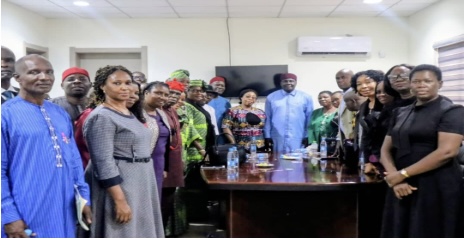
The decisions were taken at a crucial stakeholders’ engagement meeting convened by the Ministry in line with the state government’s zero-tolerance policy for extortion under the MORE Agenda, and chaired alongside the Functioning Permanent Secretary with key stakeholders from the education sector.
Addressing the outcomes of the meeting, the Honourable Commissioner for Secondary Education, Dr. Kingsley Ashibogwu, reiterated the Ministry’s zero-tolerance stance on examination malpractice, warning that any school, official or individual found culpable would face severe sanctions in line with extant regulations.
According to the resolutions, screening of candidates for all external examinations will henceforth be conducted under the direct supervision of the Office of the Honourable Commissioner.
The Ministry also approved official examination fees, clarifying that government-sponsored candidates for the Basic Education Certificate Examination (BECE) are to pay ₦1,100 only for access pins and scratch cards. Public school repeaters will pay a total of ₦4,850, while private school candidates will pay ₦5,450 in total. The fee for the West African Senior School Certificate Examination (WASSCE) was fixed at ₦31,400, while private candidates are to pay ₦28,400. The National Examinations Council (NECO) fees, the Ministry noted, are yet to be released.
Dr. Ashibogwu directed any principal or staff of secondary schools who had collected fees above the approved amounts to refund the excess within 72 working hours, with evidence of compliance, warning that failure to do so would attract sanctions.
The Ministry further announced that collection of school certificates within the stipulated time frame must be free of charge, while admission and permissible levies were also clearly defined for junior and senior secondary school students, both new and returning.
In a major relief to parents, the Commissioner stated that students must not be levied for desks or benches, as this remains the responsibility of the Ministry. He also prohibited principals from sewing, selling or facilitating the sale of school uniforms, as well as the collection of termly examination fees in any form.
On Parents Teachers Association (PTA) and development levies, the Ministry stressed that such collections can only be undertaken with the approval of the Honourable Commissioner and strictly for first and second terms, adding that all unauthorised collections must be refunded immediately.
The Ministry also abolished all monitoring committees operating within schools and mandated private schools to align their resumption and closure dates with the approved academic calendar. Private schools were further directed to employ only qualified and certified teachers and to strictly adhere to the approved teacher-student ratio, especially during admissions.
Dr. Ashibogwu emphasized that candidates seeking admission into JSS 1 must be treated equally, regardless of whether they are products of public or private primary schools.
“These measures are designed to protect parents and students, restore discipline, promote equity and enhance the quality of secondary education in Delta State,” the Commissioner said, adding that the Ministry would intensify monitoring and enforcement, warning that defaulters would be dealt with decisively.