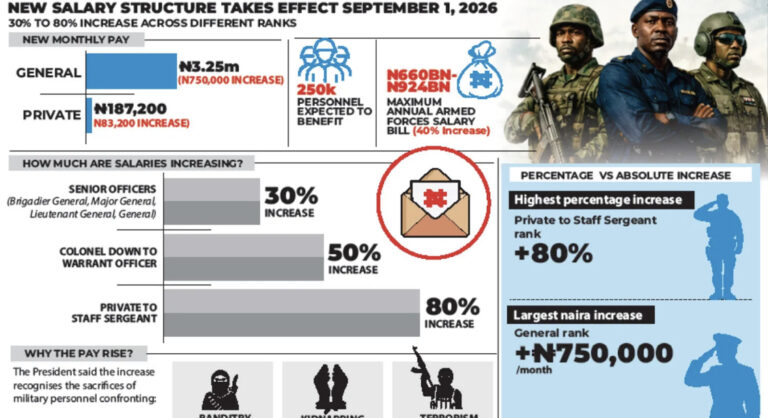
The new salary structure recently approved by President Bola Ahmed Tinubu for personnel of the Armed Forces will raise the monthly pay of a general to N3.25 million and that of a Private to N187,200.
The pay rise, which takes effect from September 1, 2026, provides increases ranging from 30 per cent to 80 per cent across different ranks of military personnel.
About 250,000 personnel are expected to benefit from the new pay package, which will increase the annual salary bill for the Armed Forces from N660 billion to N924 billion, according to a statement by the Special Adviser to the President on Information and Strategy, Bayo Onanuga.
Under the new arrangement, officers above the rank of Colonel will receive a 30 per cent salary increase. This applies to brigadier-generals, major-generals, lieutenant-generals and generals.
Personnel from colonel down to warrant officer will receive a 50 per cent increase, while privates to staff sergeants will receive an 80 per cent increase.
The Minister of Defence, Christopher Musa, had, in an interview with News Central last month, disclosed that the Tinubu administration had increased the minimum monthly salary of soldiers from N49,000 to N100,000.
A Daily Trust analysis had revealed that the N100,000 could only feed a soldier for 21 days based on the National Bureau of Statistics’ (NBS) Cost of a Healthy Diet (CoHD) report, which put the cost of a healthy diet – breakfast, lunch or dinner – for one adult at N1,589 daily.
The analysis also showed that soldiers in other African countries such as South Africa, Niger and Benin Republic earned as much as 200 per cent to 800 per cent higher than their counterparts in Nigeria.
Civil society organisations had queried whether the pay would be enough to support a soldier and his family in an economy where the cost of living continues to climb.
Also, a former Defence Spokesperson, Major General John Enenche (rtd), had called for an upward review of the soldiers’ salary, recommending a minimum monthly pay of N250,000 because the current remuneration no longer reflects the country’s economic realities or the sacrifices demanded by military service.
Speaking on the latest salary review, President Tinubu explained that the decision to increase the military personnel’s pay was aimed at recognising the sacrifices of servicemen and women confronting banditry, kidnapping and terrorism.
“The men and women who help to keep us safe in our homes must be supported and appreciated in the course of their duties to our nation,” Tinubu said in the statement.
He added that his administration would continue to prioritise troop welfare while modernising the Armed Forces with weapons and technological tools.
An analysis of the salary figures by Daily Trustbased on the current salary scale obtained from RecruitUltra – an online platform that publishes salaries of military and paramilitary forces – and the percentage increases announced by the President, shows the scale of the changes across the ranks.
What each rank will earn as new salary
Among non-commissioned personnel, a private whose current salary is N104,000, will earn about N187,200 under the new structure, representing an increase of N83,200 monthly.
A lance corporal will move from N112,000 to N201,600, gaining N89,600; and a corporal, from N115,000 to N207,000, an increase of N92,000.
A sergeant will see his or her salary rise from N125,000 to N225,000, representing an additional N100,000 monthly.
For a staff sergeant, the salary will be increased from N150,000 to N270,000, giving the rank N120,000 more each month.
A warrant officer will move from N170,000 to N255,000, an increase of N85,000; while a master warrant officer will earn N315,000, up from N210,000, representing a N105,000 increase.
An army warrant officer will move from N230,000 to N345,000, gaining N115,000 monthly.
The salary gains become considerably higher in absolute terms for commissioned officers.
A second lieutenant will move from N240,000 to N360,000, representing an increase of N120,000 monthly; a lieutenant, from N280,000 to N420,000; a captain, from N320,000 to N480,000; a major, from N380,000 to N570,000; a lieutenant colonel, from N420,000 to N630,000; and a colonel, from N580,000 to N870,000.
As expected, the highest-ranking officers will receive the highest pay under the new structure.
A brigadier-general will move from N750,000 to N975,000, representing an additional N225,000 monthly; a major-general, from N1.15 million to N1.495 million; a lieutenant general, from N1.9 million to N2.47 million, an increase of N570,000; and a general, from N2.5 million to N3.25 million.
Salary not the only package
The Manual for Financial Administration of the Armed Forces of Nigeria (MAFA), signed by former President Muhammadu Buhari on January 26, 2018, states that “personnel remuneration is governed by the Consolidated Armed Forces Salary Structure, CONAFSS, alongside other financial guidelines, including directives of the National Salaries, Incomes and Wages Commission, the Public Service Rules and the Harmonised Terms and Conditions of Service.”
The CONAFSS package does not consist of basic salary alone. The MAFA provides for a range of consolidated mandatory allowances approved by the President as Commander-in-Chief.
These include rent subsidy, utility allowance, leave grant, uniform maintenance allowance, hazard allowance, house upkeep allowance, general services allowance, entertainment allowance, transport allowance, non-practising allowance, hardlying allowance, torchlight allowance, retention incentive allowance, qualifying pay allowance, furniture allowance, command expenses allowance and meal subsidy.
Officers may also receive personal servant allowance. For example, personnel posted from one duty station to another may receive Packing on Posting Allowance equivalent to five per cent of annual CONAFSS on Step 5 of their rank where official transport is not provided. The allowance is payable once a year and does not apply to postings within the same location or personnel proceeding on courses.
Retiring or discharged personnel are entitled to a Terminal Packing Allowance equivalent to 10 per cent of annual CONAFSS on Step 5.
The manual also provides a lodging allowance equivalent to 40 per cent of CONAFSS for personnel who are not provided accommodation in military barracks or government quarters, subject to the conditions prescribed in the manual.
Military personnel deployed on specialised operations may also qualify for additional allowances.
The MAFA provides, among others, allowances for amphibious duties, diving, special warfare and counter-terrorism/counter-insurgency operations, subject to prescribed training, deployment and approval conditions.
These benefits mean that the salary figures alone do not represent the complete financial package available to every member of the Armed Forces.
Soldiers’ pay still below counterparts’ in Togo, Gambia, others
Daily Trust reports that despite the new review which pushes soldiers’ salary to N187,200, the pat still falls short of what their counterparts in several African countries earn.
A private in the South African National Defence Force (SANDF) earns between R8,500 and R12,000 monthly, equivalent to about N715,607 and N1.01 million using an exchange rate of R1 to N84.19, according to the 2026/27 South African National Defence Force salary schedule published by MoneyToday, a South African publication tracking salaries.
The gap is equally pronounced in East Africa. Estimates published by BusinessThisday in Kenya show that privates and corporals in the Kenya Defence Forces (KDF) earn between KSh19,941 and KSh70,000 monthly, equivalent to about N212,908 and N747,383 using an exchange rate of KSh1 to N10.68.
Even among Nigeria’s West African neighbours, soldiers generally earn considerably more. According to World Salaries, an entry-level soldier in The Gambia earns about 125,100 Gambian dalasi annually, equivalent to approximately N2.35 million or about N195,910 monthly.
The same database estimates that entry-level soldiers in Togo receive about 3.83 million CFA francs annually, equivalent to approximately N9.21 million, or about N767,564 monthly, using an exchange rate of 1 CFA to N2.41.
Comparable entry-level salaries stand at roughly equivalent of N526,962 per month in Niger Republic, about N661,892 in Benin Republic, around N547,000 in Senegal, and approximately N803,046 monthly in Cameroon.
Salary increament must match living costs – CSOs
The Country Director of Accountability Lab Nigeria, Friday Odeh, said the real measure of the military salary increase should be its impact on the purchasing power and living standards of personnel and their families.
Odeh said the issue should not be limited to the size of the salary increase announced by the government but whether the new pay can adequately meet the basic needs of personnel expected to protect the country.
“As you said, the issue is not whether salaries increased, but whether they can meet the basic needs of the military personnel and their family expected to protect Nigeria,” Odeh said.
He said increasing salaries was positive but argued that public policy should be assessed against the prevailing cost of living rather than nominal figures.
“Doubling pay is good, but public policy should be compared with purchasing power on the ground, not numbers,” he said.
The Accountability Lab country director said the government had a responsibility to ensure that security personnel receive wages capable of preserving their dignity and wellbeing.
“Government has a responsibility to ensure that all security personnel receive wages that preserve their dignity, support their wellbeing, and reduce vulnerabilities connected with financial hardship,” Odeh said.
He called for evidence-based and regular reviews of military compensation to ensure that salaries reflect inflation and changes in the actual cost of living.
“Beyond announcing salary increases, there should be evidence-based reviews of military compensation that reflect inflation and the actual cost of living,” he said.
From the civil society perspective, Odeh said government spending on military welfare should ultimately be judged by its practical impact on personnel rather than the size of the figures announced.
Chancellor of the International Society for Social Justice and Human Rights (ISSJHR), Omenazu Jackson, also said the salary increase was welcome but questioned whether the remuneration was sufficient to provide military personnel with a decent standard of living.
He said the rising cost of food, transportation, housing, healthcare and education meant that many soldiers, particularly those supporting families, continued to face severe financial pressure despite the salary adjustments.
Jackson called for a broader review of military welfare beyond salaries, including housing, healthcare, insurance, pensions, educational support for children and adequate equipment, arguing that proper remuneration was essential to maintaining morale and professionalism.
“A nation that values security must value its soldiers. Paying them a living wage is not an act of charity; it is a necessary investment in national security, discipline, and patriotism,” he said.
The President of the Committee for the Defence of Human Rights (CDHR), Debo Adeniran, commended President Tinubu on the military personnel’s salary increase.
On concerns that Nigeria still ranks low among neighbouring African countries in terms of remuneration for military personnel despite the recent increase, he said the government had to begin from somewhere.
“The journey of 1,000 miles starts with the first step. It is better we start the journey than to sit at one point or two because we cannot take a leap to meet all our peers where they are.
“We have to face the reality that our economy can offer. The government has started from somewhere and could do more with time and improved economic conditions,” he said.
Soldiers want inflation, cost of living crisis tackled
Some personnel of the Armed Forces, who spoke anonymously to Daily Trust, called on the federal government to tackle inflation and the cost of living crisis.
“A lot of us are not happy. At this point, with the current state of the economy and the recent salary increment, there is really no significant difference, especially considering the challenges we face. The cost of living, school fees, and other expenses keep rising,” one of them said.
He noted that military personnel also bear several service-related expenses from their salaries, further reducing the impact of the increase.
“Naturally, in the service, you provide almost everything for yourself. You buy and maintain your own uniforms, boots, and other necessities from the same salary you earn. So, in reality, there is no difference between what we were being paid before and what we are receiving now.
“Many of us had hoped the salary would be increased to around N250,000. At least, that would have made a meaningful impact,” the soldier said.
“But with this increase, we are still complaining because we never expected it to be this low. The soldiers make enormous sacrifices, yet the pay remains very small. It feels as though you are working without your efforts being properly appreciated,” he stated.
“If you have a family, you have to pay school fees, provide food, buy clothes, and meet many other responsibilities, all from the same income.
“So, while we appreciate the government’s effort, it is still not enough. The government needs to do more.
“They should consider the welfare of military personnel, our families, and the many financial responsibilities we face,” the officer said.
Some of the soldiers, including two privates, explained that personnel without rank are mostly the ones posted to dangerous terrains.
They noted that they are still receiving meagre monthly take-home pay while appealing to the government not to create further inflation.
“Well, we appreciate the fact that our salary has increased, but that’s not the issue. The main issue is what we buy, what our family members who depend on us buy. The value of our money is more important than the increment.
“Even if we are collecting N100,000, and we’re able to buy different basic needs, it is better than collecting N180,000 and use it to buy just two or three basic needs. The problem is inflation,” one of the soldiers said.
A yet-to-be-commissioned officer said, “Like myself, my family is not living in the barracks. I pay their house rent annually because I am yet to build one. And the way house rent increases in some parts of the country appears crazy.”
Another soldier said, “For now, my own problem is not about an increment in salaries. The federal government should help us address the issue of nepotism.
“Some of us have spent four to five years in Borno, Yobe, Adamawa and other war-torn zones without hope in sight that we will leave here anytime soon. Yes, it is supposed to be two years, but if you’re not connected, you will be here for long.
“Many of us have not gone to see our family members for months. Even if you want to go, the transport fare to and fro is very high.
“Apart from nepotism matter, we need motivation. I mean motivation regarding what we’re going to embark on after serving this country for 35 years. There must be a genuine hope at the end of everything for us. Not only monthly pay.”
Calls placed to the Director, Defence Information, Major-General Samaila Uba, for a reaction were not answered and he did not reply to text and WhatsApp messages sent to his mobile telephone line.
But a senior military officer at the Defence Headquarters told Daily Trust on condition of anonymity, that the military high command aligns with the position of the Minister of Defence, General Christopher Musa and the Minister of State for Defence, Bello Matawalle.
“The DHQ has not issued any statement on this. The Minister of Defence and Minister of State for Defence have each issued statements on the issue on behalf of the Armed Forces. We align and identify with those statements,” the official said.
Last week, Musa commended President Tinubu for approving a 30 to 80 per cent salary increment for the Nigerian Armed Forces personnel in a statement, describing it as “a decisive morale booster that reinforces the administration’s dedicated vision for security sector reform”.
He noted that with this development, the President had demonstrated leadership and empathy for the brave men and women who put their lives on the line daily to preserve the peace and territorial integrity of our nation.
“By raising the annual personnel cost from N660 billion to N924 billion, the President has matched words with concrete action, proving that the welfare of our troops remains paramount.
“This subversion of financial hardship for our officers and soldiers will resonate across every theatre of operation, from those confronting insurgency in the North East to troops tackling banditry, oil theft, and kidnapping across the country.
“On behalf of the entire defence structure, we assure Mr. President and the Nigerian public that this gesture will be met with renewed vigour, uncompromising discipline, and heightened operational effectiveness. Troops are urged to redouble their efforts in neutralising all national security threats, safeguarding civilian lives, and restoring total stability across every corner of the country,” he said.
Daily Trust